“It’s Almost Like an Out-of-Body Experience” — Dawn Staley’s Championship Press Conference Is a Masterclass in Coaching Greatness
Dawn Staley sat down at the podium following South Carolina’s 85-48 demolition of Ole Miss having just clinched the program’s 10th SEC regular-season title in 13 seasons — and what followed was not a celebration speech. It was something far more revealing: a window into the mind, the philosophy, and the quiet, relentless standard of the greatest active coach in women’s college basketball.
Here is everything she said, and what it all means.
“This League Is So Hard” — Why This Title Hits Different
The first question went straight to the heart of the matter. Ten titles, but does this one mean more?
“I think it means a little bit more, because this league is so hard and just the competitive nature of it. To have two games remaining and you know you’re going to share at least part of a championship, a regular season championship, with this climate, just super proud of our players for just being able to compete and win at the highest level in this league.”
The operative phrase here is “with this climate.” Staley is not talking about weather. She is talking about the unprecedented depth of the SEC in the 2025-26 season — a conference that, on any given night, can produce an upset, a statement win, or a program-defining moment. Winning five consecutive regular-season titles in that environment is not a product of scheduling fortune or favorable draws. It is the product of a standard so deeply embedded in the program’s culture that it reproduces itself year after year, regardless of personnel changes, injuries, or external noise.
The injury context is equally important. South Carolina navigated this season without the full availability of key contributors, reshuffled its rotation mid-season, and still arrived at the finish line first. That Staley led with pride in her players rather than in herself tells you everything about how this program operates from the top down.
The McMahon Blueprint: “Once She Sees Daylight, She’s Really Unguardable”
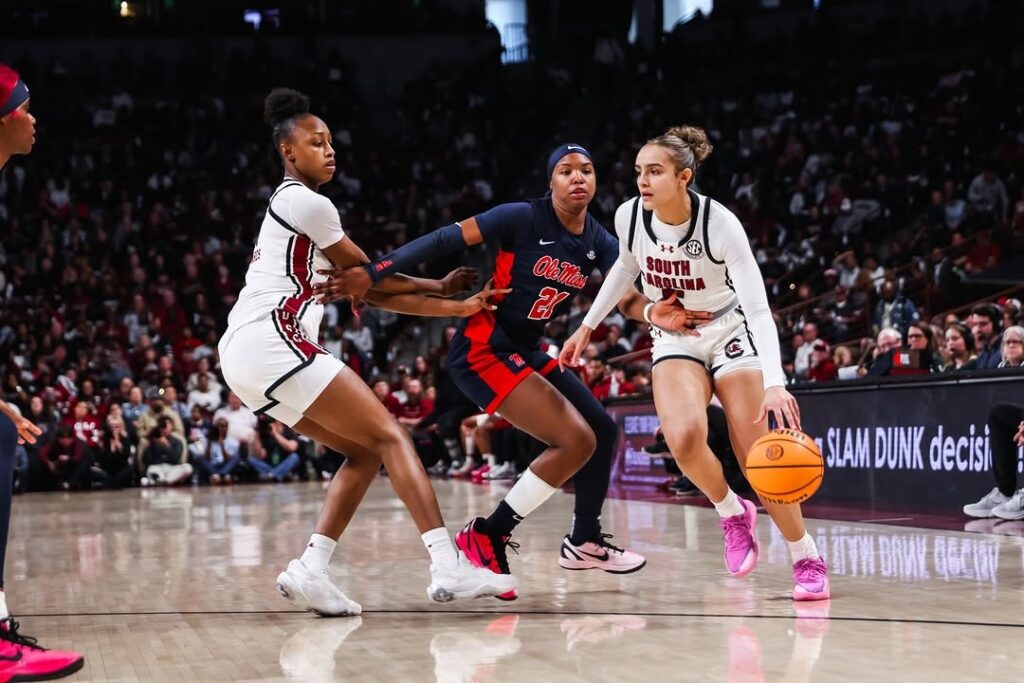
Asked about the defensive scheme that held Cotie McMahon — the SEC’s second-leading scorer averaging 20.7 points per game — to just two points on 0-of-9 shooting, Staley offered a tactical breakdown that belongs in a coaching clinic.
“She was the emphasis in what we wanted to do, and what we wanted to do is just kind of just take her paint points away. Take her paint points away and transition, just kind of build a wall so she doesn’t get clean looks, so she has to think about layers of defense before she sees daylight. Once she sees daylight, she really is unguardable. I thought our players did a great job, Raven especially. The first line of the defense was so hard, that took her vision down, that occupied her. Raven’s the very best at it, and she had backup today. Because once she did get by, Cotie did see bodies.”
The concept of “paint points” is the analytical key to this entire answer. Cotie McMahon is not a three-point specialist — she is a player who derives her scoring from attacking the paint, getting to the free-throw line, and creating in transition. By eliminating those entry points before McMahon could even establish her rhythm, South Carolina did not simply guard her — they made her think. And when a scorer of McMahon’s caliber has to process defensive layers rather than react instinctively, the game slows down in ways that neutralize her greatest strengths.
The “layers of defense before she sees daylight” framing is sophisticated zone-adjacent thinking applied in a man-to-man context — and it worked to perfection. McMahon saw those bodies every time she threatened to get loose, and the cumulative effect of that resistance produced one of the most stunning individual defensive performances of the entire college basketball season.
The Raven Johnson Testimony: “It Starts and Ends With Raven”
The Raven Johnson portion of this press conference may be the single most important stretch of quotes Dawn Staley has delivered all season. When asked about Johnson’s consistent ability to lock down opponents’ best players night after night, Staley did not offer a polished talking point. She offered a confession of admiration.
“I sometimes cringe when coaches are talking about their players. I mean, I understand it because I see it every day in Raven. It’s not just in games. This is what she does against the Highlighters. Yeah, Highlighters, she gets y’all too. Just unafraid of a challenge. She knows. Like, she knew she was going to have to guard Cotie. She knew she was going to have to guard Mikayla Blakes. She knew she had to guard our opponent’s best perimeter, and sometimes small power forwards. We aren’t afraid to switch, if need be, because we know Raven’s gonna give it her best shot at defending and making it difficult for people.”
“I see it. I don’t think she gets credit enough for what she’s been doing over her career, because it’s very much like what she’s doing now. It’s just, she doesn’t have the numbers and the steals or the blocks or anything like that that we look at. I think sometimes we laser in when we look at those kind of awards and just, she’s leading in stats. She’s leading steals, then she must be on the defensive team. No, if you really get the crux of it and you really look at, you know, what makes our team go defensively, it starts and ends with Raven.”
This is Staley making a public case — loudly and deliberately — for a player she believes has been systematically undervalued by the awards machinery that governs recognition in college basketball. Her frustration is not performative. It is the frustration of a coach who watches Raven Johnson dominate opponents in ways that do not populate box scores: positioning, communication, deterrence, switching versatility, and the psychological burden she places on opposing players who know what is coming.
The detail about practicing against “Highlighters” — the media — is a delightful, telling aside. Johnson does not switch into defensive mode for games. She is always on. That is not a skill. That is a character trait. And Staley, who has coached some of the greatest players in the sport’s history, recognizes it as something genuinely rare.
Yolett McPhee-McCuin called Johnson the best point guard in the country from the opposing press conference podium. Her own head coach says the defense starts and ends with her. When coaches on both sides of a game are saying the same things about the same player, the awards conversation needs to catch up.
A’ja Wilson Meets Joyce Edwards: A Comparison for the Ages
One of the most genuinely fascinating exchanges of the press conference came when Staley was asked about the similarities between her greatest ever alumni, A’ja Wilson — who was in attendance on Sunday — and current Gamecock Joyce Edwards.
“They both can score. They both have a knack for scoring the basketball. And they may look at it a little bit differently, they may play a little bit differently, but the results are very similar. I think Joyce probably can handle the ball a little bit better than A’ja when A’ja was her age. And similarities… Joyce probably gets a lot of probably harder scores than A’ja, just by mere height. A’ja’s got a little bit more height on her, so A’ja probably didn’t take as much contact as Joyce takes or Joyce welcomes the contact. A’ja really didn’t welcome the contact because she had a little short mid-range game that took easier shots. Joyce is looking to hit you. She’s looking for impact. But they both are equally effective.”
The nuance in this comparison is what makes it so analytically valuable. Staley is not simply flattering Edwards with a famous name — she is drawing a precise, technical distinction between two scorers who arrive at similar outcomes through different physical and stylistic pathways. Wilson’s height gave her cleaner looks and a reliable mid-range game that did not require initiating contact. Edwards, slightly smaller, compensates by actively seeking contact — a mentality that demands toughness, body control, and a willingness to absorb punishment that not every player possesses.
The ball-handling note is equally revealing. Staley suggests Edwards may be the more versatile playmaker at a comparable stage of development — a trait that, when combined with her scoring instincts, makes her one of the most complete forwards in the college game. When a four-time WNBA MVP is sitting in your arena watching her collegiate successor play, and your head coach draws substantive, credible parallels between the two, it says something profound about the player development pipeline South Carolina has built.
The Mental Strength of Latson and Okot: “The Kitchen’s Hot”
Asked about the growth of Ta’Niya Latson and Madina Okot, Staley pivoted away from statistics entirely and went straight to the psychological dimension of playing for a program that operates under a microscope.
“I’ve seen the most growth in just mental strength. Playing for our team is hard because, you know, people are watching. People are watching for various reasons. Some people want to elevate us. Some people want to see our downfall. Some people just want to nitpick at players on our team for whatever reason they choose to come here. I know Ta’Niya hears we don’t develop guards, right? I’m sure she hears that. I’m sure she shouldn’t have gone there, that’s the worst decision that she could have made, for whatever reason. Madina, probably the best decision, because we develop post-players, and if you’re a post player, you should come to South Carolina.”
“But it’s hard. It’s mentally tough to play for our team and to be an integral part of our team. So with both of them, learning to fight through things. Fight through the things that we’re needing them to do, and fight through things that they’re hearing on social media, fight through things like the comforts of what they had in their other programs. I think our coaching staff has done a great job at just making sure they’re okay.”
This is one of the most honest and revealing things Staley said in the entire press conference. She is acknowledging, plainly and without apology, that the external noise surrounding South Carolina basketball is real — and that managing that noise is as much a part of her coaching job as drawing up plays. The criticism that South Carolina does not develop guards is a narrative that has followed the program, and Staley knows Ta’Niya Latson hears it. Rather than dismissing it, she names it, contextualizes it, and explains what her staff does to ensure her players are psychologically fortified against it.
Her distinction between Latson and Okot in this context is also sharp. For a post player, South Carolina is an obvious destination — the track record of developing frontcourt talent under Staley is beyond dispute. For a guard, the calculus is more complicated, and the external skepticism is louder. The mental burden that Latson carries as a result is real, and Staley’s acknowledgment of it is the kind of coaching empathy that turns talented players into resilient ones.
“It’s Almost Like an Out-of-Body Experience” — Five Straight, 10 of 13
Could she have imagined it?
“No. I don’t even think the SEC was part of the process. I probably skipped a few steps, in the regular season and the SEC tournament, to win the national championship, right? But I do think this has been the training ground to success outside of the SEC. So no, because it’s really super competitive that you don’t want to put the cart before the horse. You just want to win the next game, and winning five SEC regular-season championships consecutively? To me, it’s unheard of. It’s almost like an out-of-body experience.”
“I wouldn’t say I imagine us losing five consecutive either. I give the credit to our players for believing in it, for playing probably a style of play that sometimes you sacrifice some of your individual success for the overall team. But we try to balance that, we try to allow that to coexist, but we also know when we won championships, the players that are supposed to get to the next level, get to the next level. Because ultimately, people want winners.”
The out-of-body experience line will be quoted and remembered. But the more analytically significant passage is what comes before it — Staley’s admission that the national championship was always the primary target, and the SEC was almost a byproduct of that pursuit. She built a program aimed at the summit, and the regular-season dominance accumulated as a natural consequence of the standards required to get there.
Her point about individual sacrifice coexisting with collective success is the philosophical core of this entire dynasty. She is not asking players to choose between personal ambition and team goals — she is insisting, with the evidence to back it up, that buying into the team is precisely how individual dreams get realized. The WNBA draft picks, the national recognition, the professional careers — they all flow from winning. And winning flows from buying in.
“The Kitchen’s Hot” — Is This Her Best Coaching Job Ever?
“I don’t know if it’s our best. That’s for you all to judge. I think we do what we need to do, with who we have. I think our approach has been the same. I don’t think we change who we are according to who we have healthy, we don’t ever do that. We just figure out a way.”
“The kitchen’s hot. Kitchen’s hot. We play in the type of league that we play in, and, you know, sometimes you’ve got to walk through it, right? Sometimes, to get to the thermostat, to turn it down, you’ve got to walk through it. I think we’ve done a really good job with, and I probably say this with all of our teams, is taking the time with our players when they need it. Them just coming up and saying, thanks for talking to me. I mean, they don’t have to say that, but when they do say it, you know you’ve helped them.”
The kitchen metaphor is quintessential Staley — plain language carrying profound meaning. The SEC is not comfortable. It is not meant to be. The discomfort is the point. And a staff that can consistently guide players through that heat, restore their confidence at the moments when it is most fragile, and send them back onto the floor believing in themselves again — that is the invisible work of championship coaching that no trophy or banner can fully capture.
Her refusal to declare this her best coaching job is also characteristic. She deflects the superlative back to the media, not out of false modesty, but because she genuinely measures her work by process rather than outcome. The approach never changes. The results vary. And the gap between the two is where great coaching lives.
The Okot Redemption Arc: “She Even Said She’s Back”
Asked specifically about Okot’s growth since the Oklahoma game — a low point in her season — Staley became briefly and beautifully emotional.
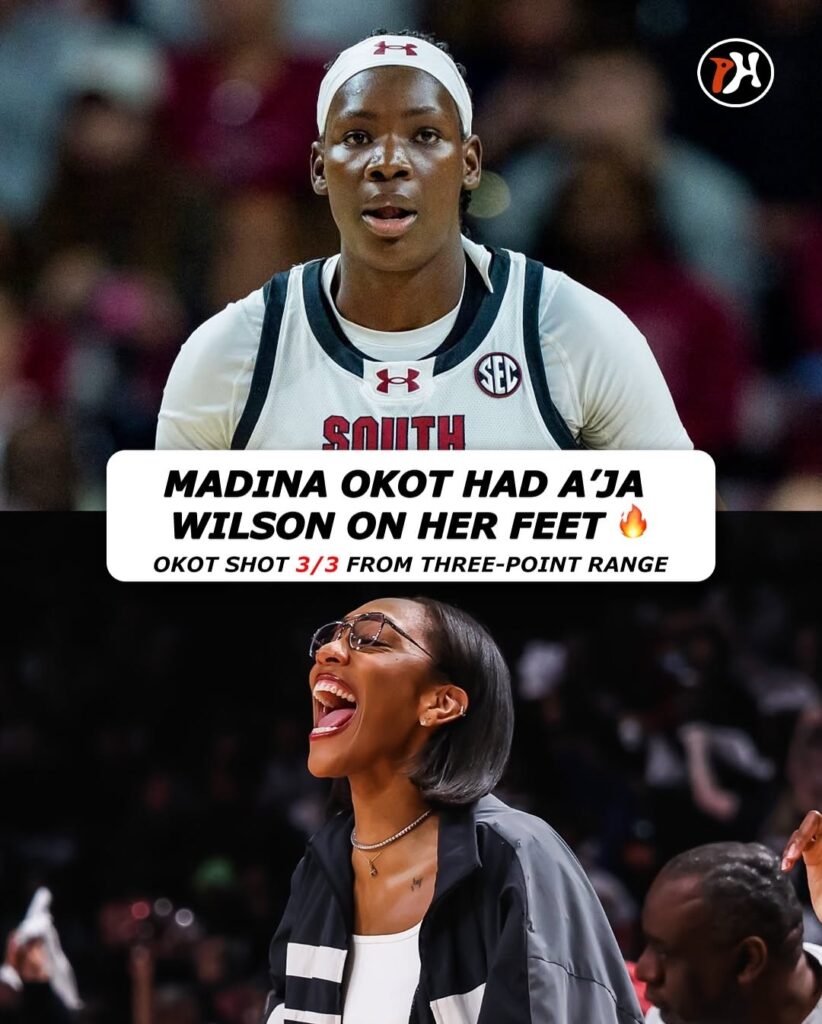
“It always makes me feel really good, almost emotional, when you see a young person go through some stuff and they really can’t see the way out of it, but you just continue to work with them, hey, you’re going to hurdle this. You’re going to get through, just each and every day, you take the pressure off, and then you apply the pressure. We took the pressure off, and then Madina started to get comfortable with it. And then I wasn’t. I’m like, nope, this is what’s gonna happen. And then she walked into it, and it’s great. She even said she’s back. And when they’re able to verbalize that, you know they’re in a really good place.”
The coaching methodology described here — deliberately oscillating between releasing pressure and reapplying it — is sophisticated sports psychology delivered in conversational language. Staley identified that Okot was struggling under the weight of expectation, temporarily lifted that weight to restore her comfort and confidence, and then incrementally rebuilt the pressure once the foundation was solid again. The fact that Okot verbalized “she’s back” to her coaching staff is the detail that matters most. Self-awareness and self-affirmation from a player in recovery from a difficult stretch is one of the most reliable indicators that a breakthrough is genuine rather than temporary.
Sunday’s 3-of-3 from three-point range, her fifth consecutive double-double, and A’ja Wilson leaping to her feet in the stands — that is the other side of that recovery arc. And it started with a coaching staff that refused to abandon a young player when the results temporarily stopped coming.
The Three-Point Development: “We’re Licking Our Chops”
On the deliberate development of Okot’s three-point shooting and what it unlocks for South Carolina’s offense going forward:
“We work them pretty much every day, and then she gets a little extra in with Coach Boyer after practice. Just over time, you want to put players in positions where they’re comfortable, and it fits. Some people can be comfortable taking threes, but they’re not accurate. Madina, she’s pretty accurate. She was accurate when she first got here.”
“As she started shooting more, I told her, kind of take a look at it, take a peek at it, if you’ve got your feet under you, take some out there. Now she’s popping back off of screening, and today we were a little bit more intentional about setting plays up for her to take them. One time she took it, one time she drove. We’re licking our chops just because I think she’s a lot more comfortable facing the basket. We want to pound it down to her because she’s big and she’s got great footwork. But I think if you mix it up and not have such hard scores, because her back-to-the-basket brings so much attention to her, where she’s not even single-covered, she’s double-teamed. If we can get her to make a few more shots outside or take some people off the dribble, we’re a better team for that. It’s more that you have to prepare for her for.”
“We’re licking our chops” is the phrase every opposing coach and scout in the country should circle. Staley is essentially announcing that what Okot showed on Sunday is not a peak — it is a new baseline from which the South Carolina offense will continue to evolve. A post player who commands double-teams in the paint AND can step out and hit threes at a 5-of-5 clip over two games presents a defensive problem that has no clean solution. Guard her at the arc and the paint opens up. Sag off her and she drills it. For March, that is a nightmare matchup dressed in garnet and black.
Raven Crashes the Press Conference — And Steals It
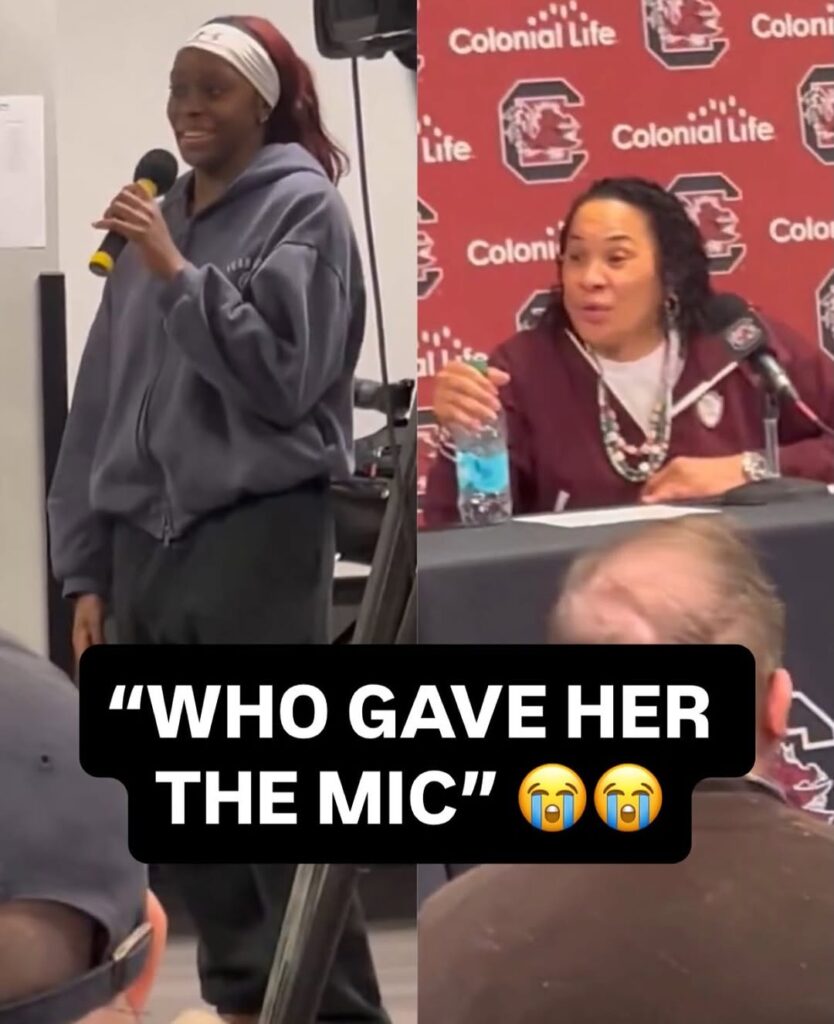
In the most delightful moment of the afternoon, Raven Johnson appeared at the back of the press conference room and was handed the microphone. What followed was pure joy.
Coach, tell me how you approach games and you look good doing it. You’re on the sideline with your fits on. Just tell me, what’s your mindset going into games?
“My mindset going into the game is, what would Raven think? What would Raven think? And if there aren’t any complaints from Raven, I think I’ve passed the test. For whoever gave her that question, thank you, because the ones she probably wanted to ask would have been censored.”
The exchange says everything about the relationship between this coach and her players — warm, irreverent, built on genuine mutual trust and affection. A player who feels comfortable enough to crash her coach’s press conference and ask about her outfits on national television is a player who plays without fear. And players who play without fear win championships.
The Legacy of Leadership: “Raven Really Can’t Help Herself”
On the institutional knowledge passed from senior to freshman and why South Carolina’s championship standard reproduces itself:
“There is a legacy of leadership that our most successful players have left every single time. You can go back to probably La’Keisha Sutton, you’ve got Tiffany Mitchell, you’ve got Val Nainima, I mean, Lisa Welch. You have all these players who have been captains and the voice of our teams. They understand what this program is about. You stick out like a sore thumb when you buck the system, so to speak. Raven’s been a winner. Like, Raven really can’t help herself when it comes to doing things the right way.”
“She’s got the over 50 mindset. When you’re over 50, you say it’s on your mind. Raven has that when it comes to basketball. She really has that. She doesn’t like losing, and Raven is probably one of the main reasons why Madina’s hurdled what she hurdled, because she lives with her, it’s her big girl, and Raven knows that in order for us to win championships, she has to be a big part of it.”
The revelation that Johnson played a direct role in Okot’s recovery — not just as a teammate but as a roommate, a mentor, and a daily standard-bearer — adds another dimension to the Raven Johnson story that the box scores will never capture. Championship culture is not maintained by coaching staff alone. It is transmitted player to player, veteran to newcomer, in the locker room, in the weight room, and in this case, at home. That is what a legacy of leadership looks like when it is operating at full capacity.
The Final Message: “Play to Our Standard. Let’s Win Outright.”
Asked for her message heading into the final week of the regular season, Staley kept it simple and sharp.
“For us, it’s been playing to our standard. It’s real simple. Play to the habits that you’ve developed over this season, and it’s worked out for us for 90% of the season. Let’s not bring anything. Let’s just stay in character. Let’s not try to do anything that we haven’t done. That’s just it. And let’s win outright.”
“Last year, we’re looking right and left. We’re looking at Texas, and we’re seeing, who do they have at the end of the season? Who are they playing? What’s our strength of schedule? We didn’t control our own destiny because we split with Texas. Then they were looking at us, we’re looking at them, and then we’re co-champions. Then it takes a coin toss. And we don’t want to go down that route again. Thanks to the commissioner, he did his big thing last year.”
The coin toss reference is delivered with the dry wit of a coach who has been through enough championship moments to find humor in the absurdity of how they are sometimes decided. But the underlying message is urgent and unambiguous. South Carolina controls its own destiny. One more win means the outright title — no sharing, no coin flips, no looking sideways at scoreboards across the conference. Just South Carolina, standing alone at the top of the SEC, exactly where Dawn Staley has built this program to stand.
The standard is the standard. And on Sunday at Colonial Life Arena, in front of a sold-out crowd and a four-time WNBA MVP watching from the stands, that standard was on full display — in the coaching, in the players, in the culture, and in a press conference that reminded everyone watching why Dawn Staley is simply in a class of her own.