COLUMBIA — The words seem contradictory until you understand the person saying them.
Difficult, but rewarding. Hard, but encouraging. Frustrating, but fulfilling. For Chloe Kitts, these aren’t contradictions — they’re a portrait of the last five months of her life.
The Moment Everything Changed
On March 23, Kitts did what she’s done all season long: she watched. She sat on the bench as her South Carolina teammates dismantled Southern Cal on the way to the Sweet 16, occasionally rising to applaud a good play, exulting in a team success she couldn’t physically contribute to. To a casual observer, she barely looked limited. To anyone who knows what she lost, the scene carried quiet weight.
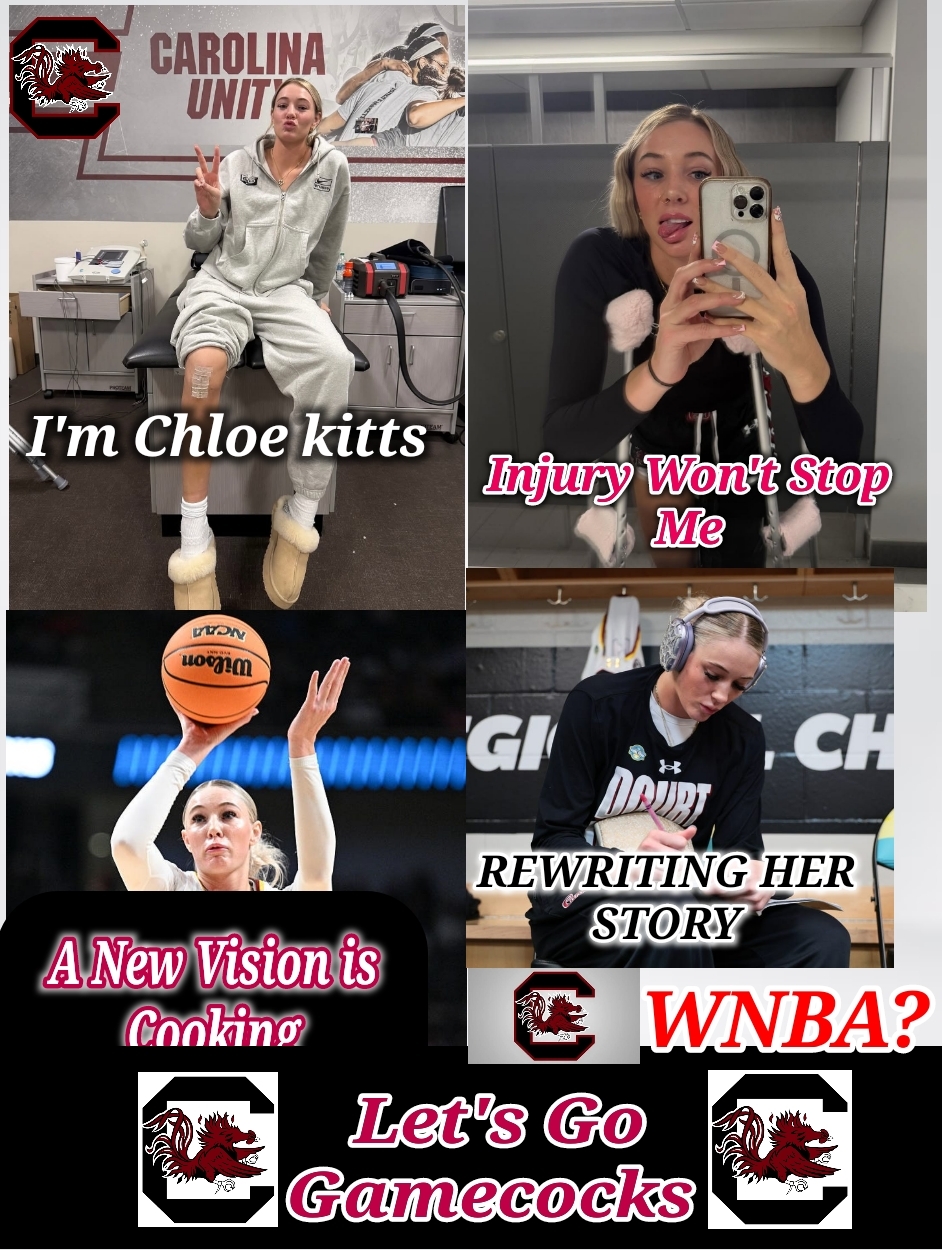
Five months ago, the news arrived like a thunderclap. First came a photo — Kitts at a volleyball game, her right leg wrapped in a brace, crutches at her feet. Then came the confirmation: a torn ACL, and a lost season. The timing was brutal. Kitts had just won MVP of the 2025 SEC Tournament and MVP of the Birmingham 2 Regional, arriving at the peak of her college career right as it was being taken away. South Carolina, already preparing for a title defense, absorbed the blow and moved forward. So did she.
“It kind of hit me fast. I wasn’t super, super-sad about the injury because I was pretty content. Because I can’t go back and undo it, so why am I going to dwell on it?” she said moments after USC crushed Southern Cal. “So I just had to worry about attacking every day in a different type of way, which means rehab, learning to walk again.”
The Competitor’s Response
What makes Kitts’ story compelling isn’t simply that she handled adversity — it’s how she handled it. One of the fiercest competitors in Dawn Staley’s program immediately drew a hard line against self-pity. Her teammates poured love and condolences on her, and she appreciated every bit of it. But she was never going to sit in grief when there was work to be done.
The injury itself happened during a preseason scrimmage — one of the closed ones where referees are brought in to walk through new rules. She went for a rebound, same as she had a thousand times before, and heard a pop. The initial read from trainers and doctors was cautiously optimistic: her knee hadn’t swelled, she could walk, maybe just a hyperextension. They told her to relax and wait for scans. Kitts already knew.
“I knew right away. I know you don’t just hear a pop for no reason,” she said. “So I was like, ‘Dang.'”
One word. No dramatics. Then she got to work.
Once medically cleared, Kitts attacked rehabilitation with the same intensity she brings to every other aspect of her game — to the point where the medical staff repeatedly had to slow her down. Feeling fine and being fine aren’t the same thing after ACL surgery, and the trainers knew it even when she didn’t want to hear it.
“They tell me to slow down a whole bunch of times, and they’re not letting me get ahead (of schedule). I’m kind of just talking, and they’re just like, ‘All right, Chloe, that’s enough,'” she said. “I’m going to take my time for sure.”
That restraint — forced as it may have been — is part of what has made her recovery steady. The milestones became celebrations: the first time she got off crutches, the first time she completed a lap on the stationary bike, and now, the day her doctor cleared her to run consistently. Each small victory was treated as exactly that — a victory.
“What really helped me is just celebrating the little moments,” she said.
More Than Basketball
When basketball was restricted, Kitts found other outlets. Pilates. Long walks. And meaningfully, she prioritized her mental health, seeking out professional support throughout the process — a candid acknowledgment that physical recovery and psychological recovery aren’t the same journey.
She also leaned into her relationships. The “Who can guard Tessa?” T-shirt she wore during the Southern Cal game — featuring a baby-faced image of teammate Tessa Johnson — was more than a fashion statement. It was a public declaration of a bond that has deepened considerably through Kitts’ hardest stretch.
“She’s helped me a lot. She has helped me build a relationship with God, and I feel like I didn’t have a relationship with God before,” Kitts said. “But I have found one, and that’s probably the best thing that I’ve had in this injury.”
Johnson, for her part, has watched her teammate’s transformation with something close to awe.
“I’m just very impressed with her and proud of her because she’s really grown. Obviously she can’t go on the court right now, but she really can; she mentions that she sees things differently,” Johnson said. “And I think that the fact that she’s able to take this injury and use it as something more than just the fact that she’s not able to play — I could go on and on about this, but I’m very proud of her.”
The Physical Rebuild
One concrete challenge has been the weight. Kitts’ detailed and disciplined approach to maintaining her body weight throughout a season was well-documented before this year. Surgery disrupted all of it — she lost 17 pounds in the first two months of recovery alone.
But the foundation she built before the injury proved critical. Her body responded to the work of regaining that weight, and she was able to recover relatively quickly. She’s now lifting heavier than she ever has, building muscle that simultaneously strengthens her knee and positions her for what comes next.
What comes next is unambiguously South Carolina. There was never a real question about that, even though Kitts is draft-eligible and a WNBA future is well within reach. Training for a comeback just to make an impression at a professional camp was never the motivation. She came back because this program means something to her, because unfinished business is real, and because Chloe Kitts doesn’t leave on someone else’s terms.
The warrior is still here. She’s just been doing her work in a different arena — and by her own account, emerging from it as a more complete person than the one who went down in that preseason scrimmage.
The court will wait. She’ll be ready.