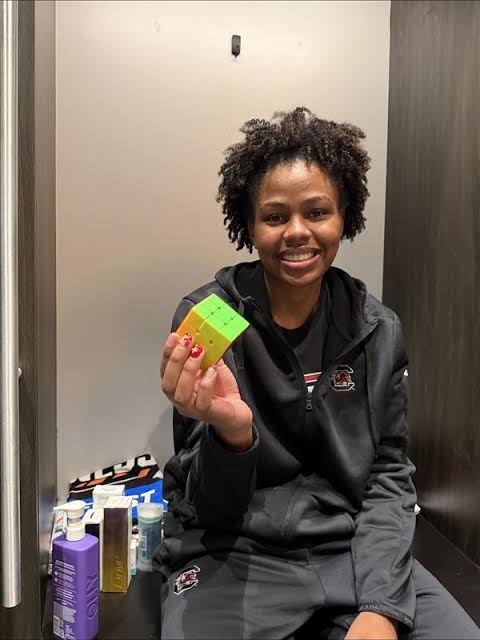
Before the lights come on and 20,000 fans fill the arena, Ayla McDowell sits quietly and solves a Rubik’s Cube. What looks like a quirky pregame ritual is actually a window into everything that makes her different.
The Engineering Major Who Found Her Calm
There is a particular kind of mind that is drawn to systems — to problems that look chaotic on the surface but reveal elegant, logical solutions when approached with patience and precision. Ayla McDowell has that kind of mind. And in the middle of one of the most demanding environments in college sports, she has found a way to make it work for her.
The 6-foot-1 freshman wing from Cypress, Texas, arrived at South Carolina with a well-established collection of hobbies. Puzzles. Legos. Building things with her hands and solving things with her brain. The structured world of Division I basketball — with its film sessions, travel schedules, practice demands and game-day routines — left little room for either.
So McDowell adapted. She found something that fit the constraints of her new life while still feeding the part of her brain that needed order before chaos.
A Rubik’s Cube.
“I just do it when I need to calm down, I solve them for each game,” McDowell said. “I’m in the process of learning how to do three others.”
That last detail is not incidental. She is not simply maintaining a habit. She is actively expanding it, pursuing new variations of the same fundamental challenge — because for a mind wired like McDowell’s, mastery is not the destination. Growth is.
A Skill Built on Muscle Memory
McDowell’s relationship with the Rubik’s Cube predates her basketball career at South Carolina by years. She first solved one in middle school, and what began as an intellectual challenge gradually became something deeper — an automated, calming process that now operates almost entirely below conscious thought.
“I was pretty young when I solved my first one, I was in middle school,” she said. “I learned how to do it and it’s been muscle memory ever since.”
The phrase “muscle memory” is worth pausing on, because it connects directly to what McDowell does on the basketball court. The greatest challenge for any freshman in a high-pressure program is converting conscious effort into unconscious execution — making the reads, the rotations, the defensive assignments feel as automatic as possible, so that the game slows down rather than speeds up when the moment gets big. McDowell, as an engineering major trained to think in systems, has been doing exactly that work with a Rubik’s Cube since she was twelve years old.
She introduced it formally into her game-day routine this season. The timing is not coincidental. First-year players at elite programs are constantly navigating anxiety — the fear of making mistakes in front of coaches, teammates and crowds that expect excellence. McDowell found her solution before she ever arrived in Columbia.
What Dawn Staley Saw Early
The highest compliment Dawn Staley can pay a freshman is a simple one. Not explosive. Not talented. Not exciting.
Predictable.
“Ayla is predictable and there is nothing more a coach wants from a freshman is to be predictable,” Staley said in early November.
That praise, offered in the opening weeks of the season, is analytically significant. Predictability in Staley’s vocabulary means a player who does what she is coached to do, consistently, without improvising at the wrong moments or disappearing when the game gets physical. It means a player whose coach can trust her in a rotation without bracing for a catastrophic error. For a freshman — still learning the speed of the college game, still adjusting to the physical demands, still integrating into a system built on years of collective understanding — predictability is extraordinarily difficult to achieve.
McDowell achieved it immediately. And in an injury-shortened season where the Gamecocks at various points dressed as few as eight available players, that reliability was not a luxury. It was a necessity.
She has averaged 4.5 points, 1.5 rebounds and 16.9 minutes per game heading into the Sweet 16 — numbers that reflect a role player fulfilling her assignment at a high rate, not a star demanding the spotlight. For a program playing for a fourth national championship, that kind of measured, consistent contribution is precisely what the moment requires.
The Person Behind the Player
Taneisha Rogers, McDowell’s high school coach at Cypress Springs, watched this version of McDowell long before college basketball discovered her. The portrait Rogers paints is consistent with everything South Carolina’s coaching staff has observed.
“She’s always building things and always just a happy person,” Rogers said. “She’s a special kid.”
That combination — the builder’s mind and the stable emotional baseline — is rarer than any individual basketball skill. Programs can develop shooting technique and defensive footwork. They cannot manufacture the disposition of a player who genuinely enjoys the process of solving hard problems and approaches pressure situations with curiosity rather than fear.
McDowell is an engineering major competing at the highest level of college women’s basketball, solving Rubik’s Cube variations in her spare time while a pile of puzzles waits under her bed back in Columbia. The throughline across all of it is the same: she is someone who is fundamentally comfortable with complexity.
March Madness and the Mind That Solves Problems
The No. 1 seed Gamecocks (33-3) face No. 4 seed Oklahoma (26-7) on March 28 at 5 p.m. ET on ESPN at Golden 1 Center in Sacramento. For McDowell, it will be her first Sweet 16 — the biggest stage of her young career, against a team that already owns a victory over South Carolina from January.
The freshman who calms her nerves with a Rubik’s Cube will walk into that arena having done exactly what she does before every game. The hands will move through the familiar sequence. The mind will quiet. And then the game will begin.
Her goal is simple and unambiguous: play the latest possible day with South Carolina — April 6, the national title game.
After that, the puzzles under her bed will be waiting.
Something tells you she’ll solve those too.