“Did Dawn Staley Just Make the Worst Substitution of Her Career? Freshman Tournebize Shows Promise Before Staley’s Overtime Decision Backfires”
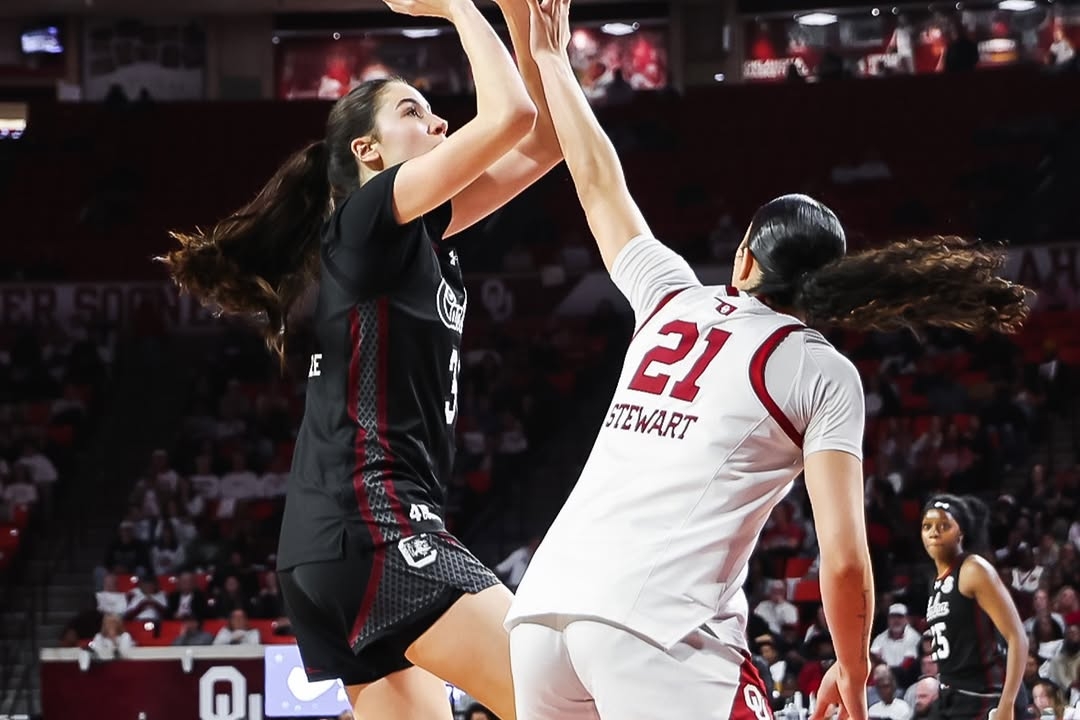
South Carolina head coach Dawn Staley’s initial hesitation to deploy freshman Alicia Tournebize against All-American Raegan Beers gave way to confidence in the young international player’s performance—though a crucial overtime substitution decision may have cost the Gamecocks, according to On3.
The Mismatch Staley Wanted to Avoid
The physical disparity appeared overwhelming on paper. Tournebize, a slender freshman who had been stateside for barely three weeks, seemed ill-equipped to battle Beers, a powerful senior All-American forward. Staley’s reluctance to expose her inexperienced post player to such a daunting challenge was understandable—the size and strength differential alone suggested potential disaster.
However, opportunity emerged from adversity when Beers collected her second personal foul early in the second quarter, forcing her to the bench. Staley immediately seized the moment, inserting Tournebize into the game with Oklahoma’s primary interior threat sidelined.
The Confidence-Building Sequence
The freshman’s first basket came two minutes after entering, though it required some good fortune. Running the high-low action with Joyce Edwards—an offensive set Staley had eagerly anticipated deploying—Tournebize launched a three-pointer that embarked on an improbable journey. The ball caromed off the back of the rim, bounced three and a half feet straight upward, ricocheted off the front iron, and somehow dropped through the net.
Lucky or not, the basket ignited something in Tournebize. She contributed five points during a decisive 10-0 South Carolina scoring run that shifted momentum in the Gamecocks’ favor. Her aggressive play also drew the second foul on Oklahoma’s Payton Verhulst, further tilting the matchup advantages toward South Carolina.
Second-Half Confidence
The tentative approach Staley displayed early disappeared entirely by the second half. Rather than protecting Tournebize from the Beers matchup, Staley inserted the freshman just three minutes into the third quarter, directly confronting the challenge she’d initially avoided.
Tournebize validated her coach’s growing trust. She forced Beers into a missed field goal attempt—the only shot Beers took with Tournebize defending—and then generated a turnover, disrupting Oklahoma’s offensive flow when they attempted to establish their star forward.
The freshman finished with nine points and three rebounds, providing valuable minutes that kept South Carolina competitive when their rotation needed fresh legs and energy.
The Overtime Decision
However, when the game reached its decisive overtime period, Staley’s confidence in Tournebize wavered at a critical juncture. After the freshman picked up her fourth personal foul, Staley opted for experience over the hot hand, choosing veteran Madina Okot instead.
The decision proved questionable in hindsight. Tournebize had demonstrated her ability to disrupt Beers and contribute offensively, yet sat during the five minutes that ultimately determined the outcome. Okot, while more experienced, couldn’t replicate the energy and effectiveness Tournebize had provided.
Analysis
This narrative encapsulates one of coaching’s eternal dilemmas: trusting inexperienced players in high-stakes moments versus relying on veteran stability. Staley’s journey with Tournebize during this game traversed the full spectrum—from protective hesitation to confident deployment to ultimately reverting to experience when the pressure peaked.
The irony is unmistakable: Tournebize had proven herself capable against precisely the matchup Staley feared most. She’d defended Beers effectively, contributed timely scoring, and played with the fearless energy that often characterizes players too inexperienced to understand the moment’s gravity.
By choosing Okot in overtime, Staley made the statistically defensible decision—experience typically matters most in pressure situations. However, basketball doesn’t always follow statistical probabilities. Tournebize’s momentum, her recent success against Beers, and her infectious energy might have provided exactly what South Carolina needed during their overtime collapse.
Staley’s potential regret over this decision reflects the burden of coaching: every substitution carries consequences that only become clear in retrospect. Tournebize’s performance demonstrated she belonged on the floor, making her overtime absence all the more conspicuous in defeat. Whether this moment becomes a learning experience for both coach and player—or a missed opportunity that haunts the season—remains to be seen.
The freshman’s performance suggests South Carolina possesses more frontcourt depth than anticipated, though integrating that depth into high-pressure situations clearly remains a work in progress.
About The Author