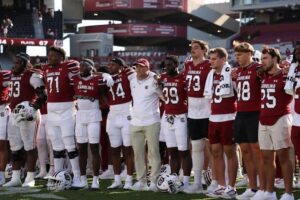
Prayers for our Beloved Gamecocks Legend Coach Lou Holtz as he Enters Hospice Care

College Football Hall of Fame coach Lou Holtz, who guided South Carolina football through one of the most dramatic turnarounds in program history, is currently receiving hospice care, The State confirmed Friday.
Reports of Holtz’s condition began circulating Thursday before longtime broadcaster Tim Brando provided further confirmation on social media after speaking with Holtz’s son, Skip.
“They’re well aware of all the (prayers) his Dad is receiving around the country and world,” Brando wrote on X/Twitter. “He (Skip) did add, ‘He’s still fighting the fight.’”
Holtz, now 89 years old, remains one of the most influential figures in modern college football, with a career that spanned decades and reshaped multiple programs across the country.

Before arriving in Columbia, Holtz served as head coach at William & Mary, NC State, Arkansas and Minnesota, building a résumé that ultimately earned him a place among the sport’s legends. Nationally, he is best remembered for his 11-season run at Notre Dame (1986–96), where he won 100 games and captured the 1988 national championship.
To a younger audience, Holtz became a familiar face during his 10-year tenure at ESPN, teaming with analyst Mark May on College Football Final and becoming a fixture of college football discussion every Saturday night.
In South Carolina, however, Holtz’s legacy carries a distinct weight.
He took over the Gamecocks program in 1999 and remained in Columbia through 2004, compiling a 33–37 record while engineering one of the most dramatic reversals in school history. His tenure included back-to-back Outback Bowl victories in 2000 and 2001, both coming against Ohio State, and consecutive AP Top 25 finishes.
The transformation was especially striking given where South Carolina began under Holtz. His first season resulted in a 0–11 campaign, the only winless year in program history, during which the Gamecocks were outscored by nearly 200 points.
What followed, though, redefined expectations.
In 2000, South Carolina surged to an 8–4 record, highlighted by wins over No. 9 Georgia and No. 25 Mississippi State in the iconic “Fade” game. The momentum continued in 2001, when the Gamecocks finished 9–3, marking just the second time in school history that South Carolina reached nine wins at the time. Prior to Holtz’s arrival, the program had achieved nine victories only once — during the 1984 season.
Holtz’s impact went beyond wins and losses. He instilled belief in a program that had struggled for consistency, laying groundwork that reshaped how South Carolina football was viewed both regionally and nationally.
As messages of support continue to pour in from across the country, Brando’s update reflected the family’s gratitude — and Holtz’s enduring resolve.
“They’re well aware of all the (prayers) his Dad is receiving around the country and world,” Brando wrote. “He’s still fighting the fight.”
About The Author