
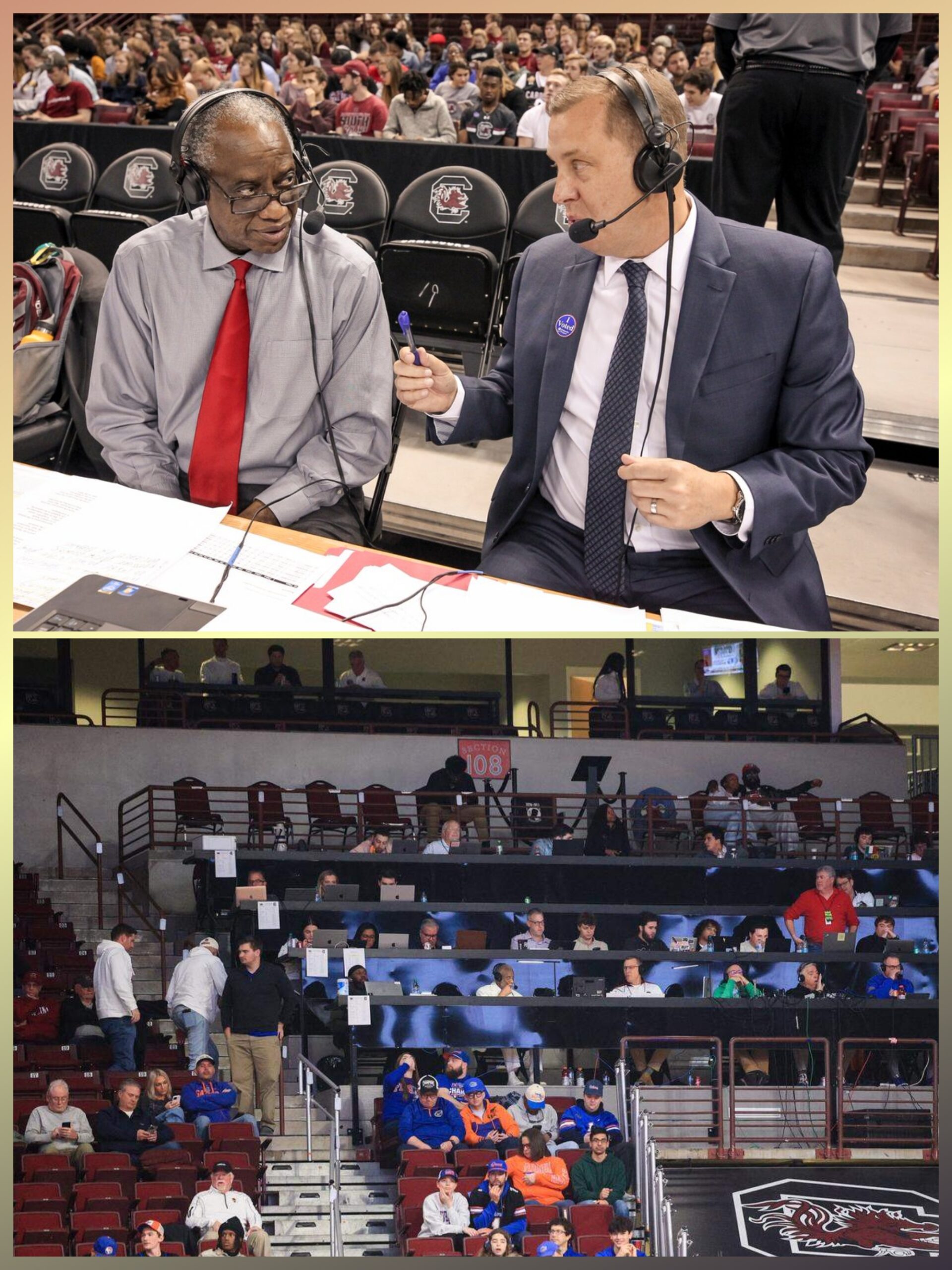
For more than two decades, South Carolina basketball’s radio announcers had the best seats in the house at Colonial Life Arena. Now, they’re climbing approximately 90 steps—across the court and up 17 rows into Section 108—to call games from a seat diagonally behind the visiting team’s basket.
Brad Muller, Derek Scott, and Casey Manning, the home radio voices for South Carolina’s basketball programs, have spent about 15 games broadcasting from their new perch in the media seating area, far removed from the courtside seats they occupied since the arena opened in 2002.
In their place? Eight new ticketed courtside seats—and a decision that exemplifies the difficult choices facing college athletics in the modern era.
The Revenue Reality
“The college athletics landscape as we know it has changed,” USC deputy athletic director and chief marketing officer Wesley Mallette told The State. “For the schools who are revenue sharing, and even for those who are not, everything you do, you have to look at from the standpoint of, are you still able to provide a great student-athlete experience? Are you still able to provide a good fan experience? Are you still able to provide a good media experience? But also, how are you able to continue to find ways to drive revenue? That’s just the world that we’re in right now.”
The move wasn’t made lightly. According to a university spokesman, the SEC informed schools in May that they were allowed to add additional premium courtside seating at basketball games. South Carolina made the decision over the summer to relocate its radio crews.
An SEC spokesperson told The State that there was never a rule preventing USC and the rest of the SEC from moving their radio crews away from courtside—this is simply the first season schools were able to put additional courtside seats in their place.
South Carolina added 16 total courtside seats—eight where the radio crews previously sat and eight more on the teams’ side of the court. While USC did not disclose specific revenue figures, the university stated through a statement that the additions have “generated a significant amount of revenue for both basketball programs.”
Backlash From the Broadcasting Community
When USC men’s basketball radio announcer Derek Scott posted a photo to X/Twitter showing his “new broadcast perch” ahead of the November 4 home opener against North Carolina A&T, the response was swift and largely negative.
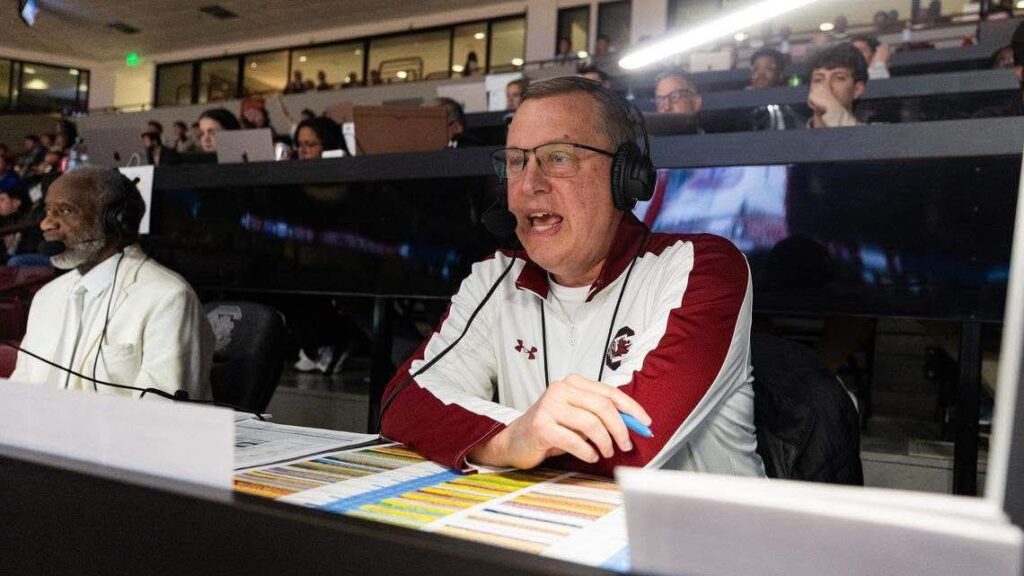
“That’s an absolutely absurd place to put your play-by-play team,” one account replied. “Ridiculous….S Carolina is unserious about college basketball.”
Former USC play-by-play announcer Andy Demetra was even more pointed in his criticism: “So TV still gets a plum spot courtside but you banish your own broadcast team to the corner. It’s not like radio needs to see the action clearly and closely to do our jobs (it’s actually more vital for us). Very disappointing from my old stomping grounds @GamecocksOnline.”
Scott and Muller were not made available for interviews for this story.
The Broadcasting Challenge
Dave Goren, president of the National Sports Media Association, professor at Wake Forest University, and Demon Deacons digital football reporter, offered insight into the practical difficulties of broadcasting from alternative positions.
“Ultimately, it is a disservice to the fans of your school who are listening, because you’re making it harder on the play-by-play person to see accurately,” Goren told The State. “Uniforms have gotten so out of whack. A lot of times, the design of uniforms now make it almost impossible to read numbers. … If there’s a funky call, the official would typically come over to the broadcast crew and try to explain what happened. If you’re upstairs or not there on the court, you don’t get that benefit.”
The logistics have changed for the broadcasters as well. Scott and Muller now bring their own lamps to games, lacking the luxury of the court’s bright overhead lights. USC women’s basketball coaches phone in for interviews with Muller, while men’s basketball coach Lamont Paris travels up into the stands to meet Scott and Manning after games.
Not Just a South Carolina Issue
South Carolina is far from alone in making this move. The trend of relocating radio and media members away from premium courtside real estate dates back at least a decade.
Mallette estimated that at least half of the SEC joined USC in moving home radio crews away from the court this season. Examples include Clemson’s Littlejohn Coliseum, where men’s basketball media sit midcourt in the upper bowl, as well as the SEC men’s tournament at Bridgestone Arena in Nashville and recent women’s basketball Final Four games, where radio crews occupy similar elevated positions.
Programs that have maintained courtside radio positions include Florida, Auburn, and Kentucky.
The Tradeoff
Mallette told The State that while he understands fan frustration with the change, the financial incentive was simply too significant to ignore.
“Nothing is done to harm people, nothing is done intentionally,” Mallette said. “Everything is done based on that set criteria: What do we need to do to make sure that the program, the student-athletes, the fans, everyone involved, is in as best a position as possible?”
The university attempted to soften the blow by selecting a location that already had power and internet connections, providing radio crews with hookups to in-game sound effects, more comfortable chairs that sit higher, and a larger video monitor to view the TV broadcast. The crews also have slightly more space in their new positions.
In the old days, USC’s “press row” was home to television, radio, and print reporters. It’s now reserved exclusively for the live TV crew.
Sustainability Questions
While Goren understands the reasoning behind such decisions, he questions whether the additional premium seat revenue justifies the impact on broadcast quality.
“The question is, the whole model, which has changed considerably in the last five years, is the whole thing sustainable?” Goren said. “And I’ve had a lot of very smart people, smart business people, tell me that it’s not.”
He added: “I just hope everyone uses common sense. And my common sense is you want to put your people in the best position to see the clearest picture so they can relate exactly what is happening on the court or on the table.”
The New Normal
The decision has been made, and the new courtside seats have been sold. If the radio crews were to be moved to a better vantage point in future seasons, Mallette indicated it likely won’t be a return to courtside.
The move exemplifies the tension between tradition and revenue generation in modern college athletics. As schools navigate the new landscape of revenue sharing and increased expenses, decisions that prioritize financial considerations over long-established practices are becoming more common.
Time will tell whether the extra revenue generated from premium courtside seating justifies any added inconveniences for radio broadcasters—and their listeners—across the SEC.
For now, Muller, Scott, and Manning will continue making the 90-step journey to their new broadcast home, adapting to a reality where even the best voices of Gamecock basketball must yield to the financial demands of the modern college sports economy.
Source: The State