Dawn Staley Pulls Back the Curtain: Hard Truths, Habit, and the Making of a Champion
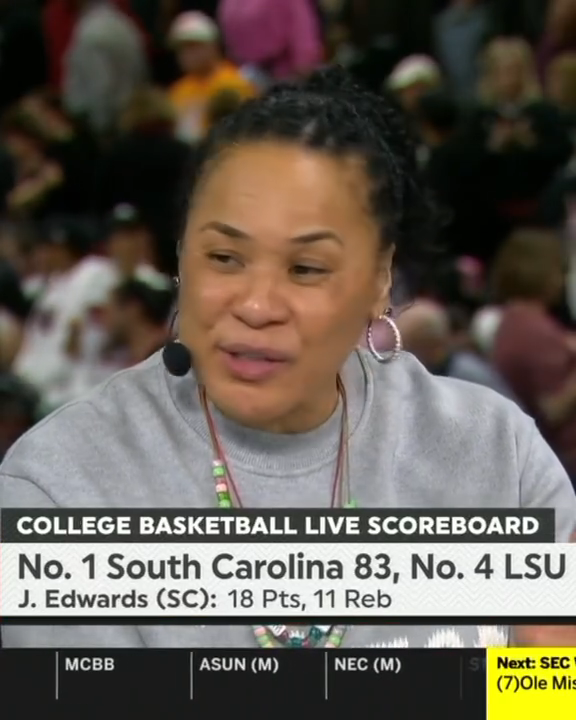
From Raven Johnson’s humbling detour to MiLaysia Fulwiley’s standing invitation, Dawn Staley’s postgame press conference was a rare window into exactly how South Carolina keeps winning — and why it’s so hard to replicate.
THE RAVEN JOHNSON STORY NOBODY KNEW
The narrative around Raven Johnson heading into this season was straightforward: fifth-year senior, Defensive Player of the Year candidate, senior leader on a dynasty. What Dawn Staley revealed in her postgame press conference was considerably more complicated — and considerably more instructive.
It started, as so many South Carolina stories do, with accountability.
“The year that we lost in the 2023 Final Four, I mean, it was an embarrassing moment because Caitlin Clark did the wave, and a lot of people don’t know, Raven was 2-4 in that particular game, shooting extremely well from outside the 3. They can take that as something to pound on.”
That detail reframes the entire 2023 loss. Johnson wasn’t a liability in that Final Four — she was one of the few Gamecocks who was making shots. The program’s most painful recent memory wasn’t her failure. It was a collective one. And she carried that weight anyway.
What followed is a portrait of athletic development that rarely gets told honestly. Johnson won a national championship the next year. Her percentages were solid. And then, in Staley’s words, something slipped.
“Her percentages were pretty good, pretty solid. And then after that year, she got happy. She didn’t put the work in. She did not put the work in, and she knew it. I had to remind her during that year, you didn’t put the work in. You can’t get it back now, so you just have to suffer through this year and figure out how we can continue to win, and you continue to make plays when it’s there. But after the season, you have to really put the work in.”
The phrase she got happy is the most revealing two words in the entire press conference. Complacency after winning is one of sport’s most predictable patterns — and one of its most dangerous. What makes this account remarkable is that Staley didn’t protect Johnson from it. She named it directly, to her face, and told her she’d have to live with the consequences for the rest of that season. No rescue. No softening. Just truth.
The payoff arrived at Bon Secours Wellness Arena on Friday night — a career-high 22 points, four three-pointers, eight assists, one turnover, and a pick-and-roll assist that effectively sealed the game against LSU.
“She’s seasoned. She’s a veteran at this. So she really understands. This is her fifth year doing this. I mean, she’s played at a high level. She’s been to Final Fours every year of her career, except the COVID year. Every year. I think she’s really understanding where she can really benefit from being a scoring threat out there.”
The arc is complete — not because everything went smoothly, but precisely because it didn’t. Johnson’s best season came after her worst professional decision, which came after her best team achievement. That is not a coincidence. That is coaching.
HABITS ARE THE STANDARD
When asked what separates teams that want to be the best from those that prove it, Staley didn’t reach for motivational language. She reached for something more fundamental.
“It’s about habits. We always try to mention to our players, bring your practice habits to the game. Now, you’ve got to have some pretty good practice habits because you’ll bring the bad habits to the game as well. We always talk about that. That is not just basketball. That’s mentality, that’s culture. That’s being a good teammate. That’s respecting the game and approaching it that way. We’ve had enough leadership in the locker room to understand that and to bring that.”
This is not a new philosophy. Every great coach in every sport talks about habits and culture. What distinguishes South Carolina’s version is the accountability infrastructure that enforces it — and the consequence when someone deviates.
“If someone else deviates from that, they look and feel out of place. That’s what the standard is. That’s the culture that we try to create at South Carolina. And fortunately, for us, it’s producing a lot of winning.”
That last sentence carries enormous weight when you consider the context. South Carolina is 31-2, heading to its fourth consecutive SEC Tournament final, with a program that has been to the Final Four in every non-COVID year under Staley. The culture isn’t theoretical. It has a measurable output. And the mechanism that sustains it isn’t rules or punishments — it’s peer pressure from within. When you deviate, you look out of place among your own teammates. That is a far more powerful enforcement tool than any coach’s mandate.
FULWILEY: A GAMECOCK IN SPIRIT, FOREVER
Staley’s comments on MiLaysia Fulwiley carried the same emotional texture they always do — genuine pride wrapped around genuine competitive respect.
“I knew she was going to have a good game. After the first time we played them, I mean, I still think MiLaysia is a generational talent. She does things out there on the floor that I haven’t seen a whole lot of female basketball players do. I’m generally happy for her. Like, I’m super happy. She’s actually doing some of the things that we talked about her doing. Just direct line drives and making plays. We all know she can play. We all know that she undoubtedly is a tremendous player.”
What makes this remarkable is the specific phrase — some of the things that we talked about her doing. Staley is acknowledging, in public, that the development she planted at South Carolina is now blooming at LSU. Fulwiley’s 24-point performance against her former program wasn’t a betrayal of anything. It was, in a meaningful way, a confirmation that the coaching worked.
“She’s also a junior now, so some of the things that she’s doing now, you just do because you’re more seasoned doing it. But I’m happy for her. Like, I’m really happy for her. She played two years for us, and we’re always going to be happy. We always consider her a Gamecock, no matter what uniform she puts on.”
The “always a Gamecock” framing is more than a gracious postgame sentiment. It reflects a program philosophy — that what South Carolina builds in its players is portable. It travels with them. Even when they leave, the foundation remains. That is the mark of a coaching staff that develops people, not just players.
THE SEC, THE STANDARD, AND THE HARD TRUTH
When asked to contextualize reaching another SEC championship game amid the deepest tournament field in recent memory, Staley gave the most candid assessment of her own program’s identity that she’s offered in years.
“Some coaches may say, and the location, right? I mean, this is a hard league. When we came to the SEC 18 years ago, I coached in the A-10 for eight years. We came here for just this, to play against the best, to coach against the best, to try to outfox the other coaches down the sideline. I didn’t think it was going to be this hard. Because it’s incredibly hard. It’s not for the faint of heart.”
That admission — I didn’t think it was going to be this hard — from the coach who has dominated that league for nearly two decades, is the kind of honesty that earns credibility. Staley isn’t performing humility. She is genuinely acknowledging that the environment she sought out has exceeded even her expectations for its difficulty.
And then she explained, with disarming candor, exactly what her brand of basketball demands — and why it will never be universally popular.
“We don’t have a brand of basketball that, to me, if you’re not really a basketball enthusiast, if you’re not willing to sacrifice and hear the hard truths, that’s not popular. It’s not popular. Well, our players are conditioned to hear the truth. If you suck, we’re gonna say you suck. But here’s how you don’t suck, right?”
There it is. The entire South Carolina program philosophy in four sentences. The hard truth delivered without cruelty — because the critique always comes with a pathway. You’re not good enough yet. Here’s what changes that. That is not a comfortable model. It requires players who can absorb criticism without fracturing, parents who trust the process without demanding their daughters be protected from it.
“We have those conversations, and they believe in it. We may have transfers. They still believe in it, but they choose to go elsewhere for a change of pace, for more playing time, for whatever it is. I get it. But I know the players that we coach are better human beings, are better basketball players, are better sisters, are better daughters because of the experience that they have at South Carolina.”
That final statement is the most ambitious claim a coach can make — and Staley makes it without hesitation. Not just better players. Better people. The proof of that claim isn’t found in trophies, though there are many of those. It’s found in the way Raven Johnson responded after being told she didn’t put the work in. It’s found in the way MiLaysia Fulwiley, despite transferring, earned nothing but warmth from the coach she left behind.
THE BOTTOM LINE
Dawn Staley’s postgame press conference was a reminder that the most sustainable dynasties are built not on talent alone, but on a specific, demanding, honest relationship between coach and player. The Gamecocks don’t win because they recruit the best — though they often do. They win because the players who stay are shaped into something harder and more reliable than raw talent alone can produce.
Raven Johnson is the living evidence. She got comfortable. She was told. She worked. She delivered 22 points on the biggest stage of her career.
That is not a coincidence. That is South Carolina.
About The Author