Raven Johnson’s Legacy Transcends One Night in Phoenix
The End of an Era, Not the Measure of One
When Raven Johnson stepped to the podium the night before the national championship game, she briefly reached for a safe answer before catching herself.
“I’ll be honest, ‘How do I stay motivated?’ I want to win,” she said.
It was vintage Johnson — direct, unvarnished, clear-eyed about what mattered. Less than 24 hours later, she was sitting with a very different reality. The South Carolina Gamecocks fell to UCLA 79-51 on April 5 in Phoenix, ending not just a season, but one of the most decorated careers in the history of women’s college basketball. Johnson, who had dreamed of becoming the first player to win three national championships under Dawn Staley, instead watched the Bruins celebrate their first title. She finished 1-of-7 from the floor for three points in her final college game.
But reducing Johnson’s legacy to those numbers would be a fundamental misreading of what she built over five years in Columbia.
What the Record Actually Says
The stat that tells Johnson’s real story is not a shooting percentage or a scoring average. It is a winning percentage. Johnson finished her South Carolina career with a 147-9 record as a starting point guard — a 94.2% win rate that is almost absurd in its consistency. She went 20-3 in NCAA Tournament play and became the only player in the sport’s history to appear in four consecutive national championship games. She won five SEC regular-season titles, three SEC Tournament championships, and two national championships, all after tearing her ACL just two games into her freshman season. She returned from that injury to go 109-8 as a starter. The numbers do not describe a player who came up short. They describe a player who figured out how to win and then kept doing it, relentlessly, for five years.
Dawn Staley did not hesitate in contextualizing the final loss within that body of work.
“We’re never going to let one game define anyone,” Staley said. “Raven has put our program on the top. She made a promise of not only winning just one national championship but put us in position to win a lot more. We came up short but when you look at Raven, she won at a really high clip.”
That framing matters. South Carolina became just the fourth program in history to appear in three consecutive national championship games this season, and Johnson was the lone returning starter bridging that entire run. She was the thread connecting multiple roster generations, multiple recruiting classes, and multiple championship windows. When Staley says Johnson put the program on top, she is not offering consolation — she is describing an architectural truth about how this dynasty was constructed.
The Growth That Defined the Final Chapter
What made Johnson’s senior season particularly compelling was how it punctuated her arc as a player. After posting a career-low 4.9 points per game in the previous season, she responded with a career-high 10.0 points per game this year while earning SEC Defensive Player of the Year honors. That dual leap — becoming a more credible offensive threat while cementing herself as the conference’s premier defender at her position — silenced whatever lingering questions remained about her offensive limitations. She did not simply return for a fifth season to collect accolades. She returned to get better, and she did.
Staley acknowledged what that kind of commitment means within a program’s culture.
“We’re going to have to work extremely hard to replace all the things she’s given to us, all the blood, sweat and tears,” she said. “She decided to come back for another year and she really didn’t have to do that and I think there’s a love affair with her in our program … it’s sad to see an era come to an end but her future is bright.”
The decision to return — forgoing whatever professional opportunities awaited — was itself a statement of character. It was the kind of choice that defines how programs become dynasties and how players become legends within them.
The Friendship That Made It Personal
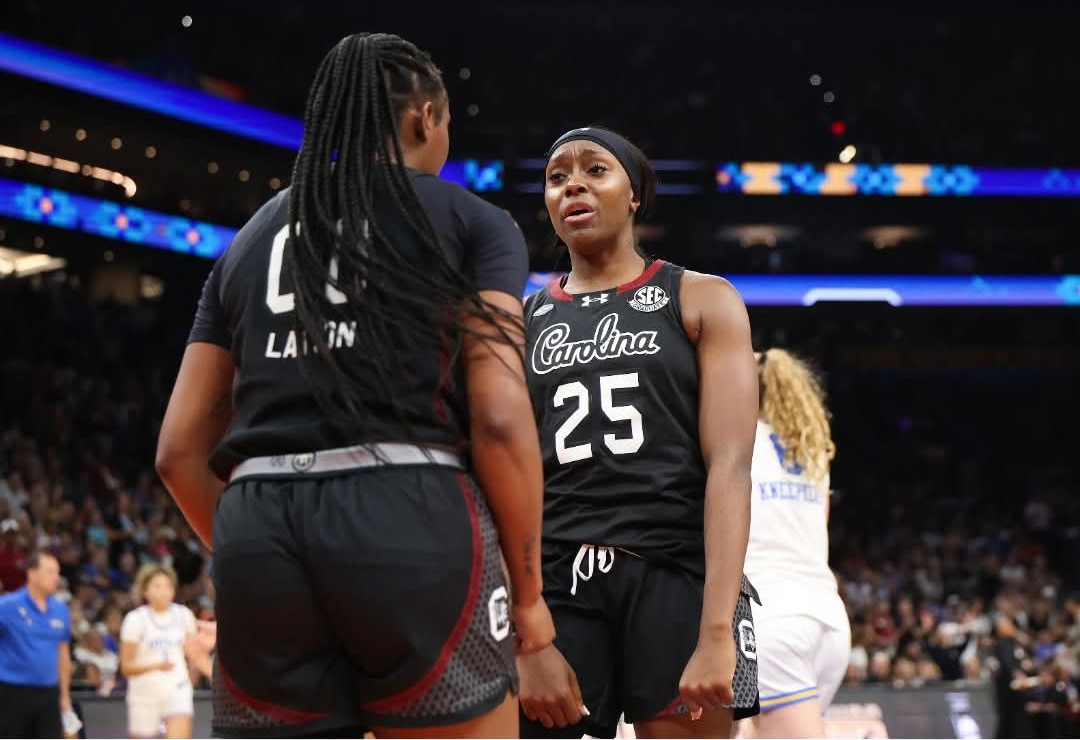
Johnson’s final season carried an added layer of meaning because of who was beside her. Ta’Niya Latson, her closest friend since their high school days in which they won three state championships together, transferred to South Carolina specifically to chase one more title alongside Johnson. The two pushed South Carolina’s offense together for 40 games, fell to Texas in the SEC Tournament championship, and then fell again to UCLA on the sport’s biggest stage.
The weight of that convergence — the friendship, the shared dream, the shared disappointment — was visible in the moments after the final buzzer. When asked to summarize what Johnson meant to her, Latson could barely maintain her composure, her smile fading and her lip quivering as she tried to find the words. Their slight laughter broke through the sound of tears as they worked through something too fresh and too significant to fully process in real time.
“Obviously she meant so much to me,” Latson began, before Johnson pulled her in with a side hug, patting her head and quietly telling her, “you’re going to make me cry.”
It was a small, unscripted moment that said more about who Raven Johnson is than any stat line ever could. Even in her own grief, her instinct was to take care of someone else.
Looking Forward While Honoring What Was
The defeat in Phoenix will sting, and Johnson acknowledged it with the same honesty she has brought to everything else.
“I’m not going to try to dwell on it too much,” she said. “It’s going to replay in my head a lot, but I’m on to the next chapter in my life. I hope the next generation that comes through here tries to win not just for themselves but for coach Staley.”
That final line is the measure of a player who understands legacy. Johnson is not asking the next generation to win for her. She is asking them to carry something forward for the coach and the program that shaped her. It is a selfless send-off from a player whose defining quality, more than any individual accolade, was always understanding that winning together was the point.
Forty minutes of disjointed basketball in a championship game does not rewrite five years of triumph. Raven Johnson won 94.2% of her games, helped build one of the most dominant programs the sport has seen, and left Columbia with two rings, an unbreakable friendship, and the respect of everyone who watched her compete. The next chapter, as Staley noted, is bright. The era she represented was brighter still.
About The Author