Audi Crooks as a Potential Replacement for Okot: Can South Carolina Land the Transfer That Changes Everything?
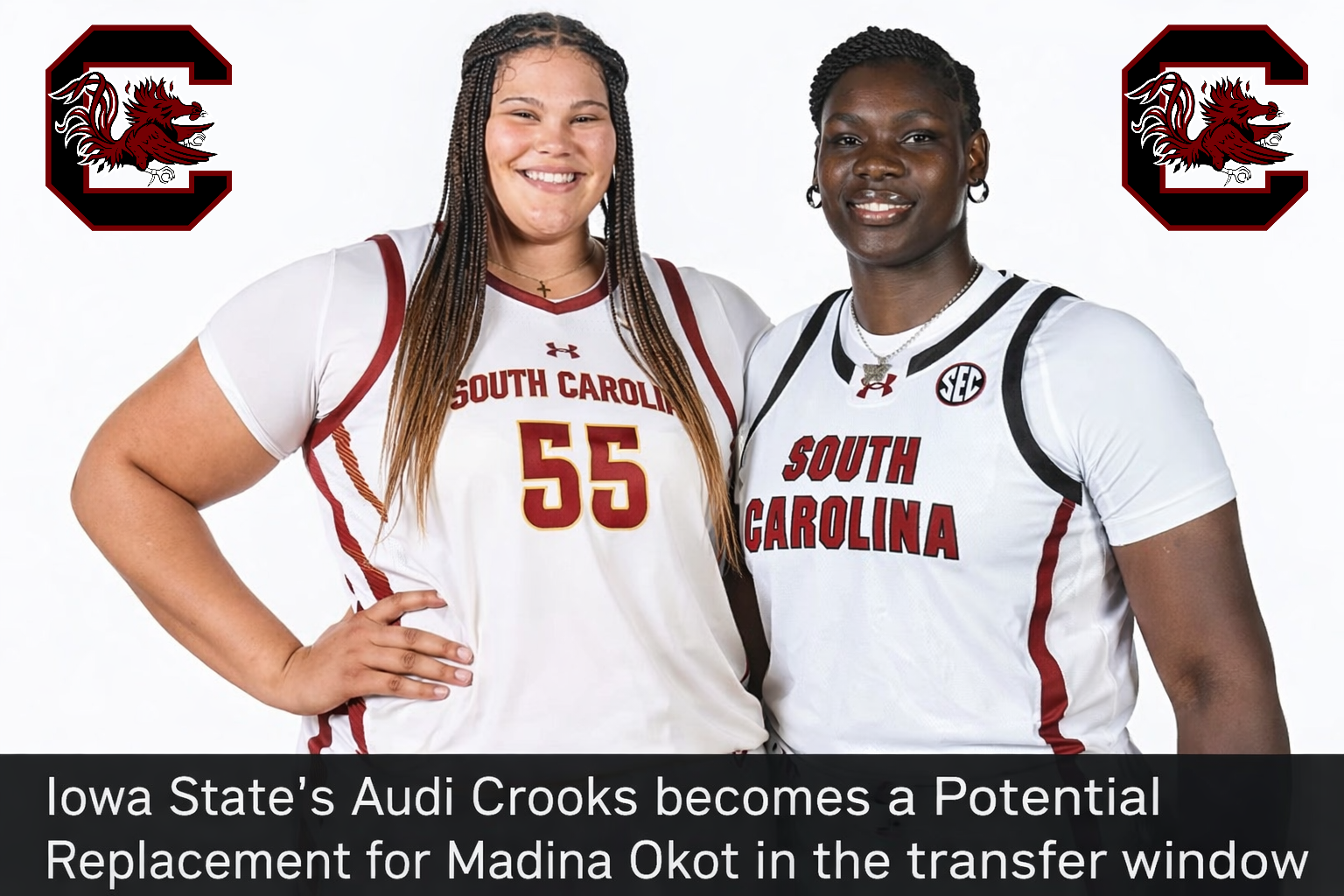
The moment Madina Okot’s future became uncertain, Dawn Staley’s staff went to work. And if the early transfer portal conversations are any indication, they may have identified the most compelling answer available.
Iowa State star Audi Crooks entered the transfer portal last week, and South Carolina has emerged as one of her primary suitors. The timing is not coincidental. The need is not subtle. And the fit, at least on paper, is as clean as it gets.
What Okot’s Potential Departure Actually Means
To understand why the Crooks conversation matters so much, you have to first understand what South Carolina stands to lose. Okot was not merely a contributor — she was the structural anchor of the Gamecocks’ frontcourt. A double-double machine who tied for the national lead among power conference players with 22 this season, she gave South Carolina size, rebounding, and interior scoring that the program had not had since Kamilla Cardoso. She also expanded her offensive game to include a reliable top-of-the-key jumper, which made her genuinely difficult to scheme against.
Okot is currently appealing to the NCAA for another year of eligibility, but that waiver is not guaranteed, and the 48-hour WNBA Draft declaration window means the situation will resolve quickly. If she leaves, the void is real, significant, and not easily papered over with the returning roster alone. Ashlyn Watkins returning from her ACL recovery helps, but counting on a player to immediately return to All-American level defense after a torn ACL carries its own risk. South Carolina needs a plan, and Crooks represents the most direct one available.
The Crooks Profile: Everything South Carolina Needs
The numbers are staggering, and they hold up under scrutiny. Crooks averaged 25.8 points and 7.7 rebounds per game for Iowa State this season, shooting 64.9% from the field. That efficiency figure is not a misprint — it reflects a post player who is dominant enough near the basket that contested shots still go in at an extraordinary rate.
What makes Crooks particularly valuable in the context of South Carolina’s system is the combination of skills she brings. She is a true interior presence who can score with her back to the basket, finish through contact, and rebound in traffic. She draws fouls at a high rate, which matters enormously in a Dawn Staley offense that has historically relied on getting to the free throw line as a primary scoring mechanism. And unlike some post players whose value is purely positional, Crooks has shown the ability to operate as a focal point — a player whose team can run offense through her in half-court sets.
For a South Carolina team that already has Joyce Edwards as its primary offensive option, adding Crooks does not create redundancy. It creates a genuine two-headed problem for opposing defenses. Edwards operates primarily from the mid-range and on the perimeter. Crooks operates in the paint. That combination forces a choice no defense wants to make — guard the perimeter and give up the interior, or pack the paint and leave Edwards open from the outside.
Staley’s Candor on Portal Economics
What makes this pursuit particularly interesting is the context Dawn Staley herself has provided around how South Carolina approaches the transfer portal financially. She has been refreshingly direct about the economics of modern roster construction:
The first question is how much it will cost, and whether South Carolina can afford the answer.
That framing matters. Crooks is not a developmental prospect or a depth piece — she is a bona fide star, the kind of player who commands significant NIL investment in the current landscape. Iowa State built their program around her, and any school attempting to bring her in will be competing not just on fit and coaching, but on financial terms that reflect her market value as one of the most productive post players in the country.
South Carolina is not without resources. The program’s national profile, championship pedigree, and Staley’s track record of elevating players’ professional draft stock represent a genuine competitive advantage in any recruitment. Latson arrived at South Carolina and watched her WNBA Draft stock rise dramatically over a single season. Okot came in and parlayed one dominant year into first-round projections. The argument Staley’s staff can make to Crooks is concrete: come here, fit into a system that wins, and your professional future becomes significantly brighter.
But the NIL reality of 2025 means that argument alone is rarely sufficient. The program that lands Crooks will likely be the program that matches or exceeds competing offers on the financial side. Whether South Carolina can and will do that is the central question.
The Competition and What It Means
Crooks entering the portal with South Carolina identified as a primary suitor is meaningful — it suggests genuine mutual interest rather than a speculative long shot. But primary suitor is not the same as frontrunner, and a player of her caliber will have no shortage of serious programs making serious offers.
The schools that can credibly compete for Crooks share a common profile: established programs with championship ambitions, the infrastructure to support a star player’s professional development, and the financial flexibility to meet her market value. South Carolina checks every box on the qualitative side. The question is whether they check the financial one.
What works in Staley’s favor beyond the money is the specific argument about role and fit. Crooks spent her career at Iowa State as the unquestioned primary option — the player everything ran through, which produced remarkable individual numbers but did not produce a national championship. At South Carolina, she would step into a roster that already has complementary pieces around her, a system that has reached three consecutive national championship games, and a coaching staff that has demonstrated the ability to get the most out of post players at the professional level.
There is also the Edwards factor. Joyce Edwards is one of the best forwards in the country. Sharing a frontcourt with a player of that caliber, rather than carrying a roster alone, may actually be an appealing proposition for Crooks rather than a concern. The best players generally want to win, and winning is what South Carolina does.
The Bottom Line
No transfer portal situation resolves cleanly or predictably, and projecting outcomes before a commitment is made is an exercise in informed speculation. But the logic of this potential marriage is undeniable.
Crooks is the most direct available replacement for what Okot provided — and in several respects, she is an upgrade. Her scoring volume, shooting efficiency, and rebounding numbers exceed what Okot produced, and she has done it against Big 12 competition at a level that translates. South Carolina has the system, the stage, and the track record to make a compelling case.
The conversation is active. The need is real. And if Staley can make the economics work, the Gamecocks may be about to answer the biggest roster question of their offseason in the most emphatic way possible.
About The Author