“Gamecocks Targets: Here is a List of Who South Carolina Is Not Looking For and Who South Carolina Is Actually Looking For”
Dawn Staley’s Offseason Blueprint: How South Carolina Plans to Build Next Season’s Roster
The national championship loss to UCLA stings, but the work of answering it has already begun. Dawn Staley enters the offseason with a roster that is more intact than most programs could claim after a Final Four run, a clear-eyed understanding of what needs to be added, and a recruiting philosophy that has consistently produced results. Here is a comprehensive breakdown of where South Carolina stands, what they need, and who might be coming to Columbia.
The Good News: Nobody Is Leaving
The first question every program has to answer after a season ends is who is staying. For South Carolina, the early answer is reassuring.
No transfers have materialized yet, and the two players most likely to have considered their options — Adhel Tac and Ayla McDowell, both of whom ended the season at the back end of the rotation — have each indicated their commitment to remaining in Columbia. That matters more than it might appear on the surface. End-of-rotation players who stay and develop are often the ones who become critical contributors the following season, and both Tac and McDowell have the tools to grow into meaningful roles.
There is always the possibility of a late departure — MiLaysia Fulwiley did not enter the transfer portal immediately last season before eventually moving on — and signing a high-profile transfer could theoretically displace a current player. But as of now, Staley appears to have kept the nest intact, which gives her the flexibility to add without subtracting.
The Real Need: Guard Play and Athleticism
South Carolina’s most pressing offseason requirement is straightforward, and Staley herself identified it publicly at the Final Four in Phoenix:
“Obviously, we’ve got to add some guard play, definitely some lead guard play, some more athleticism in the guard department.”
The numbers back her up. Maddy McDaniel is the only true point guard on next season’s current roster, and her injury history — four separate stints unavailable across two seasons — makes her an unreliable single point of failure at the most important position in Staley’s system. The Gamecocks need a second point guard who can run the team, not merely serve as an emergency option.
The athleticism component of Staley’s comment is analytically significant. South Carolina’s backcourt next season, without additions, is not slow — but it lacks the explosive, disruptive quickness that makes elite defensive teams genuinely difficult to play against. In a Dawn Staley system, guard athleticism is not a cosmetic preference. It is a functional requirement.
The Okot Question: Serious, But Not Scramble-Worthy
The NCAA’s denial of Okot’s eligibility waiver was announced April 8, and while the news was disappointing, it does not fundamentally destabilize South Carolina’s frontcourt the way it might have without what is already in place.
Joyce Edwards returns as one of the two or three best forwards in the country, coming off a season in which she set South Carolina’s single-season scoring record. Chloe Kitts, an All-American who missed all of 2024-25 recovering from knee surgery, is expected to return at full strength and immediately reclaim her status as one of the elite forwards in the SEC. Adhel Tac returns from a foot injury with a player-coach role that has already earned genuine respect within the program. Alicia Tournebize, the 18-year-old from France who joined mid-season, offers a 6-7 frame and a ceiling that had coaches talking by February. Freshman Kelsi Andrews, a talented 6-4 post with a high ceiling, arrives in the fall. Kaeli Wynn provides immediate depth at the three or four.
And then there is Ashlyn Watkins.
Watkins sat out all of 2024-25 recovering from a torn ACL and is expected to rejoin the program in May. The analytical case for her return is compelling — she was the best rebounder and defender on South Carolina’s undefeated 2023-24 team, considered superior to SEC Defensive Player of the Year Kamilla Cardoso as an interior defender, and plays with a physicality and athleticism that makes her effective well above her listed 6-3 height. Bringing Watkins back is functionally equivalent to adding a high-end transfer. There may only be a handful of players available in the portal who would represent a genuine upgrade over a healthy Watkins.
The Okot-shaped void is real, but the pieces already in place make it manageable. The scramble is not necessary. The search for an elite post addition, however, remains worthwhile.
Who South Carolina Is Not Looking For
Staley’s recruiting philosophy has always been about fit — system fit, culture fit, and competitive fit. That means certain profiles, however talented, are unlikely to be pursued.
Players seeking their third or fourth program are generally not South Carolina targets. The pressure cooker environment that Gamecock basketball demands is difficult enough for players arriving fresh. It requires a specific kind of mental fortitude and coachability that players who have already cycled through multiple programs often struggle to sustain.
On the frontcourt side, forwards Audi Crooks and Gracie Merkle represent the wrong kind of fit despite their obvious offensive talent. Both are average defenders — and South Carolina does not add forwards to score. Edwards and Kitts handle that. What the program needs from a frontcourt addition, if it makes one, is defensive presence and rebounding. Crooks and Merkle do not offer that at the level Staley requires.
At the point guard position, the profile of what South Carolina does not want is equally clear. Dani Carnegie, Liv McGill, Kiyomi McMiller, and Zam Jones are all ball-dominant, shot-first guards. Staley’s point guards have always been distributors first and scorers second — the position is about managing possessions, defending at the point of attack, and making the offense function, not about generating individual production. McMiller carries additional concerns beyond playing style, having effectively been removed from Rutgers’ program. Former Iowa State forward Addy Brown, a versatile point-forward type, represents a profile Staley has simply never deployed. The system does not accommodate it.
Who South Carolina Is Actually Looking For
Staley operates on a principle of relationship and familiarity that has produced consistently successful transfers. The Gamecocks originally recruited Kamilla Cardoso out of high school before reconnecting when she entered the portal. Ta’Niya Latson was Raven Johnson’s best friend and high school teammate. Madina Okot was a conference opponent, which meant both sides knew each other before the conversation began. The through-line is always prior connection — South Carolina rarely pursues strangers.
With that framework in place, several names stand out as genuine targets.
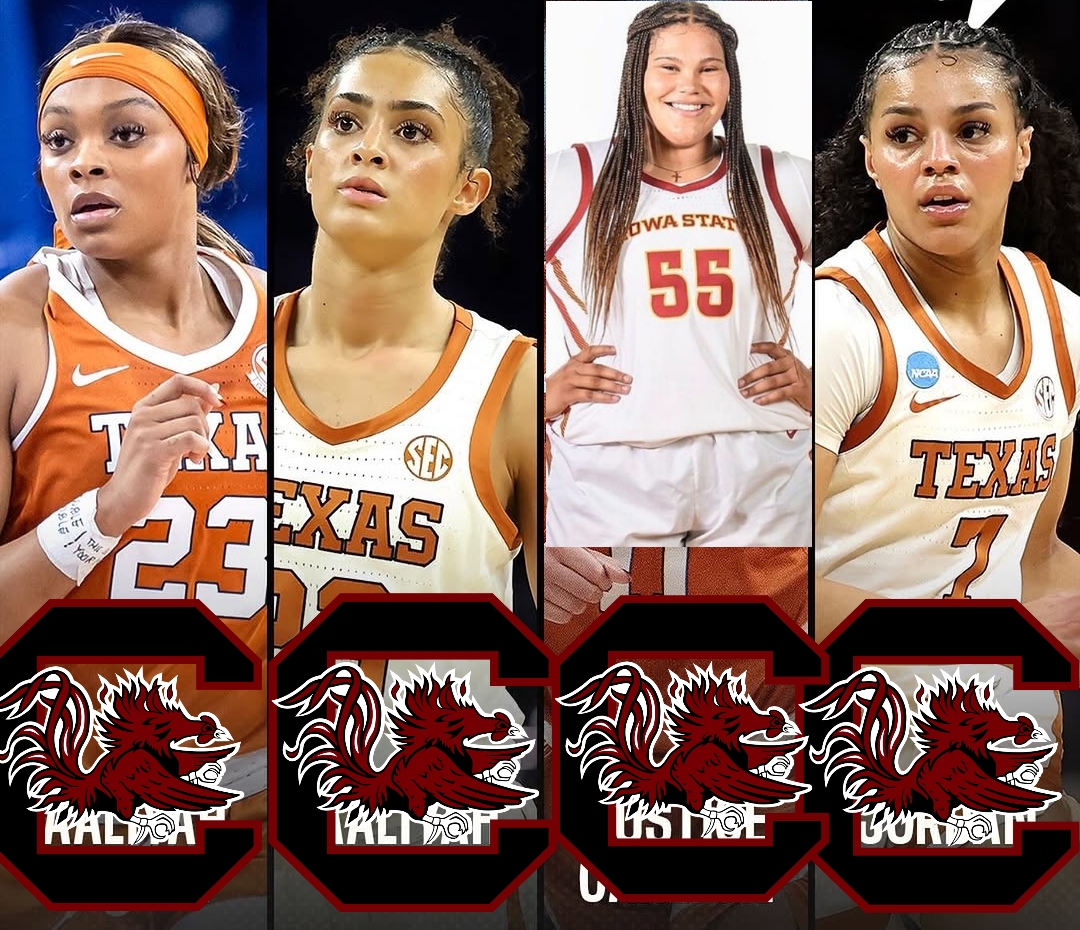
Aaliyah Crump (Texas) is perhaps the most straightforward fit. South Carolina recruited her in high school, which means the relationship exists. She is a big, athletic guard who can score and defend — exactly the profile Staley described needing when she talked about adding athleticism and guard play. Her familiarity with SEC competition shortens the adjustment curve.
Kymora Johnson (Virginia) became one of the stories of the NCAA Tournament, and South Carolina has history with her dating back to her high school recruitment. The prior relationship creates a natural conversation, and her floor general qualities fit the Gamecock point guard mold precisely.
Jada Williams (Iowa State) is the most analytically interesting name on the list. She has started at two programs — Arizona and Iowa State — which technically makes her a three-school player, an exception to Staley’s general preference. But her production demands attention: 15.3 points and 7.7 assists per game. At 5-6, she plays significantly bigger than her height in terms of court vision and impact. Her assist numbers, in particular, suggest a distributor’s mentality packaged in a scorer’s body — the kind of hybrid that could function exceptionally well in Staley’s system if the culture fit is right.
Jordan Lee (Texas) is another guard South Carolina recruited in high school, and the existing relationship matters in the current portal environment where every program is competing for attention simultaneously.
The Deeper Bench of Names Worth Watching
Beyond the primary targets, several players represent secondary interest for South Carolina — familiar names where the relationship exists even if the need is not urgent.
Tennessee’s Jada Civil was recruited by South Carolina out of high school. She does not fill a specific need on the current roster, but familiarity has a way of creating opportunities that pure need analysis doesn’t anticipate. The same dynamic applies to Texas forward Justice Carlton and LSU guard Divinie Bourrage — prior recruitment creates a baseline of mutual knowledge that makes conversations easier to initiate.
North Carolina guards Lanie Grant and Elina Aarnisalo are rising juniors who warrant monitoring for future portal windows. Both shot over 40% from three, and the three-point shooting profile is one South Carolina has consistently valued in its backcourt additions. They are not immediate targets, but they are names the program is watching.
The Bottom Line
South Carolina enters this offseason from a position of strength, not desperation. The roster is largely intact, the frontcourt is deeper than it appeared immediately after Okot’s departure announcement, and the primary need — a point guard with athleticism and distributing instincts — is specific enough that Staley’s staff can pursue it with focus rather than casting a wide net.
The program’s track record with transfers is not accidental. It is the product of a deliberate philosophy: recruit players with whom prior relationships exist, fit them into a system with defined roles, and develop them beyond their incoming profile. Latson’s WNBA Draft elevation was the most visible recent example. Okot’s first-round projections confirmed it was not a coincidence.
The nest has held. Now comes the work of filling it with exactly the right birds.
About The Author