Dawn Staley Is Not Just the Highest-Paid Coach in Women’s Basketball — She Is the Standard
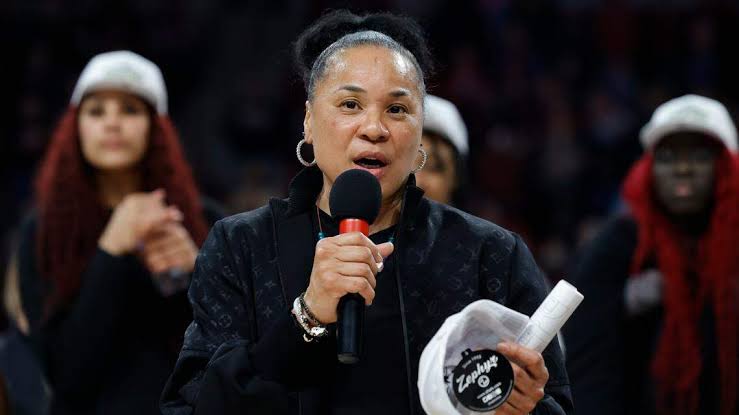
There are programs that win. Then there are programs that redefine what winning looks like. Since arriving in Columbia, South Carolina, in 2008, Dawn Staley has done the latter with a consistency that has become the envy of the entire sport. She has led South Carolina to three national championships, eight Final Fours, and five straight championship game appearances — including consecutive title game appearances in 2024, 2025, and 2026. That is not a good run. That is a dynasty.
The Gamecocks are one of only five programs in history to win at least three NCAA Women’s Basketball National Championships, and one of two programs to put together multiple 40-game win streaks. South Carolina has been ranked in the AP Top 25 every week since December 10, 2012 — the longest active streak in the sport. These numbers do not happen by accident. They happen because of the system, the standard, and the singular vision of one person.
Her most recent trip to Phoenix was a case in point. The Gamecocks dismantled UConn in the semifinal before falling to the UCLA Bruins in the championship game. But even in defeat, the message is clear: South Carolina isn’t just making an appearance on the sport’s biggest stage — they own real estate there.
The Money Finally Matches the Value
What makes Staley’s story even more remarkable right now is that the financial recognition has finally caught up to the football. The University of South Carolina’s Board of Trustees approved Staley’s contract extension, which starts with an annual salary of $4 million, includes a $500,000 signing bonus and has an annual $250,000 escalator, bringing the total value to approximately $25.25 million.
That makes her not just the highest-paid coach in women’s college basketball — it places her in a financial tier of her own. Dawn Staley will earn $4.25 million for the 2025–26 season, pulling well ahead of rivals Geno Auriemma of UConn at $3.79 million, Kim Mulkey of LSU at $3.35 million, Vic Schaefer of Texas at $2.3 million, and Brenda Frese of Maryland at $2 million-plus.
That gap is not just a matter of dollars. It is an institutional statement. The fact that Staley now earns more than multiple SEC men’s head coaches is a data point that would have been unthinkable when she arrived at South Carolina in 2008 on a $650,000 salary. In less than two decades, Staley went from $650,000 per year to the most lucrative contract in the history of women’s college basketball — a trajectory no other coach in the sport comes close to matching.
Athletics director Jeremiah Donati put it plainly when the deal was announced: “Dawn Staley is a once-in-a-generation coach who has made a tremendous impact on the University of South Carolina. She has elevated the sport of women’s basketball on the national level and here on campus, and I am excited that she will be representing our University for many years to come.”
Staley’s own response to the deal was characteristically focused on the collective rather than the individual. “I’m proud to represent the University of South Carolina and of its investment in women’s basketball,” Staley said. “What we’ve been able to accomplish on the court is a testament to what can happen when you bring together the right people from a team perspective but also have the right commitment from the university, the athletics department and the community to providing that team with everything it needs to be successful.”
That framing is deliberate. Staley has never sold herself as the show. She sells the system — and the system sells itself.
A Legacy Already Cemented, Still Expanding
The contract is historic. But the woman it rewards is even more so. Staley is the only Black basketball head coach with multiple national titles, one of only five head coaches to lead an undefeated team to a national championship, and the first Black head coach of the USA Basketball Senior National Team.
Her 2022 victory over UConn made Staley the first Black head coach to win multiple Division I basketball championships. After the 2017 title, she famously sent a piece of the net to Carolyn Peck — the first Black woman to win a championship — a gesture that said everything about how Staley views her own place in history: not as the destination, but as part of a lineage.
As a coach, her statistical fingerprint is equally commanding. Staley is a seven-time SEC Coach of the Year and four-time National Coach of the Year, with 10 SEC regular-season titles to her name and 683 career wins that rank in the top 20 all-time in Division I. She is also the second-winningest coach in SEC Tournament history and has produced 18 WNBA draft selections during her tenure — a pipeline that has transformed Columbia into a destination for the nation’s most elite talent.
But what makes the Staley story almost singular is that the coaching legacy sits on top of an equally extraordinary playing career. Before she ever held a clipboard, she was leading Virginia to three Final Fours and winning National Player of the Year honors twice. She won three Olympic gold medals as a member of Team USA and became a six-time WNBA All-Star. Staley is the first person to win the Naismith Award as both a player and a coach — inducted into the Women’s Basketball Hall of Fame in 2012 and the Naismith Memorial Basketball Hall of Fame in 2013.
Former Gamecocks standout and four-time WNBA MVP A’ja Wilson, who Staley recruited and developed, said it best: “A lot of people don’t want to see her here. I think they kind of side-eye her in some places and she is unexpected to be in those places. But she’s there and she’s 10 toes down and she’s keeping her head up, her chin up and going head forward into all adversity or anything that looks abnormal. She’s already GOATed in my eyes but another championship is another thing that a person can’t take away from her.”
Wilson’s words carry the weight of someone who knows firsthand. Staley didn’t just build South Carolina into a championship program — she built players into champions. That is the legacy that no contract figure can fully capture.
This isn’t about being “paid well for women’s basketball.” It’s about being paid what the job demands and what the results show. Dawn Staley has done far more than elevate South Carolina. She has forced the entire sport to recalibrate its value system. And if the trend continues — the winning, the recruiting, the cultural impact — she will remain the benchmark for success in more ways than one.
About The Author