
Under the Microscope: Assessing Maddy McDaniel and Ayla McDowell’s Development at South Carolina
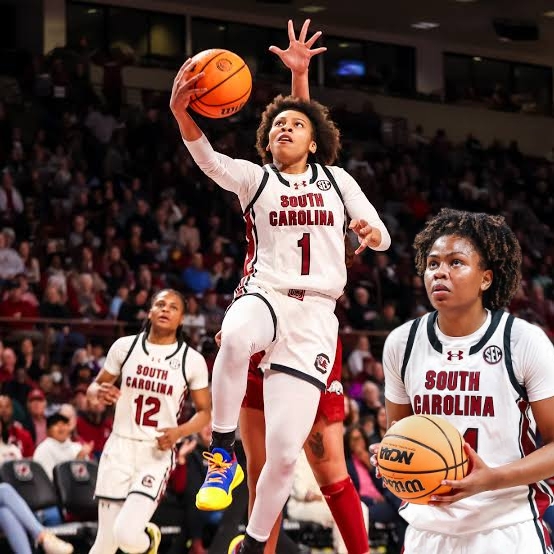
As Dawn Staley looks ahead to a retooled 2026-27 Gamecocks roster, two of South Carolina’s younger contributors — sophomore guard Maddy McDaniel and freshman wing Ayla McDowell — sit at different but related crossroads. Both players showed flashes of what they could become this past season. Both also exposed developmental gaps that the South Carolina staff is actively working to close. Understanding where each player stands is key to understanding the shape of South Carolina’s bench next year.
Maddy McDaniel: Raw Speed, Real Responsibility
McDaniel finished her sophomore season averaging 4.4 points, 2.7 assists, and 1.6 rebounds per game — modest numbers that don’t fully capture her impact. Staley described her as “high-performing, especially in practice, low-maintenance, really quiet person. Just comes to work without complaint.” When the Gamecocks needed a spark, particularly in their Final Four win over UConn, it was McDaniel who delivered it.
“She understands what it takes to win,” Staley told reporters. “Maddy was definitely a momentum shifter for us because of her speed and her ability to make passes. She had a big bucket during the time we needed a bucket in transition.”
That momentum-shifting ability is exactly why her development matters so much. McDaniel’s quickness and ability to penetrate is her best asset. When she played limited minutes behind Raven Johnson, that explosive quality was used precisely — quick bursts that changed games without demanding too much of her decision-making. But when she played for longer stretches, the challenge became clearer: the same instinct to attack the rim that makes her dangerous can also lead to overpenetration — forced shots, blocked layups, and turnovers in traffic when defenses are set.
The staff identified this pattern and addressed it. South Carolina’s coaching staff worked with McDaniel after last season on improving her three-point shooting, and that developmental emphasis will continue heading into next year. The goal isn’t to fundamentally change who she is. South Carolina needs her fearlessness — that is non-negotiable. The goal is to give her just enough of an outside threat that defenses cannot simply sit back and dare her to shoot, which would open lanes for her penetration even further.
Her defensive capabilities have already grown considerably. Her 25 steals during the season placed her fifth on the team — behind only players who had logged 590-plus minutes — a remarkable output for a reserve guard. That defensive effort showed up in a marquee moment when Staley deployed her to guard Vanderbilt’s Mikayla Blakes, the SEC’s leading scorer at 25.9 points per game. Blakes finished with 23, and Staley was direct in her praise: “I thought Maddy did a great job. She really just stayed in her pocket.”
The bigger issue looking ahead is that McDaniel has never run the team full-time, and with Raven Johnson departing, that role now falls to her. A sophomore who excelled as a change-of-pace backup must now become the primary engine. The three-point development isn’t just about diversifying her offense — it’s about becoming a complete enough player to run a championship-caliber program from the point guard position for 35-plus minutes.
“We were very excited when Maddy came back,” Raven Johnson said earlier in the season, when a brief suspension had kept her sidelined. That quote came at a moment when the Gamecocks were running just nine active players — and it spoke to something the statistics don’t fully capture. McDaniel’s presence changes how the rest of South Carolina’s lineup functions.
Ayla McDowell: The Shooter Who Needs More Than One Trick
McDowell finished her freshman season averaging 4.2 points, 1.4 rebounds, and shooting 36.3 percent from three. She showed genuine promise in stretches — a two-game run where she averaged 7.0 points on 55.6 percent shooting, including 50 percent from three, averaging 17.5 minutes per game, gave Gamecock fans a glimpse of what she could be. Her teammate Maddy McDaniel acknowledged the connection the two were building.
“Me and Maddie, we have a pretty good connection,” McDowell said. “We’ve been working together, especially in the second unit, and our connection is growing throughout the year.”
But the season told a more complicated story. Her minutes declined as the schedule intensified. This was not a single event, a bad practice, or a coaching miscommunication — it was the natural consequence of what happens when the margin for inefficiency narrows in SEC play and then again in the postseason. As one analyst put it: “She does a lot of things well, like shoot, rebound, and defend, but there’s nothing she does really well yet.”
That is a fair and honest assessment. McDowell’s perimeter shooting is clearly her primary calling card, and the mid-range dimension she has shown hints at a more versatile offensive player down the road. The “poor man’s Madison Booker” comparison is evocative — Booker is a multi-dimensional scorer who can punish defenses at all three levels — but McDowell is not there yet. Whether she gets there depends on two things the staff is emphasizing: defense and rebounding.
She is not a natural ball-handler, which effectively narrows her positional range. Her future at South Carolina most likely lies as a wing or small-ball forward — but only if she can be trusted defensively and bring in more rebounds. The ability to shoot, on its own, is not enough to hold a rotation spot on a team competing for national championships. The Gamecocks have had stretches where every possession matters and every player on the floor must be able to guard reliably and contribute in multiple phases.
The good news is that McDowell plays hard. The coaching staff has noted that there is always hope for a player who plays hard and can shoot. Those two attributes are a foundation. The sophomore year will be about building the walls — becoming more than a shooter, earning trust on the defensive end, and giving the coaches a reason to keep her on the floor when games tighten.
Two Players, One Shared Challenge
McDaniel and McDowell represent two distinct types of young players South Carolina is developing: one who has the athletic gifts but needs the technical refinements to match them; the other who has the technical skill but needs the competitive traits to survive the most demanding moments. Both are viewed by the staff with genuine optimism. But both also have a clear path ahead — and at South Carolina, there is no shortcut down it.
About The Author