More Than Minutes: Adhel Tac’s Injury, Her Role, and Why South Carolina Still Needs Her
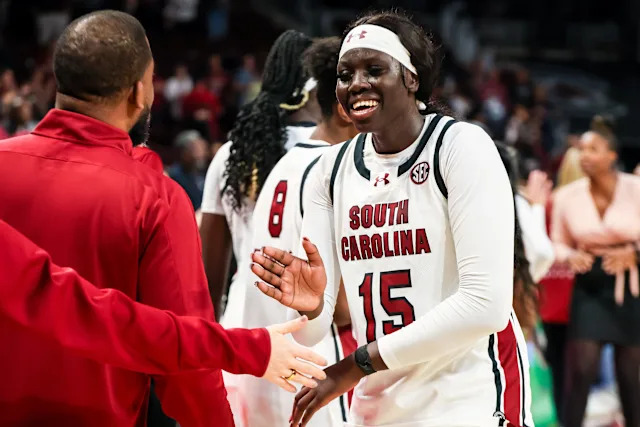
Adhel Tac’s 2025-26 s55eason ended the same way too many chapters of her young career have — not with a final buzzer but with a boot and a sideline seat. But if there’s one thing this interview makes clear, it’s that Tac’s value to South Carolina has never been reducible to what she does in a box score.
Tac missed the final stretch of South Carolina’s regular season and beyond with a left foot injury. Staley acknowledged the severity of the situation at the time, saying: “I know she’s tired of the scooter, but I think we just need to be real cautious with it. I know she’s antsy to get off the crutches and off the scooter, but she knew it was going to be rest and staying off of it as much as possible.” On3
Before the foot shut her down, Tac had played 23 games, averaged 3.1 points, 3.4 rebounds, and 0.8 blocks in 11.2 minutes per game, and had been South Carolina’s top reserve in the post before Alicia Tournebize and Maryam Dauda stepped into that role. On3 She was also, by all accounts within the program, one of the most important voices on the roster — a quiet force that never shows up on a stat sheet.
When asked about the injury itself, Tac was measured and honest.
Is it a stress fracture?
“Not a stress fracture. A doctor explained it, and we’ve gone through so many (explanations). I think it’s a stress reaction, not a fracture.”
Did they have trouble figuring out what was wrong?
“Not trouble figuring out what was wrong, just how to go about (treating) it.”
How did it happen?
“It just showed up.”
The simplicity of that answer is telling. Tac has battled injuries virtually throughout her entire playing career — she ranked as high as No. 12 in her recruiting class before sitting out the 2022-23 season with an injury, then enrolled at South Carolina in January 2024 to rehab a dislocated kneecap and ligament damage that had cut short her senior high school season. University of South Carolina Athletics The left foot injury in February was not just unlucky — it was the latest in a long line of physical setbacks for one of the most physically gifted forwards in the program.
And yet she shows up. Every timeout. Every warmup. Every huddle.
“It’s really a bummer,” Tac said. “Obviously, nobody wants to be on the sidelines, not playing, and nobody especially wants to get hurt. You know, I did so much to take care of my body and keep myself out of the position of being injured. But, you know, if anything happens, it happens. You’ve just got to be able to adapt and adjust and keep going.”
That isn’t resignation — it’s the kind of mental framework that takes years to build and is impossible to fake. For a player who has spent more time in rehab than she has in full seasons, the ability to adapt and adjust is less a coping mechanism and more a survival skill.
The Player-Coach on the Sideline
What stands out most in this conversation is not the injury itself but what Tac has become in its absence. When asked how she stays involved despite being unable to play, her answer came without hesitation.
“I like to just continue what I do, but shifted to being off the court. I’m still a very vocal person. I’m still talking to my teammates. I still, you know, give them energy, keep them encouraged, and I’m also like, paying more attention than I already was to my scout, being able to try and call out stuff on the sideline or just remind my teammates of what we can be doing, what we’re not doing. Just shedding light on that, helping what the coaches either don’t see or what they want to help get to my teammates. I’m another person to get through there.”
That description — “I’m another person to get through there” — is exactly the kind of role players underestimate and coaches treasure. Dawn Staley has repeatedly compared Tac to Aliyah Boston, pointing specifically to her communication on the floor, saying at SEC Media Days: “The communication out there on the floor, you can hear her. The amount of just support that she has from her teammates. Quite incredible. They’re pouring into her. It’s a beautiful thing to see.” On3 That communication has not gone away simply because Tac is on a scooter rather than on the court.
When asked whether she has become something like a coach for her teammates, Tac confirmed it while adding important context:
“Yeah, I mean, I feel like I’ve always been the player’s coach, even when I was on the floor, but now the attention has shifted towards doing more of it on the sideline. I feel like I’ve just tried to really put myself more into that role, to help my team out.”
The nuance here matters. Tac isn’t filling the coach role because she has nothing else to do. She’s always operated that way — the injury simply revealed what was already there. That quality is rarer than any statistical output.
The Team Mom
Anyone who has watched South Carolina this season knows that Tac is invariably one of the first players off the bench at timeouts, always in the huddle, always communicating. Players within the program describe her as someone they lean on — a detail confirmed even in the middle of this interview, when Joyce Edwards shouted across the locker room that teammate Madina Okot was the team’s grandma.
Tac’s reaction to the “team mom” label was characteristically thoughtful.
“Yeah. Try to shake it, but I’ve been labeled as a team mom. I definitely feel like I’ve learned from my family first. I was already talking about it, that I come from a really big family. And I have a whole bunch of younger siblings. So, you know, I’ve been responsible for, you know, people other than myself multiple times before, even before getting into college and coming here. I feel like I started just with how responsible I was for myself, the fact that I was able to take care of myself, I do stuff for myself, even as a young player. And then I feel like it just ebbed out into the court. Sometimes even the coaches come to me, if they need my help. I’m always available and ready to help. And I just feel like it is an important thing — we go through so much, especially as college athletes and, you know, having a support system, you know, I just want to make sure that nobody’s ever having to go through anything alone.”
There is real maturity embedded in that statement. College athletes often develop team culture without having a name for what they’re doing. Tac has clearly reflected on it, traced it back to her family background, and consciously extended it into her basketball life.
The Student of the Game
Perhaps the most analytically significant part of this interview is what Tac says about how injuries have shaped her as a player.
“Definitely. I feel like a lot of times, I was already a student of the game. You know, I’ve always put so much stock into being a student of the game. I feel like you learn the most when you can just watch, and that’s what I’ve been doing. I’ve just been watching and learning and trying to help out and do anything I can to put myself and my teammates in the best position possible.”
This is an important distinction. Players who spend significant time watching often either disengage or become passive observers. Tac has done neither. She has converted enforced stillness into active study. Staley has compared her potential ceiling to that of Aliyah Boston — a player whose greatest asset wasn’t her athleticism but her feel for the game and her communication. On3 That comparison makes more sense every time Tac speaks.
When asked about the extra work the staff has given her to stay engaged, her answer drew the sharpest line of the interview:
“It’s not that they’ve given it to me; I’ve honestly asked for it. I’ve asked for it. I just want to be able to keep contributing to my team and be helpful. So I’ve done anything I can, whether it’s helping with scouts, helping out with workouts. We joke around, but I say I’ve added myself to a team of managers. I help out in practice.”
Asking for more work when you’re hurt and can’t play is not a common instinct. It reflects something deeper — a player who defines herself by what she contributes, not by whether she’s healthy enough to play.
And when asked whether she might one day become a coach, she left the door conspicuously open:
“I’ve been told a lot by previous coaches and even the coaches now that I could go into coaching. But, you know, whatever the future holds.”
Whatever the future holds, Tac confirmed she will return next season. South Carolina’s injury toll this season was staggering — only two players, Raven Johnson and Joyce Edwards, played in all 40 games — and Tac’s recovery will be one of the most important storylines heading into 2026-27. LancasterOnline With Madina Okot headed to the WNBA and Chloe Kitts and Ashlyn Watkins both returning from their own ACL recoveries, the program needs Tac healthy and productive in the post.
But even if she never fully becomes the dominant big that Staley envisions, Adhel Tac has already proven she is the kind of player that championship programs are built around. Not just because of what she can do with the ball — but because of what she does when she can’t have it.
About The Author