The Most Exciting Prospect No One Fully Knows Yet: Madina Okot Heads to the 2026 WNBA Draft
There are plenty of players entering Monday’s 2026 WNBA Draft in New York City with polished games, four-year college careers, and years of film for scouts to evaluate. Madina Okot is not one of those players. And that, counterintuitively, is precisely what makes her one of the most compelling names on the board.
The NCAA’s decision to deny South Carolina’s season-of-competition waiver for Okot on April 8 confirmed that her college career was over, closing a chapter that had taken her from Kenya to Mississippi State to Columbia in just two years of American college basketball. She will attend the draft at The Shed at Hudson Yards alongside South Carolina teammates Raven Johnson and Ta’Niya Latson — three players from the same program, all projected to hear their names called on the same night.
ESPN Hall of Famer and analyst Rebecca Lobo framed Okot’s appeal in terms that cut straight to the heart of why scouts are genuinely excited:
“She’s been playing basketball for what, like five or six years?” Lobo told reporters. “She is relatively new to the game. And I think for a lot of people, they know that this young woman is not even close to touching what she can be as a professional player. So I think that excites people.”
That framing matters. In a draft class that is deep at guard and wing but thin in the post, Okot’s combination of size, production, and developmental upside stands apart.
The Numbers Behind the Story
The biographical narrative around Okot is compelling on its own. She didn’t begin playing basketball until she was 16 in her native Kenya, spent two years competing at Zetech University there, then moved to the United States for her junior college season at Mississippi State, where she averaged 11.3 points and 9.6 rebounds. One year later, she was starting for a South Carolina team that reached the national championship game.
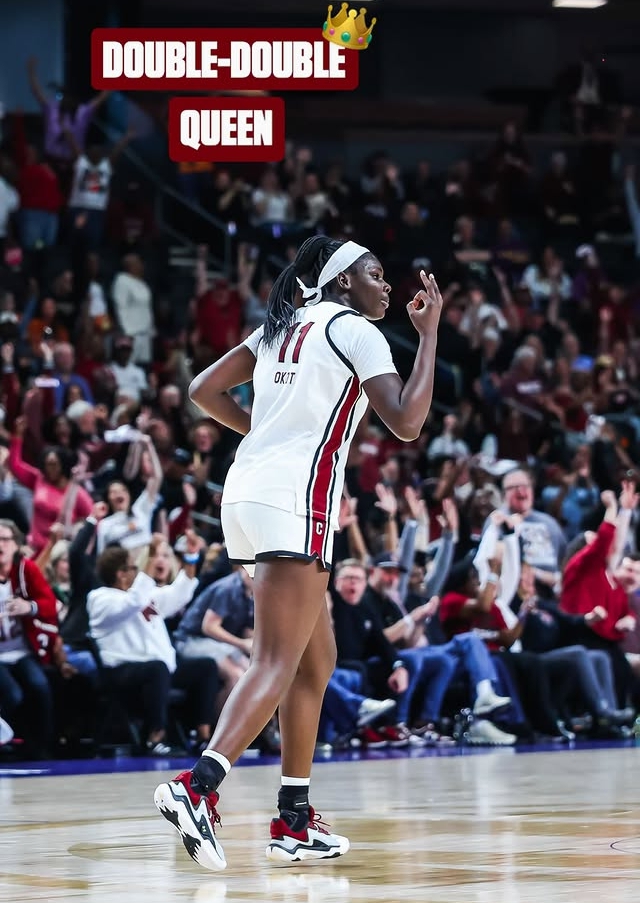
In just two NCAA seasons, Okot ranked third in the country with 22 double-doubles, 16th in rebounding average at 10.6 per game, and 19th in field goal percentage at .575. She was an All-SEC Second Team selection and was the Gamecocks’ top rebounder in 29 of her 39 games — consistency that is difficult to manufacture, especially for someone who has been playing organized basketball for less than a decade.
The most analytically intriguing development of her season at South Carolina, however, was the emergence of a three-point shot. Okot shot an extraordinary 10-for-19 from three since February 19 alone — a sample that made front offices sit up and take notice. For a 6-foot-6 center to develop a credible perimeter game at this stage of her development raises the ceiling of what she could eventually become in the professional game.
Lobo addressed this directly:
“She showed that she has range out to 3, and even though a low volume, can consistently hit it. She’s a rim protector, she can finish inside, certainly brings great size. So I think a lot of teams are really intrigued by her, especially because of her story and how new she is to the game, and what that means about her future potential.”
The profile Lobo describes — rim protector, interior finisher, credible three-point shooter at 6-foot-6 — is precisely the modern frontcourt archetype that every WNBA front office is hunting. The question is never whether Okot has the tools. The question is how quickly she can put them together at the next level.
Where She Could Land
The mock draft landscape paints a consistent picture. Tankathon projects Okot at No. 14 overall , while CBS Sports, USA Today, Sports Illustrated, and Tankathon all have her going to the Atlanta Dream at No. 13, and both ESPN and The Athletic project her to the Connecticut Sun at No. 15. The consensus is clear: late first round, with the debate centered on which specific team pulls the trigger.
The Atlanta projection is an interesting one given that the Dream just acquired Angel Reese in a blockbuster trade and re-signed Allisha Gray to a max-plus deal. Okot alongside that core would give Atlanta one of the most physically imposing frontcourts in the league almost immediately. Connecticut, meanwhile, is a franchise in rebuilding mode that has historically valued interior players and defensive versatility — a natural fit for a player of Okot’s profile.
Lobo acknowledged the structural dynamics of this particular class working in Okot’s favor:
“I would expect somewhere maybe late first round, early second round. This is a draft that is deep in the point guard and wing position and not so much in the post position. So that might help her.”
That scarcity premium is real. The 2026 class is widely regarded as historically deep at guard and wing, which means true post players with Okot’s combination of size, rebounding, and defensive impact are especially valuable by contrast. Swish Appeal In a normal draft, Okot might be competing against several elite centers for the same roster spots. In this class, she is largely without peer in that category.
The Risk and the Reward
No honest assessment of Okot’s draft candidacy ignores the uncertainty. Detailed scouting reports note that her game can be unrefined, and the downside scenario is a player who is unable to overcome her late start and limited reps, ultimately flaming out before realizing her potential. Those are legitimate concerns for any team investing a first-round pick.
But the counterargument is equally legitimate. Former South Carolina standouts like Aliyah Boston and Kamilla Cardoso strengthened their professional trajectories through dominant postseason performances , and Okot has now done the same. More importantly, the rate at which she has developed — from never attempting a three-pointer in her college career to shooting nearly 45 percent from deep in her final season — suggests a learner operating on an accelerated curve.
If Okot is selected in the first round on Monday, she will join a long line of South Carolina forwards drafted early. But unlike most of her predecessors, she may be the one with the largest gap between where she is now and where she could eventually go. That gap is either the biggest risk in the first round — or the biggest opportunity, depending on how a team reads a player who has shown, in just a few years, that the ceiling is almost impossible to define.
About The Author