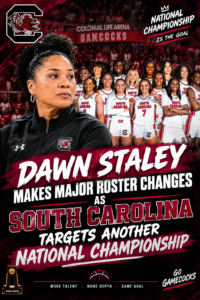
Gamecocks Make History: Raven Johnson, Madina Okot, and Ta’Niya Latson All Drafted in 2026 WNBA Draft

It was a landmark night for South Carolina women’s basketball. Three Gamecocks heard their names called at the 2026 WNBA Draft in New York City, continuing a dynasty that extends well beyond the college game and into the professional ranks.
Raven Johnson — Indiana Fever, Pick No. 10
Raven Johnson was selected by the Indiana Fever with the 10th overall pick in the WNBA Draft on Monday night, becoming the first Gamecock off the board and writing her name into program history in the process. Johnson was the first Gamecock selected on Monday night and became the 23rd Gamecock selected in the WNBA Draft — a testament to the pipeline Dawn Staley has built in Columbia.
Landing in Indiana sets up one of the more fascinating roster storylines of the draft. In Indiana, Johnson will be reunited with former teammate Aliyah Boston. She will also play with former Gamecock Tyasha Harris, whom Johnson says she looked up to as a point guard — a full-circle moment for a player who grew up watching Gamecocks lead at the highest level. And then there is the marquee pairing that will generate enormous attention throughout the season: Johnson will also team up with Caitlin Clark, whom she battled twice in the Final Four. The competitive history between the two adds a compelling layer to what promises to be one of the most watched backcourts in the league.
Financially, Johnson’s selection arrives at a historic moment for the league. The 2026 WNBA Draft is the first draft under the new CBA. Previously, first-round draft picks made about $78,000, while second and third-round picks made less than $70,000 — figures that long undervalued the talent entering the league. The transformation is dramatic. This year, first-round picks will all make at least $289,133 as rookies, more than last season’s supermax contracts were worth. As the 10th overall pick, Johnson is slated to sign a four-year contract worth $1,294,367. It will pay her $289,133 this year and increase each year — a life-changing figure that reflects both her value and the WNBA’s long-overdue economic evolution.
Madina Okot — Atlanta Dream, Pick No. 12
Just two picks later, the second Gamecock was off the board. Madina Okot was selected by the Atlanta Dream with the 12th pick in the 2026 WNBA Draft on Monday night, landing in a city that feels almost tailor-made for her arrival.
The fit in Atlanta makes obvious sense on multiple levels. In Atlanta, Okot will team up with former Gamecock Allisha Gray, giving her an immediate familiar connection within the locker room. From a roster construction standpoint, the timing of her arrival is equally significant — Atlanta lost Brittney Griner in free agency, so the Dream need a big to replace her in the lineup. At 6-foot-6 with elite shot-blocking and rebounding instincts, Okot steps directly into that void.
What makes the fit even more intriguing is the offensive freedom she will be afforded. In coach Karl Smesko’s offensive system, everyone has the green light to shoot, so Okot’s three-point shooting ability should be an asset — a dimension of her game that sets her apart from traditional post players and gives Atlanta a genuine floor-stretching threat from the center position.
Perhaps most uniquely, Okot enters a market primed to embrace her. Atlanta is the closest WNBA team to Columbia, and the Dream draws a lot of Gamecock fans, including Dawn Staley, who is a season ticket holder. The stands in Atlanta may well feel like a home game for the Kenyan-born center throughout her rookie season.
Ta’Niya Latson — Los Angeles Sparks, Pick No. 20
The night’s final Gamecock selection came with a slight twist in the narrative. Ta’Niya Latson was selected by the Los Angeles Sparks with the 20th overall pick in the 2026 WNBA Draft on Monday night. Latson was a projected first-round pick but slid into the second round — a development that will likely serve as motivation for a player who has never lacked for competitive fire.
The destination, however, makes compelling sense. The Sparks need more perimeter playmaking, so it is a good fit for Latson, whose ability to create off the dribble and score at all three levels addresses a genuine roster need in Los Angeles. Perhaps most valuably, she gets to learn from Kelsey Plum, another elite college scorer who had to diversify her game in the WNBA — a mentor whose career arc mirrors the developmental path Latson will need to follow to reach her professional ceiling.
With her selection, Latson was the third Gamecock selected on Monday night and became the 25th Gamecock selected in the WNBA Draft, further cementing South Carolina’s status as one of the premier pipelines to the professional game in the country.
Financially, even as a second-round pick, Latson benefits enormously from the new labor landscape. Under the previous CBA, second and third-round picks made less than $70,000 — a figure that hardly reflected the caliber of player entering the league at that stage. Under the new deal, as the fifth pick in the second round, Latson is slated to sign a four-year contract worth $1,234,790. It will pay her $270,000 this year and increase each year — a figure that would have been unthinkable for a second-round pick just one year ago.
A Dynasty That Travels
Johnson was invited to attend the WNBA Draft in New York along with teammates Ta’Niya Latson and Madina Okot, all of whom were projected to be first-round draft picks — and all three heard their names called on one of the most consequential nights in Gamecock basketball history.
Three players, three different teams, three different cities — but the same South Carolina foundation. Dawn Staley’s program did not just produce WNBA talent on Monday night. It produced Indiana’s newest point guard, Atlanta’s franchise center, and Los Angeles’s next perimeter playmaker. The Gamecocks’ dynasty, it turns out, does not end in Columbia. It is only just beginning.
About The Author