
Small Ball Dynasty Or Traditional Power? Gamecock Fans Are Divided On How Dawn Staley Should Deploy Her Most Talented Roster In Years
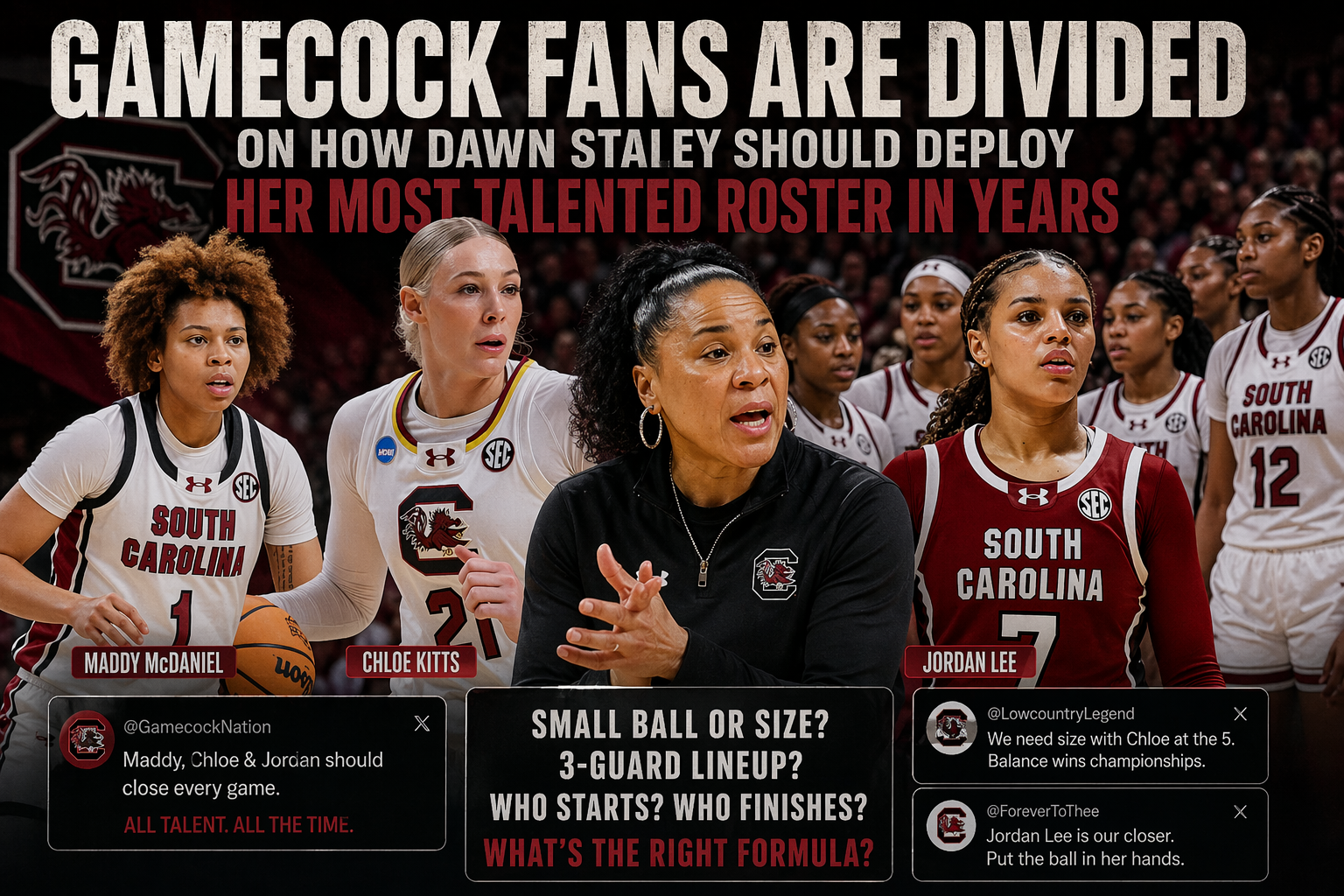
The transfer portal has closed. The recruiting class is set. And South Carolina women’s basketball fans everywhere have arrived at that most dangerous of offseason destinations — too much time, too many opinions, and a roster so loaded that everyone has a different idea of how to use it.
The addition of Jordan Lee from Texas didn’t just give the Gamecocks an elite two-way guard. It ignited one of the most passionate roster debates the South Carolina fan base has had in years. The question dividing locker rooms, fan forums, podcasts, and group chats from Columbia to the rest of the country is deceptively simple:
Does Dawn Staley go small and fast — or big and physical?
Two sides. Both compelling. Both convinced they are right. Let the debate begin.
SIDE ONE: “Go Small, Go Fast, Go Win” — The Small Ball Believers
“This backcourt is too good to waste minutes trying to manufacture a traditional lineup. Just play the five best players and let them eat.”
This is the argument that gets Gamecock fans genuinely excited when they look at what Dawn Staley has assembled in the backcourt. Maddy McDaniel running the point. Tessa Johnson providing senior leadership and floor spacing. Jordan Lee — the No. 2 transfer in the country and ESPN’s self-described best two-way player in the portal — bringing perimeter defense and three-point shooting that opponents simply cannot ignore. Agot Makeer adding another layer of defensive disruption and athleticism. And Jerzy Robinson waiting in the wings with arguably the most physically sophisticated offensive game of any of the six backcourt players competing for minutes.
The small ball argument rests on a foundational truth about this specific roster — the guard depth is historically deep. McDaniel, Johnson, Lee, and Makeer should each log 25 to 28 minutes per game, creating a rotation of constant defensive pressure, floor spacing, and versatility that no opponent can comfortably plan for. When your worst-case defensive lineup is still capable of generating turnovers and scoring in transition, why compromise that by starting a bigger, slower unit?
“Chloe Kitts can slide to the wing in small lineups. Joyce Edwards handles the post against anyone who isn’t a traditional big. We already beat UConn with this approach. Why change it?”
There is genuine tactical merit here. Kitts is a skilled enough shooter and ball-handler to play as a wing in small lineups, which effectively gives South Carolina a five-player unit that can space the floor, switch defensively, and attack in transition simultaneously. Edwards is more than capable of anchoring the post against the majority of opponents the Gamecocks will face in the regular season. And the pace that a guard-heavy lineup generates is precisely the kind of basketball that wears teams down over 40 minutes.
The small ball believers also point to spacing as a non-negotiable priority. Having Johnson and Lee — two legitimate floor spacers — on the court simultaneously creates driving lanes for McDaniel and kick-out opportunities that a floor-clogging traditional center simply cannot provide. In a modern offensive system, that spacing is worth more than size.
“Dawn Staley has never needed a traditional big to win national championships. Why start now?”
SIDE TWO: “This Is The SEC, Not The Playground” — The Traditional Lineup Camp
“You cannot go to war in the SEC and the NCAA Tournament without interior physicality. At some point, someone has to body up against a real post player.”
This is where the other half of the fan base plants its flag — and they have receipts. The honest assessment of South Carolina’s frontcourt, stripped of any wishful thinking, is that Kitts and Edwards are a small starting frontcourt without significant rim protection. Against the majority of regular season opponents, that limitation is manageable. Against the physical, traditional post players that inevitably appear in deep tournament runs, it becomes a genuine vulnerability.
The traditional lineup camp argues that Alicia Tournebize is the answer — and that her development this offseason makes the question of whether to start size far more relevant than it was a season ago. At 6-foot-7 with a full summer in Molly Binetti’s strength and conditioning program behind her, a physically evolved Tournebize represents exactly the kind of frontcourt presence that changes how opponents have to prepare for South Carolina. You cannot small-ball your way past a 6-foot-7 sophomore who can shoot threes, defend the paint, and rebound against SEC bigs.
“Tournebize after a full offseason with Binetti is not the same player we saw last season. If she’s added functional strength, she needs to be starting.”
The traditional camp also makes a compelling case around Adhel Tac and Kelsi Andrews — two players with the physical profiles to provide genuine interior toughness when healthy and available. Tac is a proven rebounder and finisher inside. Andrews, when fully recovered from injury, brings a ceiling that few freshmen in the country can match. Starting with size and bringing impact off the bench — whether that means a healthy Kitts energizing the second unit or Lee providing a scoring punch in relief — gives Staley the kind of lineup flexibility that wins games in March when adjustments matter most.
“What happens when we face a team with a dominant post presence in the Elite Eight? You can’t just hope Jordan Lee defends a 6-foot-4 center for 35 minutes.”
The rim protection argument is perhaps the most difficult one for the small ball side to answer convincingly. South Carolina’s lack of a traditional shot-blocking presence is a known limitation, and no amount of perimeter defensive excellence fully compensates for the ability to deter shots at the rim. The traditional lineup believers argue that accepting that vulnerability from the opening tip of a tournament game is a risk that doesn’t need to be taken if the frontcourt depth is developed properly.
THE WILD CARDS THAT COULD SETTLE THE DEBATE
Both sides of this argument share one important acknowledgment — there are two roster questions that could fundamentally change the calculus before the season even tips off.
Ashlyn Watkins. Technically not yet confirmed on next season’s roster, Watkins’ potential return would immediately transform the frontcourt picture and make the traditional lineup argument dramatically more compelling. A player of her athletic profile and defensive versatility at the five position gives Staley something she currently doesn’t have — a genuine rim protector who can also operate in small lineups without sacrificing pace or spacing.
Jerzy Robinson’s adjustment curve. The freshman may carry the most sophisticated offensive game and the most physical profile of any backcourt player on the roster. If she adjusts to the college game faster than expected — which Dawn Staley’s track record of developing freshmen immediately suggests is entirely possible — Robinson’s presence could make the small ball argument even more irresistible by adding another layer of offensive diversity that opponents simply cannot account for.
WHAT DAWN STALEY WILL ACTUALLY DO
Here is what both sides of this debate ultimately agree on, even if they won’t admit it in the middle of an argument:
Dawn Staley is going to do whatever Dawn Staley decides is right — and her track record suggests she will do it better than either side of this fan debate has fully imagined.
The most likely outcome is that Staley deploys both approaches situationally — starting small against teams where pace and spacing are the primary weapons, shifting to a more traditional look against physically dominant opponents, and using her extraordinary depth to keep every player fresh and every opponent constantly guessing.
That is, after all, what separates this program from the rest. It is not just the talent. It is the coaching intelligence to deploy that talent in the way that each specific opponent is least equipped to handle.
Small ball believers and traditional lineup advocates are both right about one thing — this roster, deployed correctly, is capable of winning a fourth national championship.
The rest is just details.
And Dawn Staley has always been very, very good at details. 🏀
About The Author