When I first laid eyes on this portrait, I had to stop.
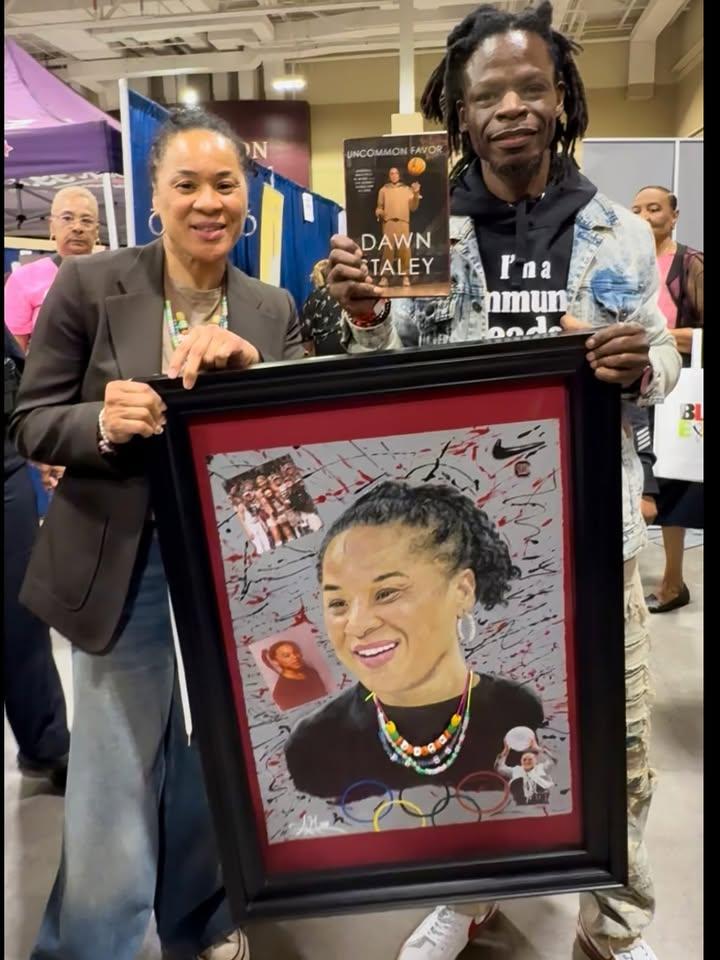
Not because of the technical execution — though that alone is worth celebrating — but because of what the artist chose to say without using a single word. This isn’t just a painting of Dawn Staley. This is a visual biography of one of the most complete figures American sports has ever produced, compressed into a single framed canvas and presented to her by a fan whose devotion runs deep enough to create it with his own hands.
Let me walk you through what I see.
The Face at the Center
The focal point of the portrait is Staley herself — younger, radiant, wearing a black top and a multicolored beaded necklace that immediately signals something intentional. This isn’t the Dawn Staley we see prowling the sideline in a blazer. This is Dawn Staley the athlete — the Philadelphia-born point guard who took the basketball world by storm before she ever picked up a clipboard.
The smile is telling. It’s not the competitive intensity we associate with her coaching persona. It’s something warmer and more personal — a reminder that before the championships, before the press conferences, before the program building, there was a young woman who simply loved the game and was extraordinarily gifted at playing it.
The Olympic Rings: A Career Defined by the Highest Stage
Positioned prominently at the bottom of the portrait are the Olympic rings — and their placement is no accident. The artist is making a deliberate statement: that Staley’s greatness cannot be understood through college basketball alone.
Staley represented the United States in three Olympic Games — Atlanta 1996, Sydney 2000, and Athens 2004 — winning gold medals in all three. As a player, she was one of the defining guards of her generation, a fierce competitor whose floor vision and leadership made the U.S. women’s national team functionally unbeatable during that era.
But the rings carry a second layer of meaning. In 2024, Staley returned to the Olympic stage — this time as head coach of Team USA in Paris. She led the Americans to yet another gold medal, cementing her status as not just a great basketball mind but one of the greatest ambassadors the sport has ever had, on either side of the coaching divide.
The Olympic rings at the base of this portrait are the foundation. They are the artist saying: everything else was built on this.
The Team Photo: The Championship Chapter
In the upper left corner of the canvas, the artist has embedded what appears to be a team photograph — a visual reference to the collective achievement that has defined Staley’s coaching career at South Carolina.
This is where A’ja Wilson enters the story. Wilson, who arrived in Columbia as a McDonald’s All-American and left as one of the most decorated players in program history, was the cornerstone of South Carolina’s 2017 national championship — the first in program history and the breakthrough moment that announced Staley’s program to the country on the biggest possible stage.
Their relationship transcended the typical coach-player dynamic. Staley recruited Wilson when others overlooked her, developed her into a consensus national player of the year, and watched her become the No. 1 overall pick in the WNBA Draft. Wilson has spoken openly about Staley’s influence on her development — not just as a basketball player, but as a person and a leader.
The championship photograph embedded in this portrait isn’t just a trophy moment. It’s a reminder that Staley builds people, not just rosters.
The Nike Presence
Look closely at the portrait and you’ll spot the Nike swoosh — subtle, but deliberately placed. It’s an acknowledgment of one of the most significant brand relationships in women’s basketball.
Staley has been a Nike athlete for decades, first as a player and then as a coach. But in recent years, that relationship has taken on new cultural weight. As women’s basketball has experienced an unprecedented surge in visibility and commercial interest, Staley has been at the center of it — a figure whose personal brand aligns seamlessly with Nike’s positioning around excellence, authenticity, and community impact.
The Nike affiliation in this portrait isn’t just a logo. It’s a symbol of the commercial recognition that Staley’s influence has earned — recognition that extends far beyond Columbia, South Carolina, and speaks to her standing as one of the most marketable and respected figures in all of American sport.
The Man Behind the Canvas
What makes this moment as powerful as the portrait itself is the story surrounding it. This fan — wearing a hoodie that reads “I’m a Community Leader” — didn’t buy Staley a gift. He made her one. He invested his time, his skill, and his genuine love for a coach who has meant something real to his community, and he brought it to a conference where Staley was signing copies of her book, Uncommon Favor.
She signed his copy. He gave her his portrait. Two people, connected by a shared story about what Dawn Staley represents to the people of South Carolina and beyond.
The Final Word
This portrait is a love letter written in paint. It captures Staley as an Olympian, a champion, a brand, and a human being — all at once, all on the same canvas. The artist didn’t have access to a press credential or a courtside seat. He had brushes, paint, and fifteen years of watching a woman build something extraordinary.
The result is a portrait that says what statistics cannot: that Dawn Staley’s legacy isn’t just measured in wins. It’s measured in the people she’s moved deeply enough to create something with their own hands and give it away for nothing in return.
That’s Uncommon Favor — in every sense of the phrase.