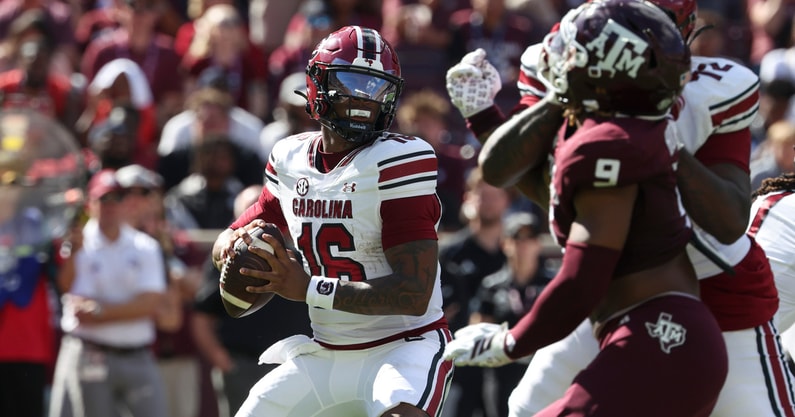
When South Carolina dismantled UConn 62-48 in the Final Four, the story should have been straightforward — the Gamecocks were the better team, dominant in the second half, and earned their place in the national championship game. Instead, the dominant narrative walking off the court in was Geno Auriemma’s conduct in the final seconds, and the ESPN analysts who covered the game weren’t willing to let it pass without comment.
What Happened on the Court
With the outcome no longer in doubt, Auriemma approached the midcourt handshake line just before the final buzzer. What followed was anything but routine. He confronted Dawn Staley directly, an exchange that quickly turned heated. When it was over, Auriemma walked off the court without shaking a single South Carolina player’s hand — an extraordinary breach of the postgame protocol that coaches at every level model for their players.
The confrontation didn’t emerge from nowhere. It was the culmination of a pattern of behavior throughout the game that ESPN’s analysts found deeply troubling.
The Auriemma Incidents: A Timeline of the Night
Before the fourth quarter, during a sideline interview with ESPN’s Holly Rowe, Auriemma made two notable claims. He suggested the Gamecocks had torn UConn star Sarah Strong’s jersey, and he publicly criticized Staley’s interactions with the referees — doing so in a live televised interview while Staley had no platform to respond.
Both moves drew sharp rebuke. On the jersey issue, Strong herself appeared to acknowledge after the game that the tear was self-inflicted, not the result of South Carolina’s play. On the sideline interview, Chiney Ogwumike had a pointed reaction:
“Secondly, he called out Dawn Staley in his interview at the end of the third quarter. I’ve never seen a coach do that, especially with this magnitude and on this stage. I have never seen a coach call out another coach when the other coach can’t hear them.”
It was a calculated sequence — make a public accusation, on national television, when the accused has no immediate ability to respond. Whatever the intent, the effect was to put Staley on the defensive in the middle of the biggest game of the season.
Ogwumike: Respect the Legacy, Reject the Behavior
Chiney Ogwumike, speaking during the halftime of the UCLA-Texas game that followed, didn’t flinch. She opened by acknowledging Auriemma’s place in the sport before making clear that his stature changes nothing about the accountability he deserves:
“I say this, respecting the fact that Geno is the winningest coach in college basketball history. His behavior does not sit well with me. Actually I find it quite problematic.”
She walked through both incidents methodically — the Strong jersey allegation and the live interview criticism of Staley — before landing on what was perhaps the most incisive point of the night:
“I understand emotions are running high, but he put Dawn in a position where she always has to take the high road.”
That line deserves to sit with people for a moment. It speaks to something that extends well beyond one game. When false allegations are made publicly and criticism is leveled at a coach who cannot immediately defend herself, the burden of composure and restraint falls entirely on the person being attacked. It’s an unfair dynamic — and Ogwumike named it precisely.
WATCH HERE👇
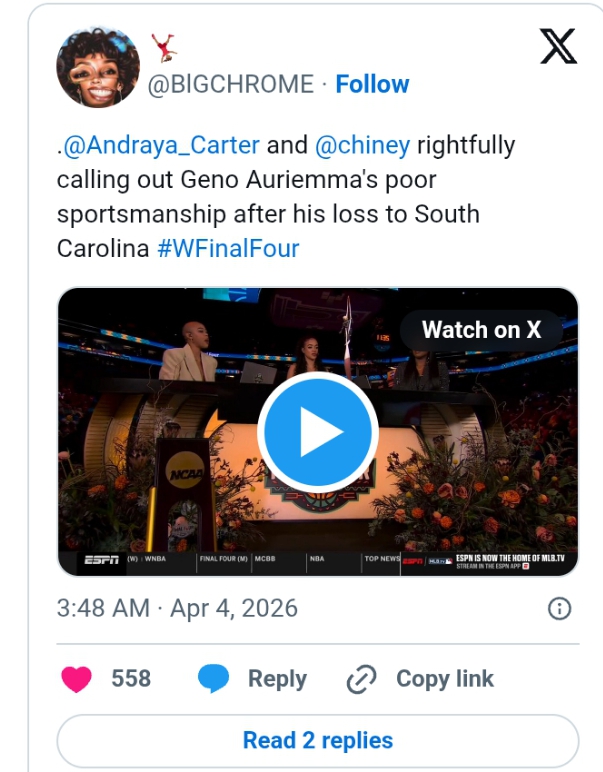
“Watching Geno Auriemma — and he is one of the greatest coaches we have ever seen — but I don’t like the behavior I saw. I know it is a tough night, but that shouldn’t happen.”
Carter: Was It Strategic?
Andraya Carter offered a more unsettling interpretation. Rather than reading Auriemma’s conduct as emotional or impulsive, she suggested it may have been deliberate — a mechanism for redirecting the story away from his team’s performance:
“To me, it almost feels like because it’s so bad and it’s so out of line, it almost feels like it was on purpose — because the fact is his players got outplayed the entire game. His players were outplayed. South Carolina’s players played better, but what are we talking about? Geno Auriemma against Dawn Staley. We’re taking attention off the game where South Carolina dominated to talk about Geno’s behavior.”
Carter’s reading is hard to dismiss. UConn’s 48-point total was the program’s lowest in a tournament game since losing to South Carolina in the 2022 national championship. The Huskies, the No. 1 overall seed entering with an unblemished record, were outplayed comprehensively. If you wanted to change the subject, this would be the night to do it.
Whether the behavior was calculated or reactive, the effect was identical — the Gamecocks’ dominant performance was buried beneath the postgame controversy.
Lobo: The Weight of History
Perhaps the most emotionally resonant voice on the night belonged to Rebecca Lobo, a former UConn player under Auriemma from 1991 to 1995, and someone with a uniquely personal understanding of who he is as a coach. She wasn’t angry, exactly — but she was clearly wounded by what she witnessed from her former mentor:
“Geno Auriemma, this is his 25th Final Four. Thirteen times he has gone out without a championship, and every other time he has lost with class. … It’s frustrating to see what transpired at the end of that game.”
The implicit message in Lobo’s words is significant: this was not who he has been for most of his career. Twenty-five Final Fours. Thirteen exits without a title, each handled with the kind of grace that defines a program’s character. Which makes what happened on Friday night not just a bad moment, but a departure from a standard he himself established over decades.
A Broader Reckoning
The reaction from analysts and public figures — from Ogwumike and Carter on ESPN to Stephen A. Smith, Lisa Leslie, and Jalen Rose on social media — reflects something important. The unanimity of the criticism, cutting across platforms and voices with no particular stake in either program, suggests this was not a close call.
Geno Auriemma has built one of the most decorated coaching careers in the history of American sport. That legacy is real and it is earned. But a legacy is not a shield. It is not a reason to lower standards or absorb behavior that would draw immediate condemnation from any coach without an 11-title résumé. If anything, the expectation should run in the opposite direction — those who have benefited most from the sport’s platform carry the greatest responsibility to model what it means to compete and lose with dignity.
South Carolina won. They won clearly, convincingly, and on merit. That was the story. For one night, at least, it got buried. The analysts who refused to let that happen did exactly what good sports journalism is supposed to do.