Dawn Staley After the Blowout: Joy, Accountability, and a Warning to the Bracket
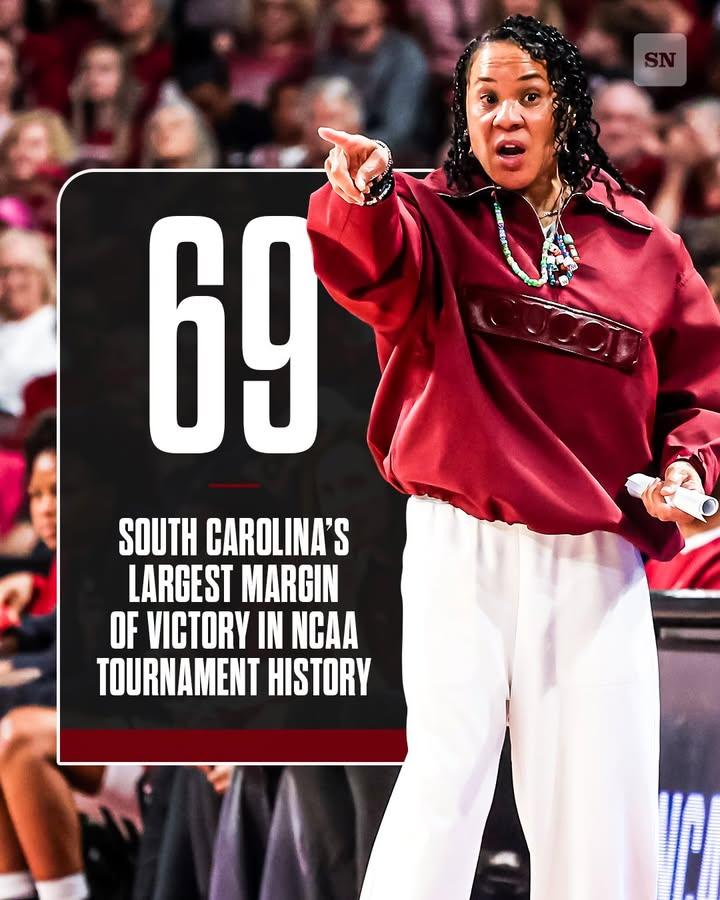
A 69-point victory tends to generate celebratory press conferences. Dawn Staley’s postgame session after South Carolina’s 103-34 dismantling of Southern was something more layered than that — part coach’s analysis, part life philosophy, part comedy, and ultimately a sober warning to every team remaining in the Sacramento Regional.
Respect for the Opponent, Honesty About the Gap
Staley opened by doing something that has become a hallmark of her public presence: she refused to diminish the opponent, even in a record-setting blowout.
“I thought Southern did a really good job of defending and doing the best that they can against our team. They are a well-coached basketball team on both sides of the basketball,” Staley said. “I like to say, when we were in [Southern’s] position, we used to get out-talented. I thought they got out-talented tonight. Nothing against the effort that they put out there on the floor.”
The framing is deliberate and telling. By invoking South Carolina’s own past — when the Gamecocks were the outmatched program absorbing similar beatings from more talented rosters — Staley contextualizes the result without sanitizing it. The talent gap was real. Southern competed with effort and structure. Those two things are not mutually exclusive, and Staley articulated that with the precision of someone who has lived both sides of the equation.
On Ta’Niya Latson’s Moment — and Playing to the Room
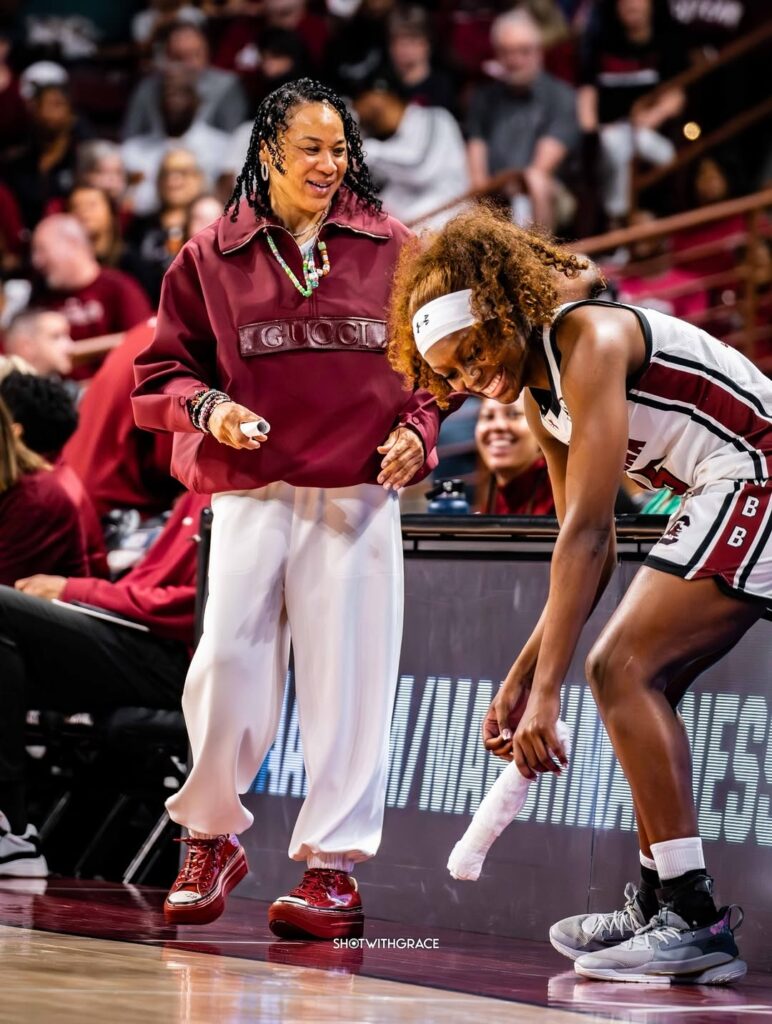
One of the evening’s signature moments came when Ta’Niya Latson delivered a behind-the-head pass to Joyce Edwards that brought the crowd to its feet. Staley’s reaction was equal parts appreciation and pragmatism.
“Ta’Niya has done it before, and probably to Joyce. It’s just players out there playing, just feeding off the moment. But I don’t think they do it in a — I don’t think Ta’Niya does it in a gym that’s not full of people. I think she played a little bit to the crowd,” Staley said. “It was just another play for me. I’m glad we didn’t turn it over.”
That final line is the most revealing. Staley can appreciate the spectacle while remaining anchored to the outcome. A no-look pass that draws gasps is only valuable if it results in a basket, and for a coach who has spent years conditioning her point guards to operate with calm and precision, the instinct to measure a highlight by its result rather than its aesthetics is deeply ingrained. The crowd loved it. Staley was relieved it worked.
Body Confidence, Dove, and the Weight of Personal Experience
Perhaps the most candid stretch of the press conference came when Staley was asked about her partnership with Dove and The Game is Ours campaign — an initiative centered on reclaiming confidence for women athletes. Her answer went somewhere personal immediately.
“I was a recipient of body shaming when I was growing up. Obviously, I’m short. I’ve got big shoulders. I got a big head. I got big hands. I got big feet. When you’re growing up as a girl, you’re called many different names, and you have to be stronger in situations,” Staley said.
She then connected the personal to the professional, citing Raven Johnson as a specific example of how the dynamic plays out at the elite level.
“Raven doesn’t like her arms. She’s got great arms. Are they muscular? Yes. But in order for her to play at the level she has to play, she has to have them. And I got the most compliments when I did have arms. So you have to combat some of the things that are being said about women athletes who have to do certain things in order for them to compete at a high level,” Staley said.
The throughline here — from a Hall of Fame player’s childhood to her current star’s relationship with her own body — is that the pressures placed on women athletes don’t disappear with success. They evolve. Staley’s decision to engage publicly with those pressures, rather than deflect them, reflects a coaching philosophy that extends well beyond the basketball court.
She then reached for a Butchered Biggie Smalls reference to land the point — “I’m not only a player, but I’m a player’s president, or something like that” — before admitting mid-quote that she had the line wrong. When corrected afterward that the actual quote was “I’m not only a client, I’m the player’s president,” Staley responded with characteristic humor: “Hey, I need y’all to edit. Cut, paste, put it in there. I don’t know what I was saying earlier. I was close, though.”
She was not close. But the point landed anyway.
Madina Okot: Working Through the Hard Way
One of the more quietly significant storylines of South Carolina’s season has been Madina Okot’s battle with homesickness, and Staley addressed it with the kind of measured empathy that defines how she approaches player development holistically.
“Madina has worked harder than she’s probably ever had to work. When you’re in that situation, you miss the comforts of your family and your friends. When you’re working your hardest and feel like you can’t go anymore, you need a little bit of home cooking in order for you to make it through,” Staley said.
But she was clear that the support structure only goes so far — and that the growth has to come from within.
“We can hold their hands, but they’re going to have to step through the moment,” Staley said.
Okot played just 17 minutes Friday, picking up early foul trouble, and still nearly posted a double-double. Staley read that performance as a direct reflection of what Okot has built through adversity. “I think when she was going through it, maybe she doesn’t come back and get close to a double-double. But you see she’s working through.” The implication is clear: the difficult months weren’t just something to endure. They built something.
On Point Guards, Parenting, and Letting Go
Asked about her history developing elite point guards — fitting, given her own Hall of Fame playing career at the position — Staley outlined the qualities she looks for with uncommon specificity.
“One, they’re super competitive. Two, they’re coachable. You’ve got to understand that we’re preparing them to handle the very worst in the situation. So we’re trying to familiarize them with situations that, when they arise, they’ve already been through it,” she said.
She acknowledged freely that she holds point guards to a different standard than any other position on the floor.
“Oh, for sure. It’s a position in which, if everything goes right, they get all the praise. If everything goes wrong, it’s their fault. And you have to condition them to believe that,” Staley said.
The parenting analogy she reached for was the most illuminating part of her answer.
“When you allow your children to grow up, it is a direct reflection of your parenting. Direct. If you hover over them all the time and they can’t work through problems, they’re going to have issues. You’ve got to let them work through problems because they’re working through the things you’ve instilled in them. That’s the same thing with point guard play for us.”
It is a philosophy of deliberate release — of building a player thoroughly enough that you can trust them to execute under pressure without your hand on their shoulder. For a program that has consistently produced elite guards, it is clearly more than theory.
The Real Message: This Bracket Is Not Safe
The press conference’s most pointed moment came when Staley was asked how she views first-round games. Her answer began as a halftime anecdote and sharpened into something resembling a direct warning to the bracket.
“We’ve got to find a way to elevate our play to play on the scale of — because we’re going to get everybody’s best. No matter what, we’re going to get everybody’s best. We shouldn’t have to get a wake-up call in the first quarter or the second quarter, third quarter, fourth quarter to say, ‘Hey, you’ve got to really play now,'” Staley said.
She had watched the other teams in the regional at halftime — Oklahoma, Michigan State, Iowa, Clemson — and she named them by name to her team. The message was not subtle.
“I mentioned all of those programs that are part of our region so they can understand that there’s a level of basketball being played out there, and if we’re not playing at that level, then we’re going to get sent home early.”
A 69-point win, and the coach is already dissatisfied with the first-half performance. That is the standard Staley has set in Columbia — and it is a standard that has produced five consecutive Final Fours.
The bracket has been warned.