7,700 Miles From Home: How Raven Johnson Helped Madina Okot Find Herself — and How South Carolina Found Another Gear
COLUMBIA, S.C. — The statistics told one story. The real story was happening behind closed doors, 7,700 miles from where Madina Okot grew up.
The numbers were jarring enough on their own. A player averaging a double-double — 14.8 points and 10.9 rebounds — suddenly producing 8.4 points and 6.4 rebounds over a five-game stretch in late January. A player who had started 18 consecutive games finding herself on the bench against Vanderbilt, Auburn and Texas A&M. A player Dawn Staley had trusted as a cornerstone of her frontcourt visibly struggling under the weight of something that had nothing to do with basketball.
But what was really happening had roots in Mumias, Kenya — and the distance between there and Columbia, South Carolina is not just a number on a map.
The Weight of Distance
Mumias is a town of roughly 100,000 people on the east side of Africa. Getting from there to Columbia requires more than 20 hours in the air. For Madina Okot — who arrived at South Carolina after one season at Mississippi State, having left Kenya sometime in 2024 — that distance was never just geographical. It was emotional, daily, and at times overwhelming.
Last summer, in her first interviews with local media, Okot was moved to tears when asked how long it had been since she last saw her parents and seven siblings. The answer said everything.
What the public didn’t fully know was how frequently that weight surfaced throughout the season. Okot’s roommate — South Carolina veteran guard Raven Johnson — saw it up close, from the very beginning.
“In the summer, she was crying her butt off, saying she didn’t want to be here, she wanted to go back to Kenya, her hometown,” Johnson said during the SEC Tournament.
That is the context behind what looked, from the outside, like a simple on-court slump. Staley acknowledged during the rough stretch that Okot was “going through it” mentally — that this was “unfamiliar territory for her regarding big stakes, big game, everybody’s watching.” What she was describing, without naming it explicitly, was a player trying to compete at the highest level of college basketball while carrying a homesickness that would have broken most people’s focus entirely.
“This is unfamiliar territory for her regarding big stakes, big game, everybody’s watching,” Staley said. “So it takes some time to get used to.”
The Sister Who Showed Up
What makes Okot’s story more than a redemption arc is the person standing at the center of it.
Raven Johnson didn’t just encourage her teammate from a distance. She showed up — literally — at Okot’s door, repeatedly, throughout the season. When Okot went quiet and retreated into her room, Johnson came anyway.

“Most of the time when I feel bad, or maybe when I’m homesick, I just want to be in my room by myself, maybe talk to my family,” Okot said. “She feels like I’m so lonely, and she doesn’t like it when I feel that way so she used to come to my room — and she’s still doing it — to make sure I’m good, make sure I have everything that I need. Trying to keep myself busy, maybe watching movies, watching games, trying to ask me what I want, and she’ll provide it.”
That kind of care — patient, consistent, and completely unconditional — is not something that can be coached. It is a reflection of Johnson’s character, and it speaks to something deeper about what South Carolina’s program culture actually looks like when the cameras aren’t on.
Staley recognized it immediately for what it was — not just friendship, but a direct investment in the team’s championship potential.
“I think Raven is probably one of the main reasons why Madina’s hurdled what she hurdled,” Staley said. “Because she lives with her. It’s her big girl. Raven knows that in order for us to win championships, regular season, whatever, she has to be a big part of it, and she has to play better than what she was playing.”
For Okot, the relationship has become something that transcends basketball entirely.
“She’s more than a teammate. She’s like a sister to me,” Okot said. “I just have been going through a lot of things outside basketball, but she’s been there. She’s been present. She’s been there to listen, give advice whenever needed.”
“I’m Back”
When Okot returned to the starting lineup on February 5 against her former team Mississippi State, the statement she made wasn’t verbal — it was statistical. Ten points and 10 rebounds. Her first double-double in nearly a month.
Three days later, against Tennessee, she posted 10 points and 16 rebounds in a 93-50 rout.
“I’m back,” Okot declared.
She wasn’t exaggerating. What followed was one of the most dominant individual stretches by any frontcourt player in the country this season. Seven consecutive double-doubles to close the regular season. Averages of 16 points and 14.1 rebounds during that run. A field goal percentage of 58.5 percent. Two performances of 20-plus points. Four games with 15 or more rebounds.
“It always makes me feel really good, like almost emotional when you see a young person go through some stuff and they really can’t see their way out of it,” Staley said. “But you just continue to work with them. ‘Hey, you’re going to hurdle this. You’re going to get through’ just each and every day. You take the pressure off, and then you apply the pressure.”
That push-and-pull — relieving pressure while simultaneously demanding growth — is Staley’s coaching philosophy at its most precise. And Okot’s response to it, once Johnson had helped stabilize her emotionally, was exactly what the program needed.
The Postseason Proof
If anyone needed evidence that the Johnson-Okot bond had moved from off-court emotional support to on-court competitive chemistry, the SEC Tournament semifinals against LSU provided it in real time.
Okot struggled in the first half. One shot made in five attempts. Two points. The kind of start that, in January, might have spiraled. But Johnson didn’t let it.
“I had been trying to make layups the whole game and they weren’t going in,” Okot said. “It’s just about my teammates encouraging me. She was like, ‘No, I’m not gonna stop giving you the ball. When you’re free I’m giving it to you. Go to work.'”
Johnson was literally audible on the court — yelling “Shoot it! Shoot it!” — refusing to allow Okot to retreat into hesitation. The result: eight points and 13 rebounds, with a pair of game-icing layups in the final minutes that effectively sealed the win over LSU.
The player who passed Okot the ball immediately before both of those buckets was Johnson.
It was, in its own way, the entire story of their season compressed into two possessions.
“I think Madina just needs to trust her ability,” Johnson said after the game. “When you’re not seeing the ball go through, keep shooting. When she’s open, shoot it. She can shoot the ball.”
What It Means for March
Okot’s 21 double-doubles this season rank third in the nation. In the context of what South Carolina lost with Ashlyn Watkins sitting out and Chloe Kitts tearing her ACL in October, that production isn’t just impressive — it has been essential to the Gamecocks maintaining their standing as a No. 1 seed.
A frontcourt anchored by Okot and Joyce Edwards gives South Carolina one of the most physically imposing interior combinations in the tournament. But what makes Okot’s presence truly valuable isn’t just the rebounding or the post scoring — it’s the fact that she found a way through, when finding a way through required more than basketball skill.
Johnson’s assessment of where her teammate now stands is simple and unambiguous.
“I think everything that she deserves, she’s getting it. A double-double every night? I mean, that’s big. That’s big. I think she’s the best big in the country. Like she said, she’s back, and we see it.”
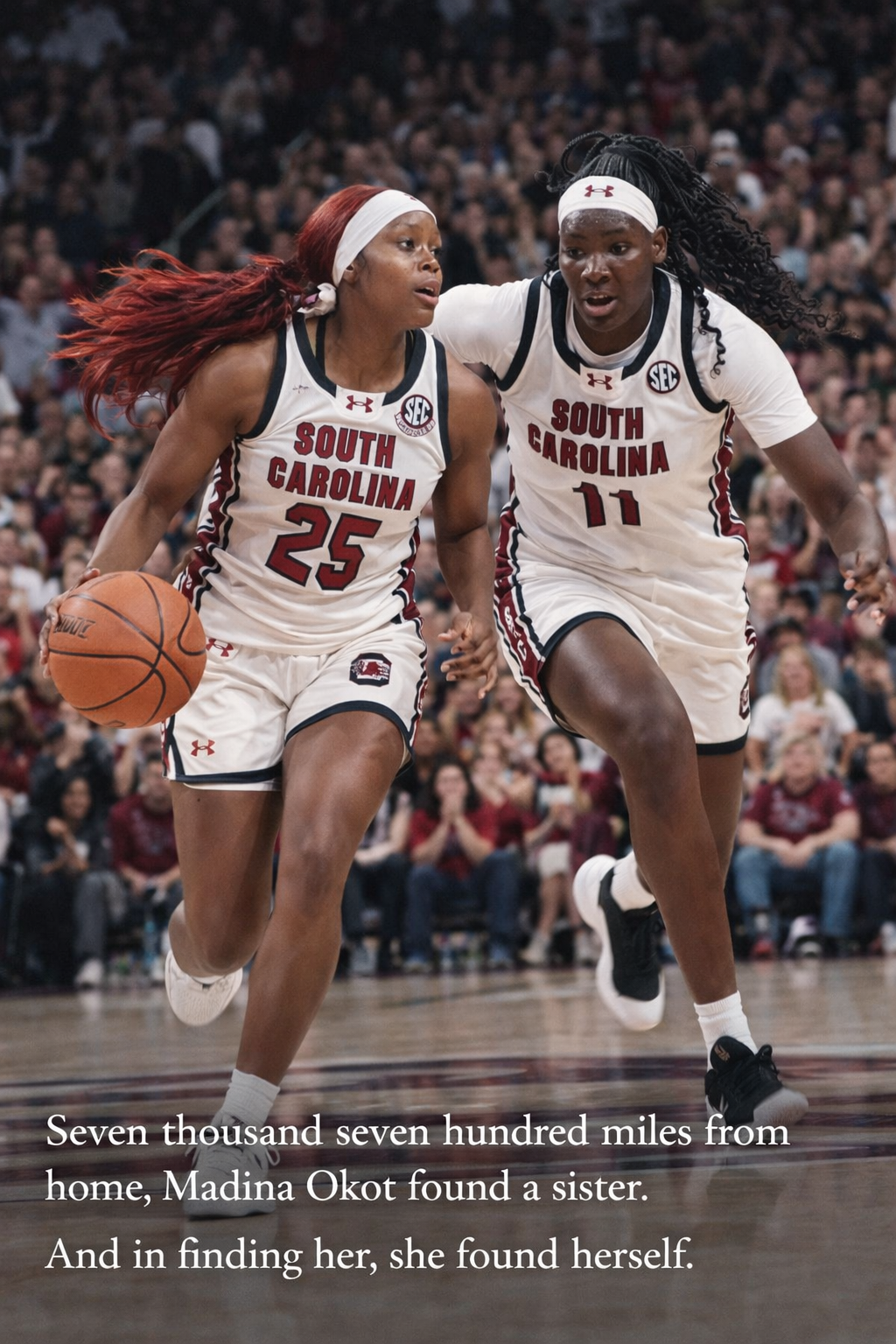
Seven thousand seven hundred miles from home, Madina Okot found a sister. And in finding her, she found herself.
South Carolina found another gear in the process.