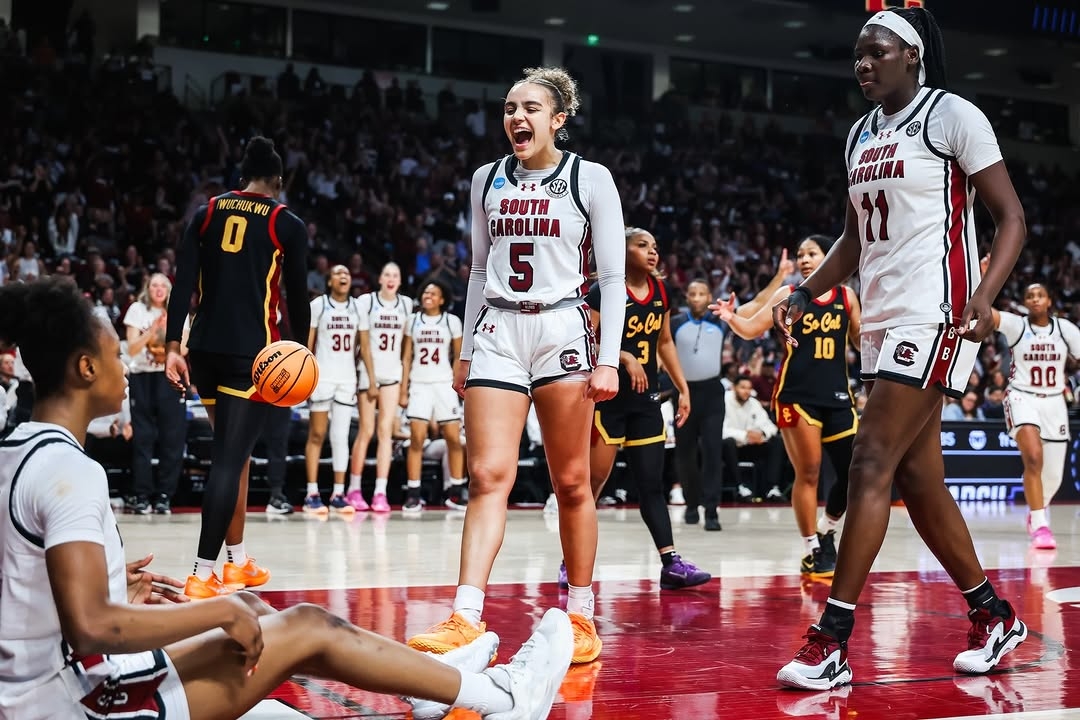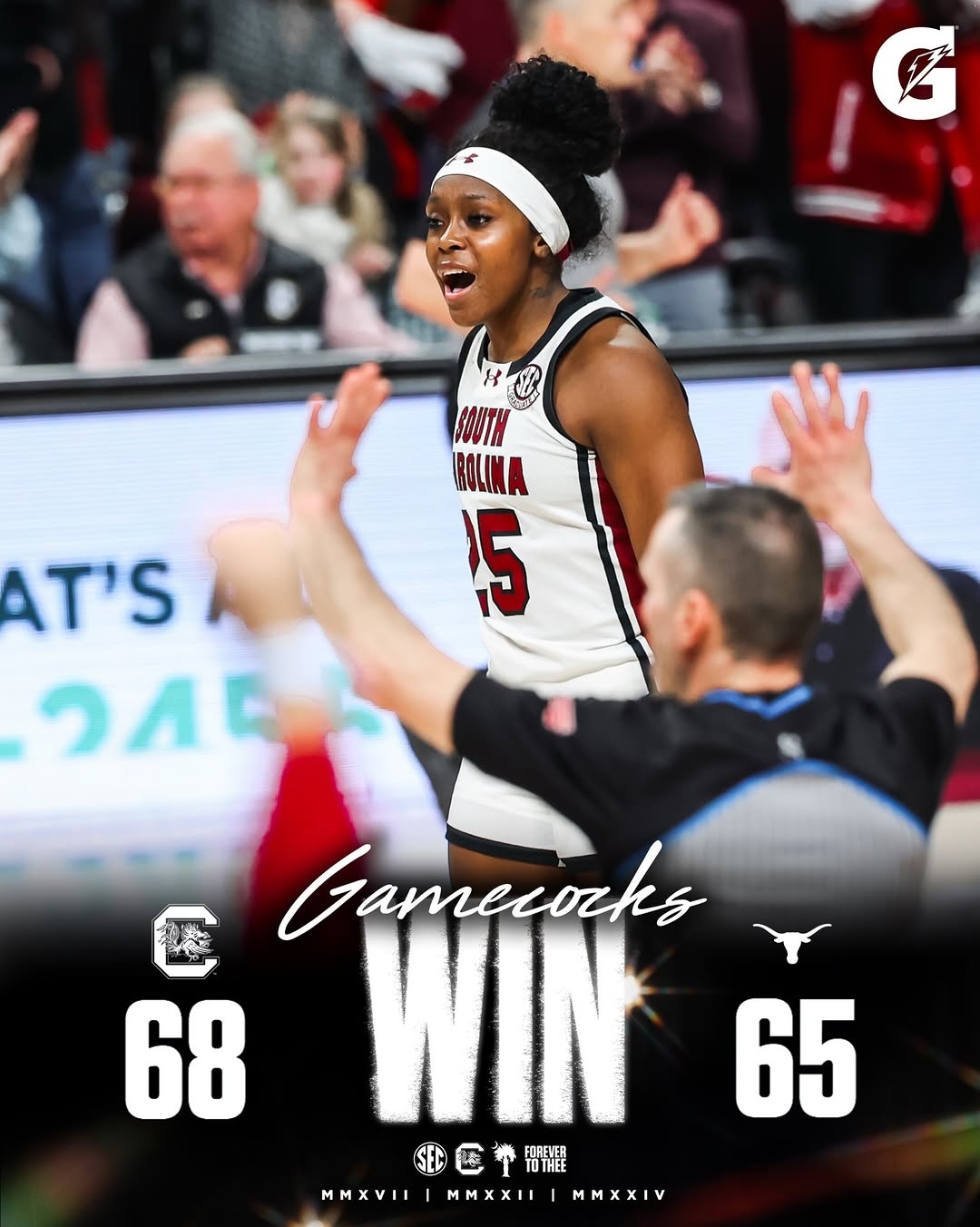
When South Carolina and TCU clash in the Elite Eight on Monday, the most compelling subplot won’t be found in the frontcourt — it will play out between two players who arguably represent the pinnacle of the point guard position in women’s college basketball today: Raven Johnson and Olivia Miles.
Both are finalists for the Nancy Lieberman Point Guard of the Year Award, and their head-to-head matchup has rightfully drawn attention as one of the most anticipated individual duels of the tournament. TCU head coach Mark Campbell put it plainly:
“They’re two of the best point guards in college basketball, I think they’re two of the top five point guards in college basketball. They’re both old veterans that have been doing this at an elite level. They go about their games and they go about impacting winning differently, but they’re both incredible at what they do… What a great match-up at the point guard position between those two players.”
Campbell’s framing — that they “impact winning differently” — is the critical analytical lens through which this matchup must be understood. These are not mirror images of each other. They are distinct player archetypes whose contrasting styles will force both coaching staffs to make real tactical adjustments.
Olivia Miles: The Complete Package
Few players in the history of women’s college basketball have done what Olivia Miles has done this season. In her fifth collegiate year — her first with TCU after four seasons at Notre Dame — Miles hasn’t just performed well. She has dominated statistically in a way that stretches the imagination.
Her season averages of 19.6 points, 7.3 rebounds, and 6.6 assists make her one of the most well-rounded offensive forces in the country. More striking still, she leads the nation with six triple-doubles — a figure that speaks less to luck and more to the systematic, repeatable nature of her dominance.
In the NCAA Tournament alone, Miles is averaging 19.3 points, 12 rebounds, and 10 assists, effectively delivering a triple-double average across the bracket. Her opening-round performance against UC San Diego — 12 points, 14 assists, and 16 rebounds — bordered on the surreal. While she fell just two assists short of triple-doubles in both the second round and Sweet 16, the fact that she was that close in consecutive games underscores how consistently she operates at that level.
What makes Miles genuinely difficult to defend isn’t just her scoring — it’s the way her passing elevates everyone around her. Raven Johnson, who will likely carry the primary defensive assignment, recognized this quality immediately:
“She’s a great point guard. I think she don’t look just for herself. She look for others. She knows how to assist to people. She knows where they like the ball. I think that’s why she does a really good job.”
South Carolina head coach Dawn Staley expanded on that point, identifying Miles as a multiplier for her teammates:
“Olivia Miles changes things for them. She’s obviously a scorer, playmaker, so she can do a lot with the basketball. She definitely puts her players in positions of being able to probably do a little bit more than what they normally do because of her ability to pass the ball.”
This is the essence of Miles’s threat. She doesn’t just create for herself — she manufactures advantages for teammates who might otherwise be only average contributors. That makes her almost impossible to neutralize through conventional man-to-man defense.
South Carolina’s Defensive Answer: Collective, Not Individual
Faced with the challenge of slowing one of the most dynamic players in the country, Staley was refreshingly candid about the limits of any one-player solution:
“It’s a collective. I mean, obviously we’ve got an elite defensive point guard in Raven Johnson, who I’m sure will want to match up with her. But you do it by committee, and you do it as a collective.”
This is sound strategic thinking. Assigning Miles entirely to one defender — even one as accomplished as Johnson — risks defensive breakdowns the moment Miles shifts gears or attacks a mismatch. By deploying rotating looks, South Carolina aims to prevent Miles from settling into a rhythm.
Johnson herself echoed that philosophy:
“For us it’s going to be a team effort — just different rotations on her, different looks, throwing different punches at her. And I think we’re going to practice that today.”
Perhaps the most tactically interesting perspective came from Ta’Niya Latson, Johnson’s backcourt partner, who has faced Miles in ACC competition. Latson’s scouting report cuts to the heart of what makes Miles vulnerable:
“She likes to play at her own pace. Obviously, she’s a great passer. So try to deter her passing and make things hard for her. She’s a great player. She’s a pro. I have to give credit where credit is due. And I feel like she’s going to go out there and play her best, but I know we’re going to make things hard for her.”
Latson’s insight — that disrupting Miles’s tempo and passing lanes is more effective than simply trying to outscore her — reflects a mature defensive understanding. A player averaging triple-double numbers lives and dies by controlling pace. Force her into a faster, more chaotic game, and her efficiency may suffer.
Raven Johnson: Defense First, But No Longer Only Defense
For much of her career at South Carolina, Raven Johnson has been celebrated as one of the premier defensive guards in the country — a reputation cemented this season when she was named the SEC Defensive Player of the Year and earned Third-Team All-American honors. Her ability to disrupt opposing offenses has been central to the Gamecocks’ identity.
But reducing Johnson to her defense alone in 2025 would be a significant analytical oversight. This season, she has taken a meaningful leap offensively, posting career highs across the board: 10.2 points per game, 50.7% from the field, and 40.6% from three-point range. For context, those shooting percentages suggest a player who has become a genuine scoring threat — not merely someone defenses can ignore on the offensive end.
Her 18-point performance in the Sweet 16 against Oklahoma further validated that evolution. Campbell, who recruited Johnson out of high school during his time at Oregon, offered this assessment:
“I’ve been able to watch Raven since high school way back in the day when I was at Oregon. Recruited her hard. Obviously didn’t land her. But she’s just a winner. It’s what she’s done her whole career. She had a tremendous game last night.”
The word “winner” is doing a lot of work in that quote — and intentionally so. Johnson’s value to South Carolina has never been reducible to a stat line. She is the engine of a program chasing its sixth consecutive Final Four appearance, a run of sustained excellence that demands leadership as much as talent. Johnson provides both.
What’s at Stake
The stakes couldn’t be clearer: South Carolina is pursuing a Final Four berth that has become almost expected under Staley’s program. For TCU, a win would be historic — the program’s first Final Four appearance ever.
Miles is the player most capable of making that history happen. Johnson is the player most equipped to prevent it. But as both coaches have made clear, neither outcome will be decided by one player in isolation.
What Monday’s Elite Eight game offers is something rare in college basketball — a legitimate battle of philosophies. Miles represents explosive, statistically overwhelming creation. Johnson represents disciplined, suffocating resistance. The team that best executes its identity will punch its ticket to Phoenix.