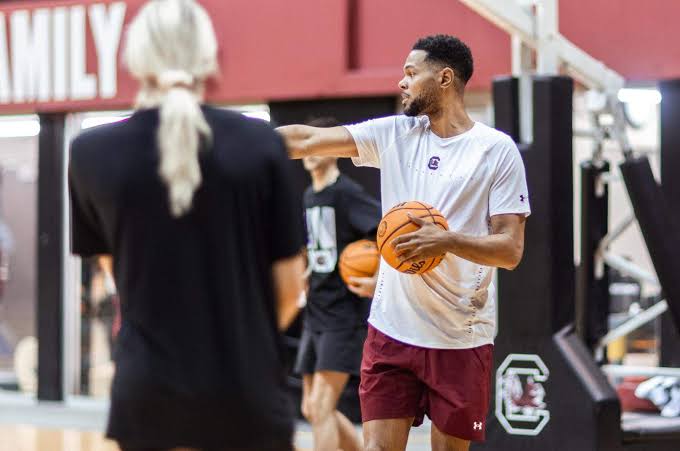
When the NCAA Tournament bracket placed South Carolina in the Sacramento region, most people associated with the program groaned at the cross-country travel. Wendale Farrow was not among them.
For the Gamecocks’ first-year assistant coach, Sacramento isn’t a road trip — it’s home. Farrow grew up in North Highlands, roughly 20 minutes from the Golden 1 Center, making this regional stop something far more personal than a bracket assignment.
“It’s my home, my hometown,” Farrow said. “I’m very happy and proud to go home.”
A West Coast Foundation
At 38, Farrow has built his entire identity — and most of his career — on the West Coast. After navigating junior college out of high school and earning his way into a scholarship at Eastern Michigan, where he eventually completed a master’s degree, Farrow constructed his coaching résumé almost entirely in California. He started as a video coordinator at UCLA under Cori Close before linking up with Lindsay Gottlieb, first at Cal, then at Southern Cal. A one-year detour as an assistant at Vanderbilt under Melanie Balcomb — who was later fired — proved the exception to a West Coast rule.
That background made Dawn Staley’s recruitment of Farrow last offseason a genuine challenge. When the South Carolina head coach reached out to replace Winston Gandy on her staff, she knew geography was working against her.
“His name came up, and I reached out. We had a conversation. We went back and forth a little bit. I just needed him to get to campus,” Staley said. “He’s a West Coast guy. Part of me didn’t think we would get him because he’s such a West Coast guy.”
Staley’s instinct was to get Farrow on campus and let the program sell itself — and it worked. The combination of South Carolina’s culture, its players, and its staff ultimately proved persuasive enough to pull a California native east.
The Gottlieb Connection
The call that set the process in motion reached Lindsay Gottlieb at an unlikely moment. She and her son were passing through security at Disneyland when Staley’s name appeared on her phone screen.
“My son went in right before me, and he’s looking at my phone. He goes, mommy, Dawn Staley’s calling you,” Gottlieb recalled. “Oh, she sure is. She’s at the Final Four. So it went to voicemail.”
The voicemail led to a conversation, and Gottlieb — who describes Farrow as family — gave her blessing. The depth of that relationship became apparent again when the bracket dropped and Gottlieb’s son Jordan noticed that Southern Cal was heading to Columbia for regionals.
“Delly is like my family. He’s Uncle Delly to my kids,” Gottlieb said. “He’s just a great human, and proud of what he’s doing in his career and as a person.”
Farrow is equally reverent about the bond. “That’s my nephew,” he said of Jordan. “I’ve been with Lindsay for a large portion of my career. That’s family to me, that’s like a big sister. I’m indebted to her for so much.”
The Servant’s Heart Behind the Career
What makes Farrow valuable to a program like South Carolina extends well beyond basketball IQ. Gottlieb traces his effectiveness back to where he started — growing up in Section 8 housing, sharing two bedrooms among five or six people, earning his path forward through junior college before anyone offered him a scholarship.
“He’s a terrific human, first and foremost,” Gottlieb said. “Came from a place where he had to struggle to get exactly where he is and always thinks about giving back. He has a servant’s heart, does a ton of community service when nobody’s looking.”
That lived experience translates directly into his coaching. At 6-foot-7, Farrow can work with post players in ways shorter assistants simply cannot. But his deeper value lies in serving as a cultural bridge — softening the edges of demanding coaching while holding players accountable in a voice they trust.
“You’re essentially a vehicle, right? You want to take the messaging from your head coach to the players, and get those players across that bridge to success,” he said. “You’ve got to hold them accountable, give them a level of discipline and a level of confidence.”
That credibility has already shown up in recruiting, with future Gamecocks Kaeli Wynn and Jerzy Robinson among the relationships he’s helped cultivate.
“A lot of young people kind of relate to the struggle, you know, relate to the grind,” Farrow said. “I just want to be a reflection on my community and make our people proud.”
Going Home
Despite settling into South Carolina’s culture — and, by extension, the rhythms of the South — Farrow hasn’t lost his California identity. He describes himself as “a Cali dude, a high sock-wearing, a taco, burrito, avocado type of man,” and he already knows exactly where he’s headed when the team lands in Sacramento.
“In my neighborhood, we go to Adalbertos,” he said. “It’s a taco spot, we get a 24 burrito with sour cream and a pink lemonade.”
For a coaching staff chasing another championship, Sacramento is a tournament site. For Wendale Farrow, it’s something richer — a chance to compete at the highest level of the sport, on the streets where he first learned what it meant to fight for something.