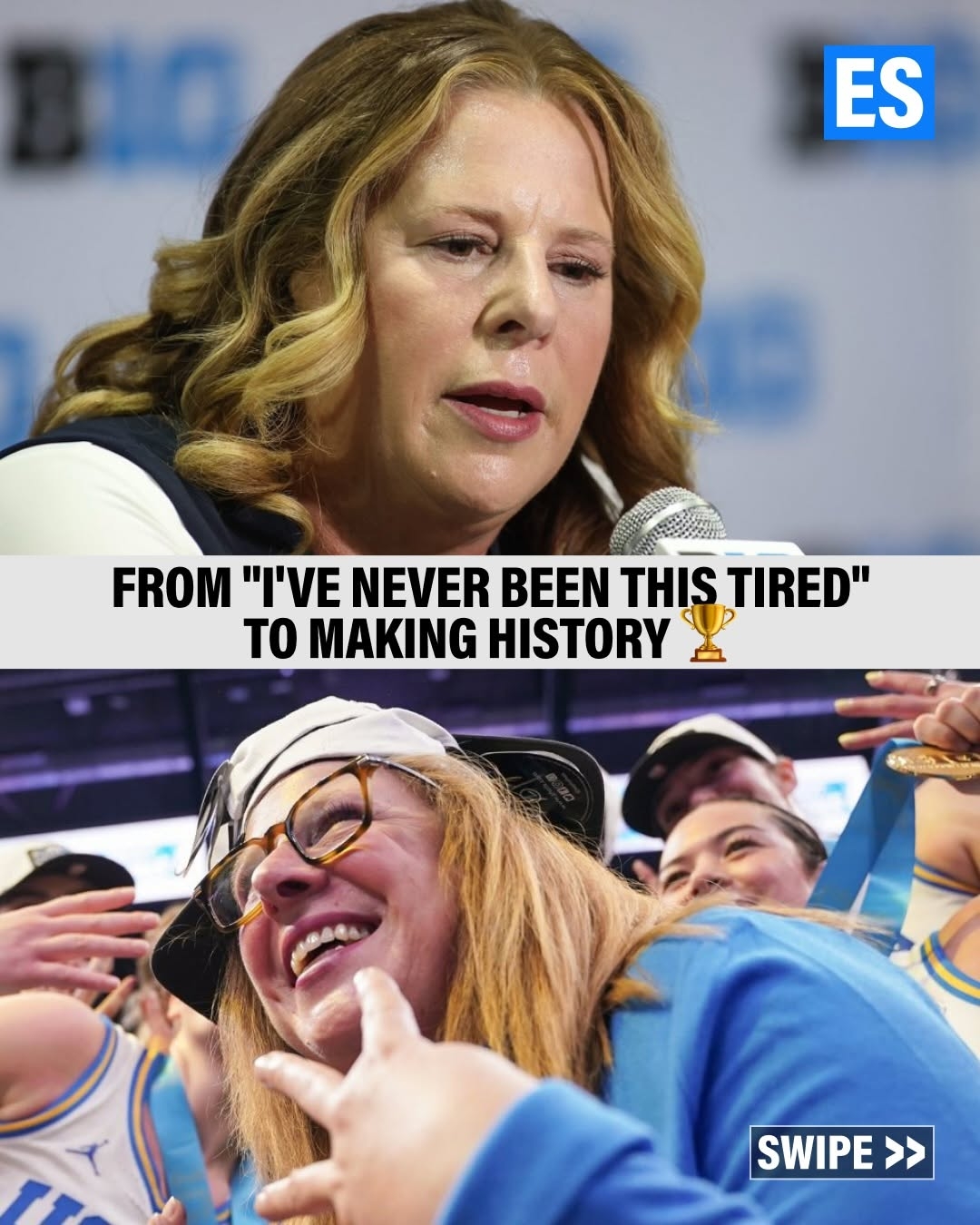
PHOENIX — Cori Close had just won her first national championship. She sat at the podium with tears in her eyes, gratitude in her voice, and the unmistakable composure of a coach who has been building toward this moment for fifteen years — and who understands, with genuine humility, that the trophy is the least important part of what happened Sunday.
What followed was one of the most philosophically rich postgame press conferences in recent women’s basketball history.
What Coach Wooden Would Have Said
The first question drew a connection that clearly moved Close deeply — her relationship with legendary UCLA coach John Wooden, who died in 2010, the year before she took the job.
“I did say to my mom, ‘The transfer portal just got easier,'” Close said, drawing laughter before turning serious. “I think Coach Wooden actually wouldn’t care as much about the championship as he would about staying true to our process. I hope I would make him proud by realizing and recognizing that this is a by-product of what’s happened in their habits, in their love for each other, in committing to a process over a long period of time.”
“When you just look at how the pyramid of success is built, the foundations — I just think he would be way more interested in hearing about that journey than he would about the final product because he knows that’s a by-product of what was happening on the inside.”
The reference to Wooden’s Pyramid of Success was not rhetorical decoration. Close described looking down that hallway at Pauley Pavilion before every game, touching each of UCLA’s championship banners, and imagining what it would feel like to hang another one.
“I think the pyramid of success, there’s a reason it’s been so timeless,” she said. “Character never goes out of style. I just think it’s all lit now. We are believing in it in its entirety. But it will always be about the foundation first.”
The ‘I Will’ Statements That Built the Championship
One of the most revealing windows into how Close prepares her team came when she described the daily practice ritual that ran through the final thirty days of the season.
“Every single day we’ve been starting out film with these ‘I will’ statements. They have to write five to seven of them every time. Sometimes we will add gratitude statements, too.”
In the final days before the Final Four, each of the 21 players on the roster had to choose a statement and recite it aloud to the group.
“When I literally think back even on the games of this Final Four, I just think about how many of those ‘I wills’ they actually lived out,” Close said. “That’s just so rewarding to see something that you really planned for, you really sacrificed for.”
The exercise reflects a coaching philosophy that prioritizes intention over instruction — getting players to articulate their commitment publicly, then holding themselves accountable to it in competition. Sunday’s performance suggested it worked.
What Wooden Taught Her About Leadership
Close became emotional when asked to recall specific lessons from her meetings with Wooden in the 1990s, and the wisdom she described was not tactical — it was foundational.
“You leave his presence and you just go, I hope I can remember everything, every nugget that he, first of all, lived and role modeled, then secondly, taught,” she said, her voice breaking. “I remember he passed away the year before I got this job. I remember thinking to myself, ‘I don’t want to let him down.’ The biggest way I can pay it forward is to live in a way and coach in a way and teach in a way that pays it forward what he did for me.”
The most enduring lesson Wooden gave her, she said, was also the most counterintuitive.
“The biggest thing he did is every time I would ask him, ‘What would you do here?’ he would never answer. He would always make me realize that I’m wired uniquely, and it wasn’t about what he would do — it’s how am I wired to lead to my best.”
Fifteen years of figuring out the answer to that question produced Sunday’s championship.
On Gianna Jaquez: The Competitor Who Finally Had a Team
Gabriela Jaquez’s 21-point, 10-rebound, 5-assist performance was the individual story of the championship game, and Close’s description of what made it possible revealed something important about what UCLA built this season.
“Gianna is a spectacular competitor. One of the things I thought we really could give her — she’s always had to be the most hard-working player. She’s always had to do it alone,” Close said. “I told her, ‘When you come here, you will get buoyed by the comradeship of everybody does that here. That’s the baseline expectation here.'”
“She was like, ‘Really, that can happen?'”
Close smiled at the memory. “I knew she was a competitor. I knew she would work her tail off. I didn’t know she was as funny as she is. I didn’t know she was going to fit in so seamlessly off the court.”
The transfer from Utah brought championship habits. UCLA gave her championship company.
The Senior Sacrifice That Made It Possible
Close offered an assessment of her graduating class that carried genuine weight.
“If any of our six seniors were on any other team, I believe they would have been an All-American, first team,” Close said. “To say that that is not as important to me than experiencing this together — wow, how lucky am I to be part of young women that would make that hard, right choice.”
That is the architecture of a championship team articulated precisely. Six players who chose collective identity over individual recognition, who subordinated their own statistical ambitions to a shared pursuit, and who held that choice for an entire season.
Fifteen Years, One Mountain
When asked about the fifteen-year journey to a first championship and what it feels like to finally reach it, Close pushed back gently on the framing of the critics who had doubted her ability to win a big moment.
“I really never listened to those things,” she said. “I care that my players feel that we show up for them. I care that the families of our players feel like we lived out what we told them when we recruited them. I care about having consistency with our mission.”
Then she described what the win actually felt like from the inside.
“I really did expect us to win today. I thought about it several times. I’m like, ‘We’re going to win.’ I felt very peaceful all day. It wasn’t about whether or not we got the W or not. I wanted us to be able to play our best when our best was needed. We delivered on that.”
The parallel to Wooden’s timeline was not lost on her.
“It took Wooden 16 years. It took me 15. I just think that’s the best part — when you ask Lauren about what she’s most proud of, it’s about what she was able to overcome.”
The Personal Cost of Coaching
Close’s most vulnerable moment came when she was asked about the personal sacrifices she has made over fifteen years of coaching at UCLA.
“I don’t have a family of my own,” she said quietly. “So I really do think of them like children. What would their parents want from me as sort of their basketball mama?”
She did not frame the sacrifice as a loss. She framed it as a calling.
“I feel very purposeful about the sacrifices I’ve made on a personal level for what I believe is trying to live imperfectly but live out my calling. But I wouldn’t trade it.”
The NIL Era and What It Demands
Close was asked to reflect on the distance between the 1995 UCLA men’s championship — which she witnessed as a young assistant — and the current era of NIL and revenue sharing. Her response was candid about both the opportunity and the responsibility.
“It’s a different era now. What they said is that, yes, they’re thankful to be able to benefit from that, but it can’t overtake our love of the game or our love of each other.”
She described the letters she wrote to twelve UCLA alumni — six men, six women — when she first took the job, asking what the program could have done better for them. The responses shaped how she built her infrastructure.
“One of the first ones was financial literacy. The second is providing more resources for mental health. The third one was access to the UCLA alumni network with more intentionality.”
“It doesn’t do any good if we give them this money, if they’re pros, and we don’t give them the equipping to actually be able to maximize those for real opportunities that change lives.”
The Staff Moment That Meant Everything
The most emotionally complete moment of the press conference came when Close described sharing the championship with assistant coach Michaela, a former player whose presence in the locker room clearly carried meaning beyond basketball.
“Right when starting lineups were about to be announced, I was standing next to Michaela. She just put her arm around me. ‘I’m just so happy to be a part of this,'” Close recalled, tearing up. “She was so emotional after the game.”
“Even this morning as we did our walk-through, I got the whole circle together. Right after that, Michaela came right to me and held on to me.”
She paused. “This was even better experiencing this with her than I thought.”
Cori Close left Phoenix as a national champion. She got there by building habits, honoring a process, embracing sacrifice, and listening to a coach who passed away before she ever got the job he helped shape her for.
Wooden never answered the question of what he would do. He made her figure out what she would do.
On Sunday in Phoenix, she had her answer.
I’m