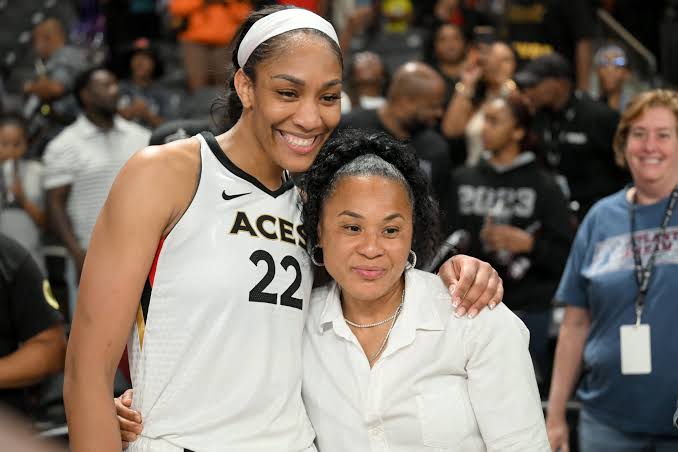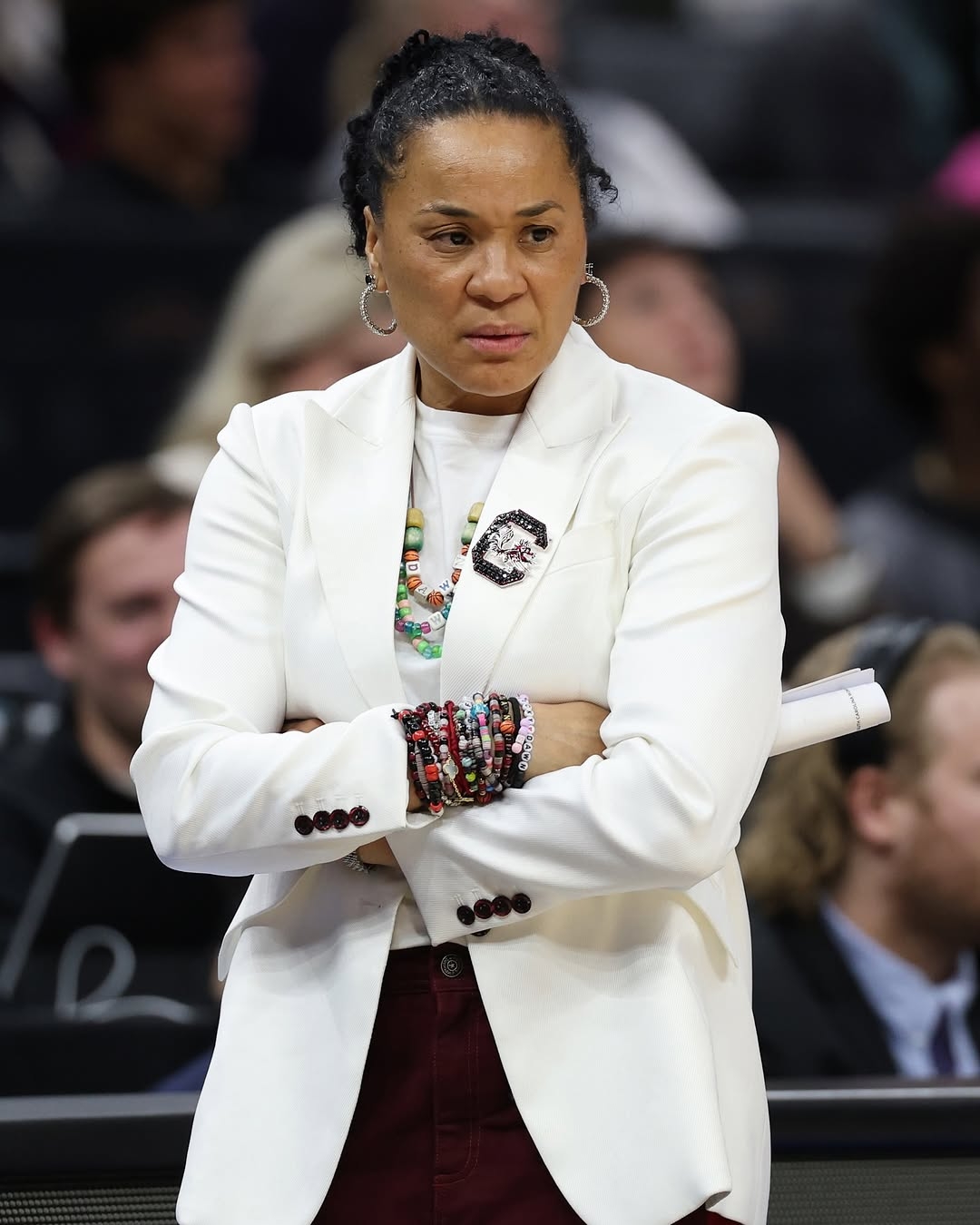
SACRAMENTO — Dawn Staley sat down at the postgame podium after her South Carolina Gamecocks had punched their ticket to a sixth consecutive Final Four, and what followed was less a traditional press conference than a masterclass in perspective. She talked about coaching, about women’s empowerment, about Raven Johnson, about Agot Makeer, and about the enormous debt she feels she owes to basketball itself.
Giving TCU Their Due
Staley opened by acknowledging what the Horned Frogs brought to the arena on Monday night. “I want to congratulate TCU on a great season,” she said. “It was a really hard-fought game, one that took us a little bit to just kind of open it up.”
That measured respect was earned. TCU led 12-4 in the first quarter and forced South Carolina to adjust on the fly before the Gamecocks eventually pulled away. Staley noted the two players most responsible for breaking the game open — Joyce Edwards and Agot Makeer — but was careful to frame the outcome as a collective achievement. “I thought, overall, it was a great team win from both sides of the basketball.”
On Women, Strength, and Poise Under Pressure
Asked about the sport’s contribution to women’s empowerment, Staley did not reach for a prepared answer. She reached for her mother.
“I mean, you all are seeing us play sports,” she said. “I think women are some of the most powerful beings on Earth. And I will take a page out of my mother’s book, in that she used to say, a woman has the strength of 10 men. And I believe her.”
She then connected that belief to the specific reality her players navigate. “The challenges that we’re faced with, I think we do them with a great deal of poise and composure because we know that if we handled things any differently, we probably wouldn’t be able to accomplish what we need to accomplish because of just opposing forces.”
It was a candid acknowledgment that performing at this level as a woman — as a player, as a coach — requires managing a different set of external pressures than the game itself creates.
Six Straight — And What It Actually Takes
A sixth consecutive Final Four is, by any measure, a remarkable achievement. Asked whether it still feels special, Staley answered honestly — and used the question to push back on how coaches are evaluated.
“Anytime you’re able to play in the third weekend in the NCAA Tournament is always special,” she said. “But it really doesn’t feel like that because the work that it requires for you to get to this place. It’s a lot.”
Then she pivoted to something she clearly wanted to say. “A game day is the easiest time of our day,” Staley said. “It is what you have to do to prepare players who are going through whatever they go through because they go through things. They go through not doing so well in a classroom. They go through breaking up with their significant others. They go through just mental exhaustion just for having to deal with their young lives. So that’s the hard part. Don’t criticize us on game day. That’s the easiest part.”
She was not done. The coaching criticism that surfaces on social media — especially after a loss — clearly sits with her, even if she does not let it destabilize her. “We lose a game, and I can’t coach. Well, I don’t really take it to heart like that, but for someone to actually generate that statement, put it out on social media, and think they’ve accomplished something — it’s hard.”
But she immediately redirected that frustration toward something more meaningful. “It’s gratifying because there are five new players on our team that haven’t experienced that.”
The Full Accounting of Raven Johnson
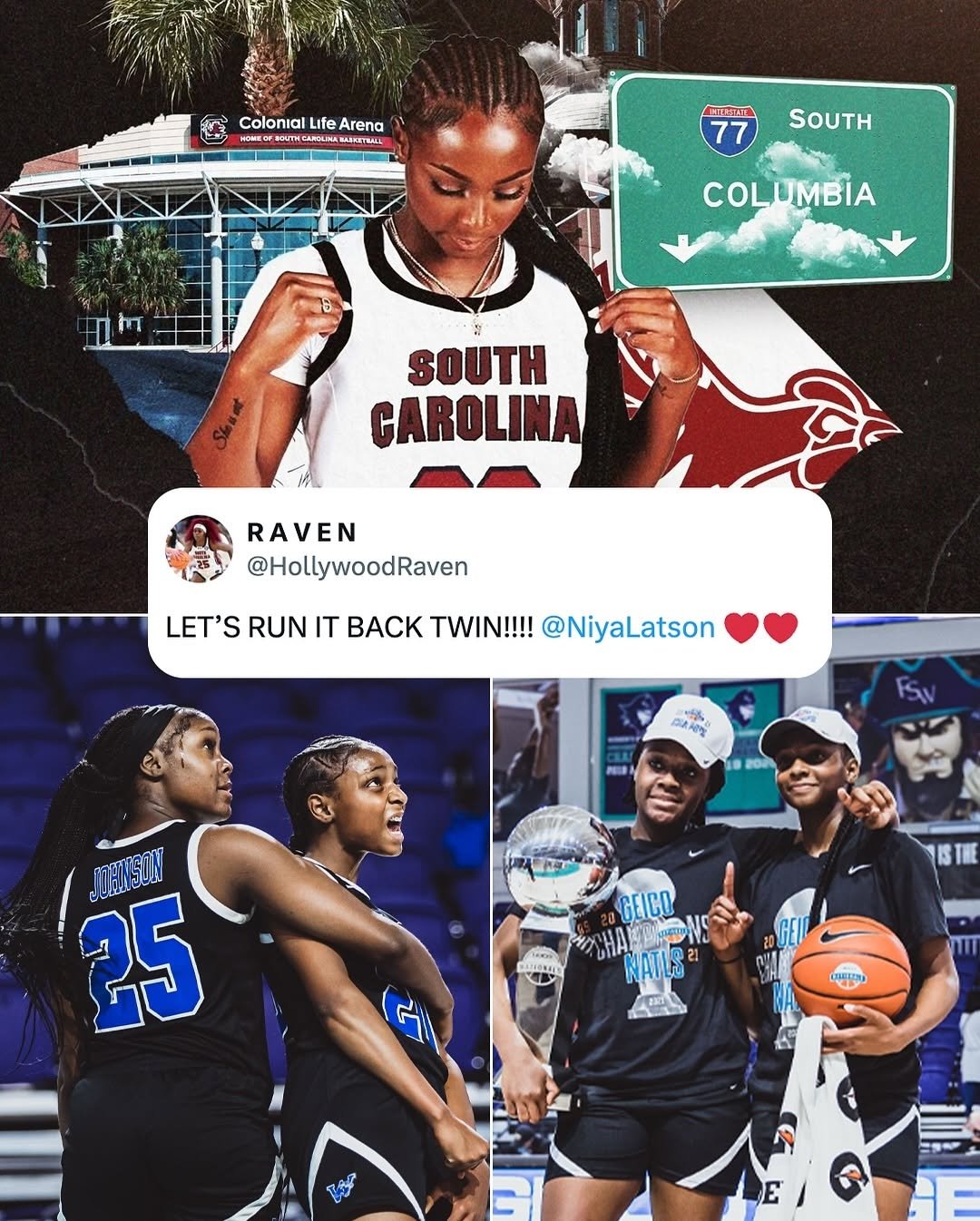
No moment in the press conference landed with more weight than Staley’s extended reflection on Raven Johnson. The senior has been the subject of five years of public discourse, much of it reductive, much of it critical, and Staley laid out the full picture with the precision of someone who has watched every moment of it.
“There’s one player on our team that experienced a Final Four every year of her college career, and that’s Raven Johnson,” Staley said. “And the think pieces on her for five years are quite incredible. But at the end of the day, Raven’s a winner — a winner. And now people are seeing the type of player that she is, that she was capable of being.”
She also acknowledged the context that made this season possible. “We just lost the core of our team. There was a core group. They’ve all gone to the WNBA, which leaves Raven left to be able to just play how she’s playing this year — scoring when we need it, facilitating when it’s needed.”
Then Staley shared a small, unscripted moment from the tournament that captured Johnson’s leadership more clearly than any statistic could. During a shoot-around, Edwards had started expressing frustration about the rims being tight. Johnson approached her immediately. “She said, we only want positive thoughts,” Staley recounted. “She didn’t know I was listening, but I saw the entire exchange.”
The point Staley was making was precise and important. “You really can’t discount, and you can’t really just know the full extent of a person and her leadership because they shot 2-for-10 on any given night.”
Agot Makeer: Patience, Health, and a Bright Future
Makeer’s emergence this postseason has been one of the tournament’s better stories, and Staley explained how it happened with characteristic directness — it required patience, challenge, and health finally cooperating.
“She was in and out with injuries,” Staley said. “And then we had some other injuries, and she got pushed up to knowing that she was going to play. I do think she’s a different player when she knows she’s going to play.”
The coaching approach, she explained, was to keep believing in Makeer even when the circumstances made it difficult. “We never stopped thinking about the contributions that Agot can give to us. It’s always, like, she’s super talented. When is it going to click? And then we just kind of stayed with it, probably even when she didn’t want to stay with it.”
That last phrase reveals something important about how Staley operates. Young players in limited roles often lose confidence and begin looking for reasons their situation will not improve. Staley and her staff refused to let Makeer settle into that narrative. “Because young people, when they’re not playing, they think they’re never going to play. They probably have excuses as to why they’re not playing. Except the real reason is, you’ve got to start stacking practice days.”
As for the postgame moment the two shared on the court — Staley kept it simple. “I’m just proud. Just proud.”
Keeping South Carolina Stars at Home
Asked about the importance of recruiting within the state, Staley was clear about the program’s philosophy without being dismissive of players who choose to leave.
“It’s really important to us that we keep our very best stars at home,” she said. “If it’s a local star that just wants to leave and experience something outside of their local grounds, that’s great. But at the same time, I think you could get everything you want and you need from South Carolina. And your family gets a chance to see you play. And that’s very, very important to South Carolinians.”
The proximity argument is one Staley has made consistently, and it has increasingly won. The combination of national championship pedigree and family access is a powerful recruiting combination.
Sacramento, Distance, and Controlling the Controllables
South Carolina played this regional in Sacramento — about as far from Columbia as the bracket can send them. Staley was asked whether the distance presented a challenge. Her answer was honest about why the Gamecocks ended up so far from home in the first place.
“We didn’t control the controllables,” she said simply. “We lost to Texas in the SEC Tournament. We knew we were going to get bumped. So you just take the hit. You take the hit, and you just keep on going.”
She then reframed the location in the most South Carolina terms possible. “You start thinking about the last time we were here in California, it worked out for us,” she noted, referencing the program’s 2017 run through Stockton. “And for the people to come watch us play and cheer us on — I have no complaints about being here.”
What Basketball Is Owed
Perhaps the most revealing answer of the night came when Staley was asked to reflect on her own star power — on how far she has come from her playing days and what it means to be where she is now.
She deflected the premise almost immediately, turning it into something larger than herself. “I feel like I owe basketball,” she said. “Basketball has been incredible to me, to my family. And I always feel like I have to repay. I don’t get a chance to really take a big chunk out of the debt because we’re going to the Final Four. It’s another thing that basketball has provided that keeps stacking on the debt.”
She then made a broader case for investment in women’s sports. “There is investment in women’s sports and women’s basketball. And a lot of times there’s not a great return on your investment, but I think for women’s basketball, when you pour in — once our units get up to par, I think we’ll be respected even more. There won’t be articles written on how much we’re spending against the budget.”
Managing People, Not Just Players
Staley was asked about players who have described her as more than a coach — as a maternal figure in their lives. Her response reframed the entire concept of what her job requires.
“I’ve got an easy job. I really do have an easy job,” she said — a claim that landed with deliberate irony given everything she had just described. “Because I think our players have conditioned me and our coaching staff, and we’ve conditioned them to be able to handle the real truth. Like real truth.”
That mutual conditioning is the actual product of what she builds. Not just basketball players, but people capable of receiving honesty and using it. “When you’re able to handle real truth, it doesn’t really hurt,” she said. “It’s just a part of your process. So we have those kinds of back-and-forth conversations with each other so we can have greater — like more depth to our relationship.”
A Final Four program. A team of people who can handle the truth. In Dawn Staley’s framework, those two things are not separate. They are the same thing.