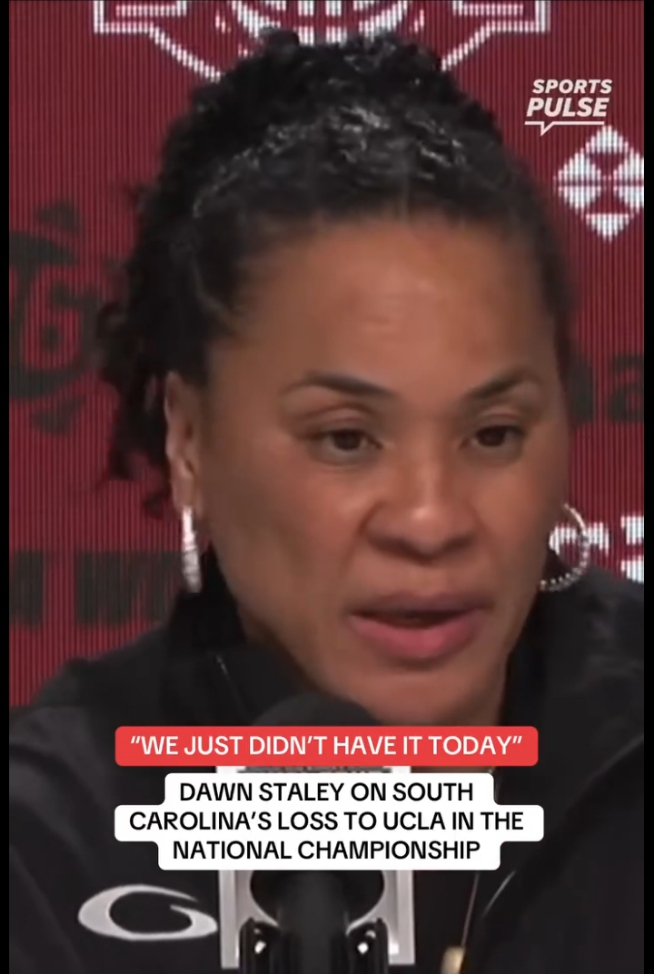
PHOENIX — Dawn Staley sat at the postgame podium having just lost a national championship by 28 points. She was composed, candid, and already thinking about next season. What followed was one of the more revealing press conferences of her coaching career — not because of what went wrong on Sunday, but because of how she processed it and what she intends to do about it.
Acknowledging the Better Team
Staley did not look for excuses. The first question drew a direct parallel to last year’s championship loss to UConn, and she drew it herself before anyone else could.
“It kind of felt like the same thing,” Staley said. “I thought they came out and disrupted from a defensive standpoint. Then they pretty much got what they wanted offensively. When they did it, they created second-chance opportunities. We just didn’t have it today. We tried, but we just didn’t have it today. They were the better team today. Congratulations to them.”
She then reframed the loss in broader terms — not defensively, but philosophically.
“Sometimes you’re part of women’s basketball history. It’s not favorable to you. You could see if you’re going to lose to a team like UCLA, you want to lose to a team that just really out-works you, out-executed you, made it very difficult for you to perform at a high level. It was a direct reflection of what they did to us.”
That framing matters. Staley is not minimizing the result. She is contextualizing it — acknowledging that UCLA earned this, that the loss was genuine, and that understanding why it happened is more valuable than managing how it looks.
What Actually Went Wrong Offensively
Fifty-one points. For a team that averaged 87 per game, that number demands explanation. Staley provided one that was simultaneously honest about South Carolina’s failures and generous in crediting UCLA’s defense.
“I thought the first quarter, first half, we had a lot of people taking shots that aren’t normal for us. So we didn’t do a good job of getting the people that probably was supposed to get some better looks the ball.”
But she was clear that this was not purely a self-inflicted wound.
“I think UCLA had a lot to do with it. Not going to say that they didn’t. They really did. I didn’t think we had to play perfect basketball, but we had to play better basketball. We had to make shots, create offense for our defense. We had to be better defensively, actually pushing them off their spots.”
She identified the specific failure mode with precision: “You can have a good defensive possession, but give up an offensive rebound, that’s just really deflating.”
And on the structural problem of navigating Lauren Betts’s size: “You can’t go in there thinking you can score over her or through her, so sometimes you have to go in there and draw and kick, maybe draw and kick another time. We actually wanted to do that. We took the first shot available. Sometimes that shot didn’t go in. A lot of times that shot didn’t go in. We weren’t creating extra possessions offensive rebounding. Things we do a lot. The things we built our success on weren’t happening for us tonight. And UCLA made us pay for it.”
The Gabriela Jaquez Problem
Jaquez’s 21-point, 10-rebound, 5-assist performance was the decisive individual storyline of the game, and Staley acknowledged it without hesitation.
“Hard matchup. Hard matchup. You come into a game, you know exactly what she’s going to do, and she does it. She’s relentless. She’s a relentless rebounder. She’s a relentless, just championship-type behavior. Intangibles are needed in order for you to win. If you don’t prioritize her on the court, she’s going to make you pay. She did that against us.”
Knowing what Jaquez was going to do and being unable to stop her is the most honest summary of what happened Sunday. South Carolina had a game plan. UCLA executed better than the game plan anticipated.
On UCLA’s Experience Edge
Staley made an interesting and analytically sound point about how UCLA’s Final Four appearance last year functioned as preparation rather than simply a result.
“UCLA is a quality team with very experienced players who got a taste of being in the Final Four last year. You make adjustments. You use that experience as a learning lesson, and you come back sharper, and you increase your chances of winning. From last year to this year, they played determined last year, but they played more determined this year. They were so close. They’ve had the experience to do that. They took advantage of it.”
It is the same arc South Carolina has benefited from over six consecutive Final Fours. And now, for the first time, Staley has watched it work against her.
Respect for Cori Close
One of the most gracious moments of the press conference came when Staley was asked about her relationship with Close — a coach she had invested in professionally, who had just beaten her for a national championship.
“I’m always happy for people that worked hard in this game, who are really quality people. I want good things to happen for them. Cori is one of those people who really works at making our game better. Not just UCLA, but our entire game.”
“Although we didn’t win, I can swallow it because we lost to a really good human being and a good team that represent women’s basketball well.”
She also offered a reflection on Close’s 15-year journey to the championship that carried unmistakable personal resonance.
“That’s what you want. You don’t want to be given anything. You want to work for it. 15 years is a long time that you’ve dedicated to young people and to our game. The game finally paid her back. I think it took me 17 years to win a national championship. Someone would send me a text message, ‘What’s delayed is not denied.’ That’s the case with Cori.”
The WNBA Cases for Johnson and Latson
Staley was asked to make the case for Raven Johnson and Ta’Niya Latson as professional players, and her answer was as much about character as basketball.
“I think they are well-rounded individuals from a basketball standpoint. They are great humans. You want somebody in your franchise that you see is going to come to work every day on time, early, stay late, then everything in between. They’re great teammates. They’re people that you want to play with. One, they’re winners. Two, they just have a lot of basketball experience.”
“I just think that they’re ready. They’ve created pro habits. A lot of what someone that’s unprepared for a WNBA training camp, they’ll be prepared for it. Maybe the terminology will be a little bit different. When it gets down to basketball, they can be coached by anybody.”
The Geno Question That Wasn’t
When asked whether Auriemma had reached out since the confrontation, Staley was characteristically deft.
“Yes, that’s a Geno question, right? It really is a Geno question. I haven’t heard from Geno, so… I have not. I got 800 text messages. I don’t know if he texted or not. Like, I don’t want — this is UCLA’s day, right? Let’s keep it UCLA, them winning the national championship.”
She will address it. Just not today. And not in a way that diminishes what Cori Close and UCLA accomplished.
The Chloe Kitts Reality
When asked to describe the season in one word and reflect on Kitts’s absence, Staley’s answer was unexpectedly blunt — and clarifying.
“When we knew we weren’t going to have Chloe Kitts, we considered her dead. We don’t bring it up. She can’t help us. She’s not a part of our team in a way of preparation and being on the floor. She was in other areas where she would talk to the players and help them out. But when it comes to just game prep, we just didn’t bring her name up once we knew she wasn’t able to play.”
It is the language of a coach who operates without sentiment when preparation demands clarity. Kitts’s absence was a fact. Facts are addressed and moved past. Everything else is noise.
What Drives the Rebuild
The final exchanges in the press conference were about next season, and Staley was already constructive.
On roster needs: “We got to add some guard play, definitely some lead guard play, some more athleticism in the guard department. I think our front line is pretty good, especially the ones that are coming back from injury.”
On the program’s identity after Raven Johnson: “Raven was the last of the core group of players that had been together that actually had taken our program to the very top. We just need players who are committed to team, committed to getting better as individuals, creating pro habits so when they are challenged to perform at a high level, it won’t be something that they wrestle with. It is a norm.”
On the pressure of sustained excellence: “To get here is hard. To win here is harder. We just have to keep getting here and make adjustments when we don’t win. Obviously, we got smacked today. We got to figure out how we smack back and put ourselves in the position where we’re hoisting the trophy at the end of the day.”
And on what drives her forward from this specific loss: “Losing in the national championship game, the way we lost, I guess that will be the thing that really drives us. There’s always something lurking. When we have an opportunity to win a national championship, you just try to get better, find the lessons within this game, and try to get better.”
Dawn Staley left Phoenix having won a Final Four and lost a championship in the same weekend. She acknowledged the result completely, credited the opponent generously, processed the loss honestly, and began the rebuild publicly.
That is what seventeen years of elite coaching looks like. The trophy went to Westwood. The standards stay in Columbia.
She will be back. She always is.