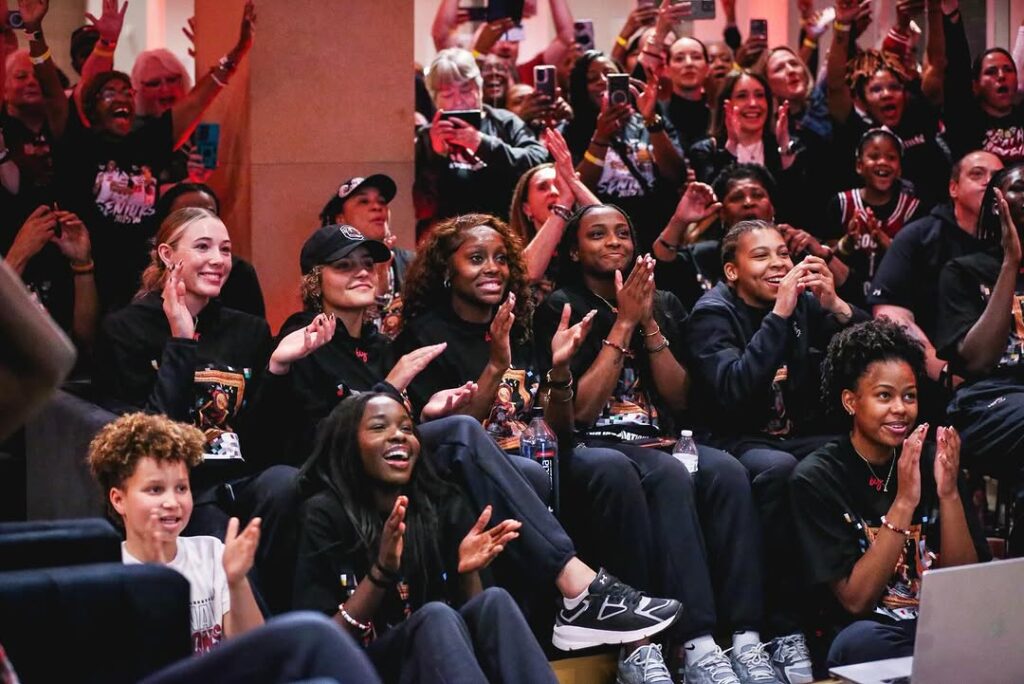
FanCOLUMBIA, S.C. — Selection Sunday has become something of an annual ritual for South Carolina women’s basketball fans — a predictable confirmation of what most of the college basketball world already knows by early March. The Gamecocks are in the tournament. They are a one seed. They are hosting. The bracket reveal is more coronation than revelation at this point, and the celebration that follows has reflected that certainty for years.
What was not predictable about Sunday evening was the setting, the format, or the unmistakable sense that something about the way South Carolina presents itself to its fans has fundamentally shifted. The watch party was not at Colonial Life Arena. It was at the Columbia Museum of Art — and it arrived with a DJ, a magician, a bar, $100 T-shirts, and dinner with the players if you paid the right price.
Welcome to women’s college basketball in the revenue-sharing era.
The Event: A Museum, a Media Company, and a New Model
The gathering was organized by Rae Rose Media, a sports-centric media company that works specifically with women’s athletic programs and female athletes to build and monetize their brands. Proceeds from the event went directly toward the women’s basketball program’s enhancement fund — a detail that reframes the evening not merely as a fan experience but as a deliberate piece of program infrastructure in the new college athletics economy.
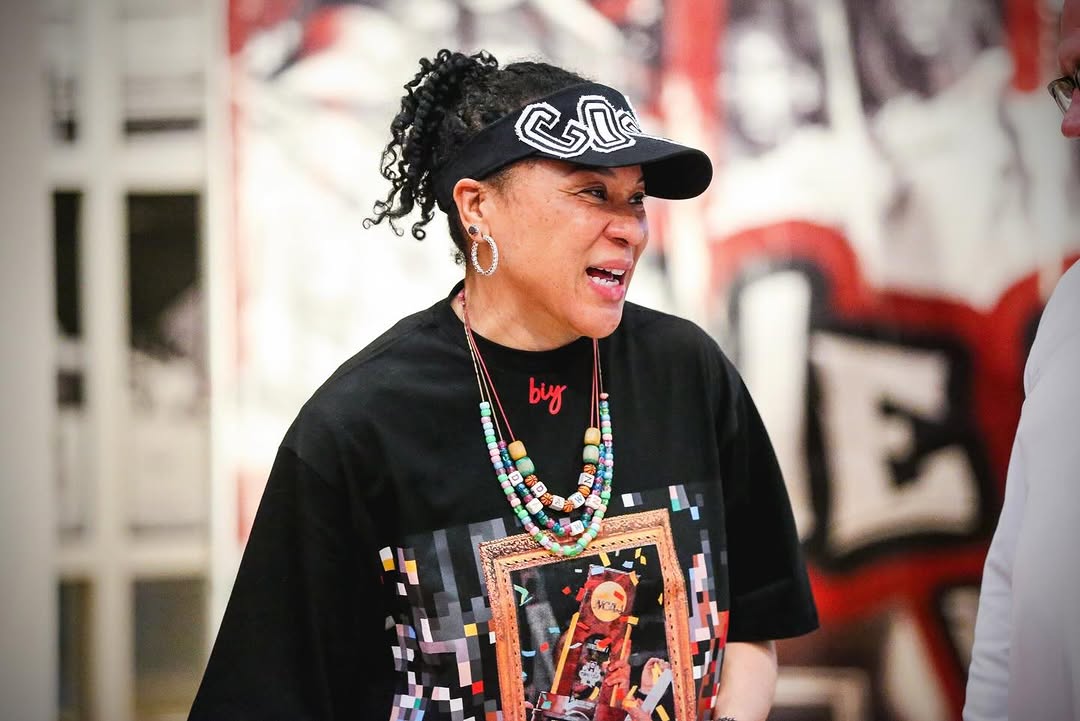
Staley was direct about why the format changed and why the partnership with Rae Rose matters. “I know that we probably experienced thousands of fans in Colonial Life Arena,” she acknowledged, “but I thought doing something different and just kind of introducing ourselves to Rae Rose, which is a media company that our team is working with to provide NIL opportunities for our players, because you have to be in this space.”
That final phrase — “you have to be in this space” — is the most important thing Staley said all evening, and it had nothing to do with the bracket. It was a candid acknowledgment from one of the sport’s most innovative leaders that the landscape of college athletics has changed in ways that require programs to think differently about every touchpoint they have with their fan base. A Selection Sunday watch party is no longer just a celebration. It is a revenue opportunity, a brand-building moment, and a direct mechanism for funding the NIL ecosystem that now surrounds every competitive college program.
The Tiered Experience: From $50 to Dinner With the Team
The event’s pricing structure was as deliberate as its setting. Beyond 100 free tickets distributed in advance, entrance started at $50. A $125 “deluxe pass” included food and 50% off merchandise. The $250 “VIP package” included a free shirt — retail value $100 — and a private dinner with the team.
That premium tier sold out.
The fans who paid $250 did not simply attend a watch party. They sat at dinner tables with Joyce Edwards, Maryam Dauda, Adhel Tac, Alicia Tournebize, and Raven Johnson — the kind of access that, until recently, simply did not exist in women’s college basketball at any price point. Michele Doto and Lisa Cash chose the VIP package and found themselves chatting with different players throughout the evening, moving table to table with the ease of guests at exactly the kind of upscale gathering the museum setting was designed to evoke.
Doto eventually found Johnson and proudly showed off the “Raven ‘Crockpot’ Johnson” shirt she had worn to games all season. “I’ve been wearing it to all the games,” Doto said. “I told her when I saw her I might wear it next year because I’m gonna miss her so much.” The moment — a devoted fan in a player-specific merchandise shirt, sitting at dinner with that same player at a museum on Selection Sunday — captures something genuinely new about what women’s college basketball has become.
Aisha Haynes, who has attended South Carolina games since enrolling at USC in 2000 and has been present at all 16 Selection Sunday events since, found the format refreshing rather than jarring. “I actually really liked it here,” she said. “It was like a more-intimate setting, a more upscale event than the other ones.” She dined with Tac and Tournebize — two players whose names most casual fans are only beginning to know — in a setting that felt less like a sporting event and more like an exclusive gathering of people who genuinely care about the same program.
The History of South Carolina’s Selection Sunday Events
The evolution of how South Carolina has monetized this moment is worth tracing. The program held watch parties at “The Zone” inside Williams-Brice Stadium in 2017, 2018, and 2019, with prices progressing from $12 (or free with a fan club membership) to $22 to $25 across those three seasons. From 2021 onward, the annual watch party moved to Colonial Life Arena — a free event that regularly attracted large crowds and represented the program’s most accessible community touchpoint of the year.
Sunday’s event represents the next evolution in that progression — and a sharp one. The jump from a free arena event to a $50-and-up museum experience with tiered access and player dinners is not incremental. It is a philosophical shift in how the program conceptualizes the relationship between fan engagement and program revenue.
Staley was transparent about the accountability that shift requires. “I wanted to make sure that the people that paid their money got their money’s worth, and that is top priority for us,” she said. “Because if people go to budget and come and they want more than just access to our place… And you know that’s what we wanted to accomplish, and I hope we did accomplish that tonight.”
By multiple accounts, the people who paid felt the investment was worth it. Therese Griffin, a season-ticket holder since 2014 who paid for the deluxe pass after the VIP package sold out, came away with something she had not anticipated: a selfie her niece took with Staley, a collection of photographs with players — “We got Raven, Chloe (Kitts). We got Tessa (Johnson). We got everybody” — and the kind of memory that a standard arena watch party does not manufacture.
The exclusive shirt she purchased at half-price will eventually fade. The photographs will not.
What This Means for the Future of Fan Engagement
Sunday’s event in Columbia is not an isolated experiment. It is a preview of what fan engagement in the revenue-sharing era of college athletics may increasingly look like — premium, tiered, monetized, and designed to provide genuine value at every price point rather than simply filling a large building with free admission.
The model works because the product supports it. South Carolina women’s basketball is a national championship program with a roster of legitimate celebrities — players whose faces, names, and personalities are known to tens of thousands of invested fans. The ability to charge $250 for dinner with that roster is a function of the program’s earned cultural relevance, not a departure from it.
For fans of programs without South Carolina’s profile and fanbase, the model may not translate directly. But for the Gamecocks — a program that has led the nation in home attendance for twelve consecutive seasons, whose head coach is among the most recognized figures in all of college athletics, and whose senior class includes players with genuine WNBA draft stock — the museum event on Sunday evening was a natural expression of where women’s college basketball has arrived.
The bracket is set. South Carolina is a one seed, hosting in Columbia, chasing a third national title in five years. None of that changed at the Columbia Museum of Art on Sunday night. What changed was the understanding of what gathering to celebrate it can look like.
Welcome to the new era. Dawn Staley is already operating in it.