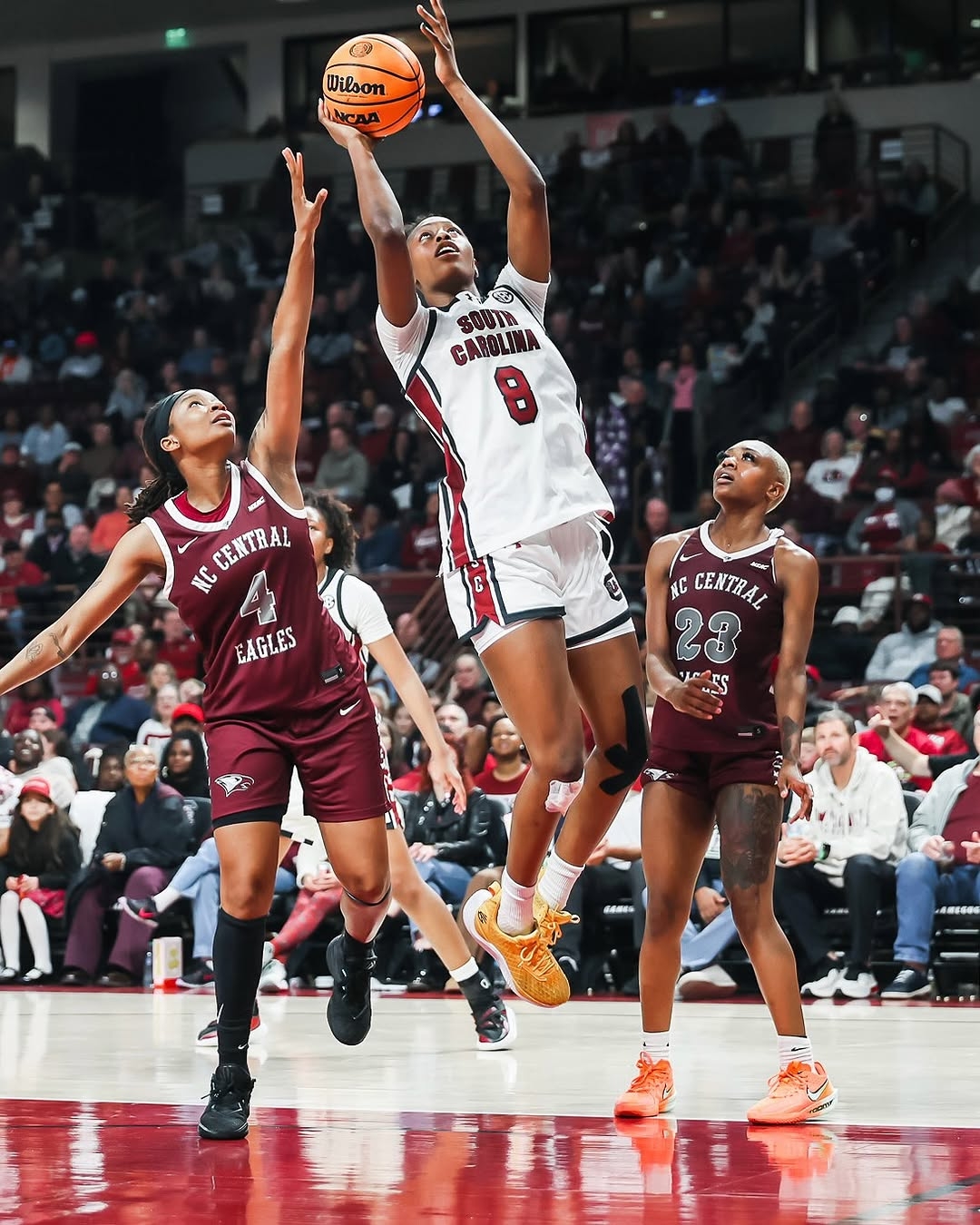
With the first month of the season complete—and roughly a third of the schedule already behind them—South Carolina’s statistical identity is beginning to take shape.
Joyce Edwards leads the Gamecocks with 19.4 points per game, while Ta’Niya Latson isn’t far behind at 17.8. Both are producing the highest scoring averages by a South Carolina player since A’ja Wilson’s 22.6 points during the 2017-18 season. Under Dawn Staley, only Wilson has posted higher single-season marks, making Edwards’ and Latson’s numbers the second- and fourth-best of the Staley era.
Madina Okot is also off to a standout start, averaging 14.8 points and 11.1 rebounds. If she maintains her pace, she will become just the fourth Gamecock under Staley to finish a season with a double-double average, joining Alaina Coates (twice), Wilson, and Aliyah Boston (twice).
Okot’s efficiency has been exceptional—she ranks 17th nationally in field goal percentage at 60.95%, and sits 11th in rebounds per game, only 0.01 away from cracking the top ten. She has already recorded seven double-doubles, tying Oklahoma’s Raegan Beers and Murray State’s Sharnecce Currie-Jelks for the most in the country. She was just one rebound away from another on Sunday despite playing limited minutes.
Tessa Johnson’s rise continues as well. Her 13.1 points per game give South Carolina four players scoring in double figures—something the Gamecocks last achieved consistently from 2016-17 through 2019-20.
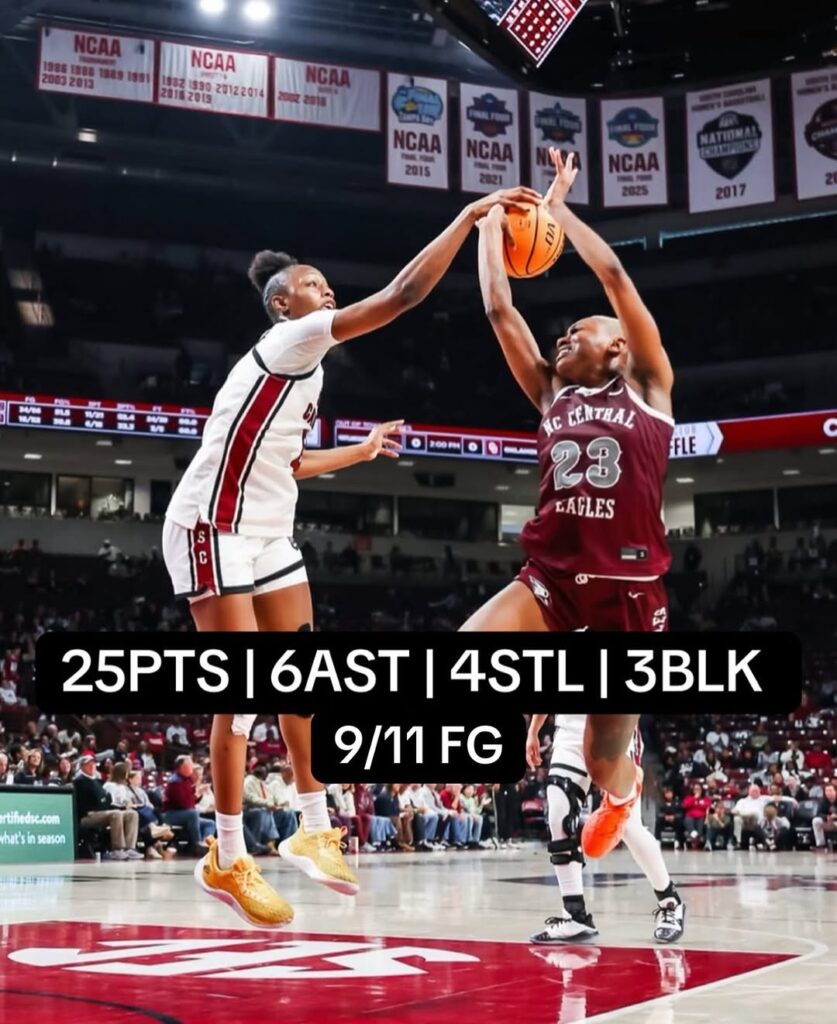
Edwards, who led the team last season with 12.7 points per game, has made one of the biggest leaps on the roster. She has increased her scoring by 6.7 points, raised her shooting percentage from 52.9% to 57.7%, added 1.1 more rebounds, boosted her assists from 1.2 to 2.9, and tripled her blocks from 0.5 to 1.5.
Raven Johnson is putting together a record-threatening year as a distributor. She’s averaging 6.6 assists with a 3.7 assist-to-turnover ratio. The single-season assist record is 7.3 (Mindy Ballou, 1983-84), and second place is 6.7 (Cristina Ciocan, 2002-03). Johnson is also on track to break the program’s assist-to-turnover ratio record of 3.2 set by Tyasha Harris in 2018-19.
Johnson is posting career highs across the board—scoring, shooting efficiency, three-point accuracy, assists, and blocks. Nationally, she ranks 7th in assist-to-turnover ratio and 13th in assists. As a team, South Carolina sits 11th nationally in ratio (1.59) and 15th in assists per game (19.6).
Tessa Johnson has emerged as one of the nation’s most efficient shooters from deep, knocking down 48.8% (21-43) of her threes. That pace would rank second in program history behind Tiffany Mitchell’s 54.1% in 2013-14. Her career three-point percentage of 44.2% is just shy of Karen Middleton’s all-time South Carolina record (44.5%), and she is on track to break into the top ten for career threes made by the end of the year.
Nationally, Johnson stands 19th in three-point percentage and is producing career highs in scoring, field goal percentage, three-point shooting, rebounding, assists, and blocks. She’s also a perfect 7-for-7 from the free throw line. Her shot volume has climbed significantly—from 2.9 attempts per game last season to 4.8 this year.
As a team, South Carolina is operating at a historic offensive pace, averaging 90.1 points while shooting 53.0% from the floor—both numbers that would set program records if sustained. For context, the Gamecocks averaged 79.1 points on 46.5% shooting last season. Their three-point accuracy has also skyrocketed from 34.0% to 43.1%.
Nationally, the Gamecocks rank 10th in scoring, 4th in field goal percentage, and 3rd in three-point percentage.
Defensively, South Carolina has returned to elite shot-blocking form. After averaging just 5.7 blocks last season, they’re now up to 7.2, which ranks fourth in the country. Last year marked their lowest block average since 2016-17.
The only noticeable drop-off comes from the bench. South Carolina is averaging just 17.3 bench points, ranking 252nd nationally—a major contrast to last season, when the Gamecocks led the nation with more than 40 bench points per game.