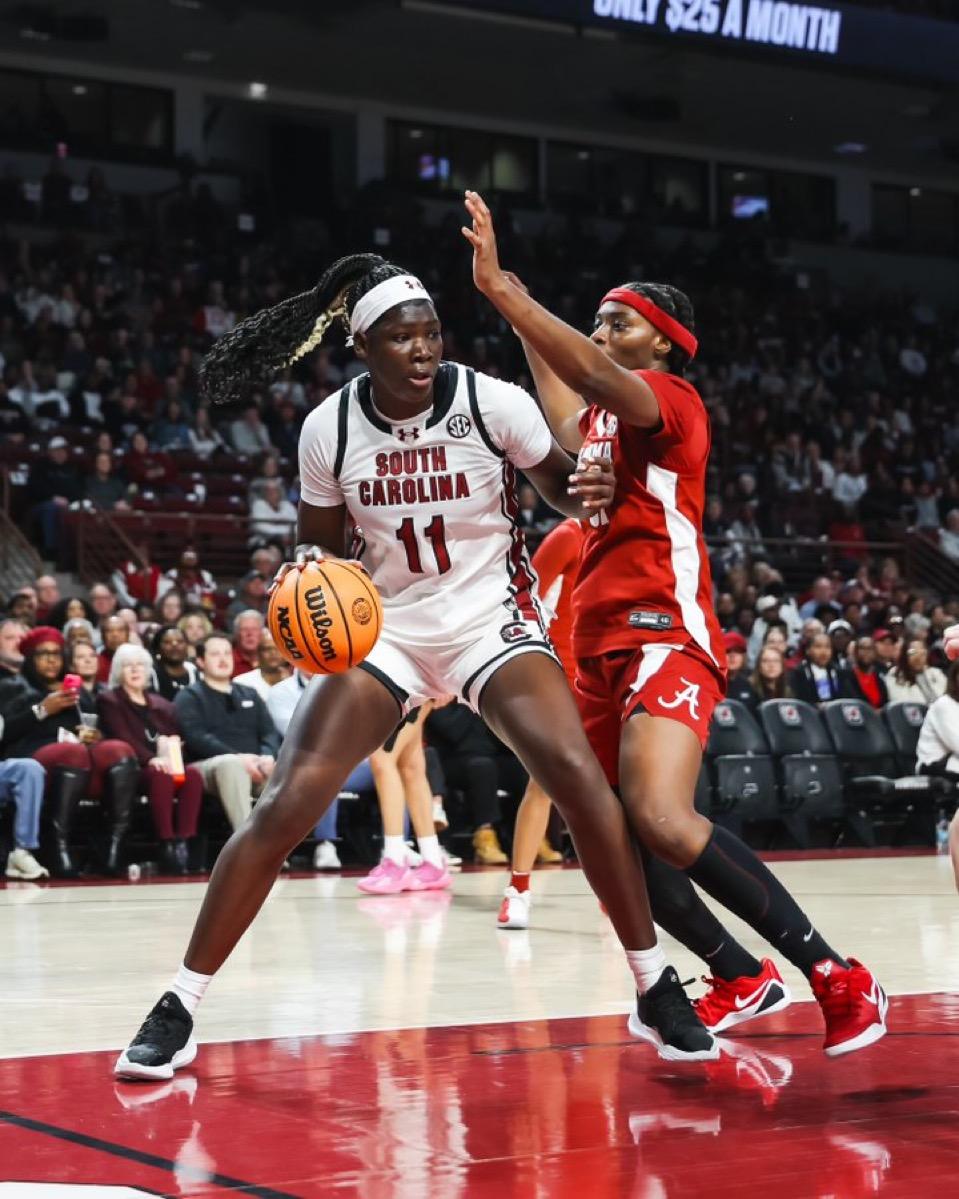
The NCAA’s denial of Madina Okot’s eligibility waiver on April 8 was more than a bureaucratic ruling — it was a significant personnel blow that immediately reshapes how Dawn Staley must construct South Carolina’s frontcourt heading into the 2026-27 season. Okot was not just a starter. She was the centerpiece of a championship-caliber interior. Replacing what she brought is no simple task.
In just two seasons of NCAA play, Okot ranked third in the country with 22 double-doubles, 16th in rebounding average at 10.6 per game, and 19th in field goal percentage at .575. She was an All-SEC Second Team selection and ranked second in South Carolina’s single-season record books in offensive rebounds. South Carolina Athletics She was also a finalist for the Lisa Leslie Center of the Year Award — a marker of national recognition that reflects just how dominant her presence had become.
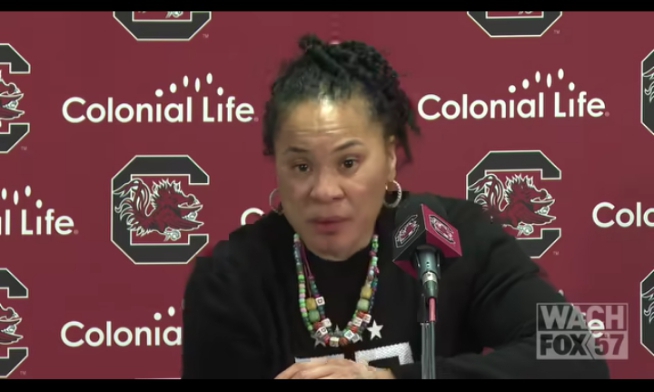
Staley, for her part, was unambiguous about what Okot represented beyond the statistics.
“Early in her basketball career, Madina made courageous choices not just to pursue the sport, but also to better her life,” Staley said. “Her path included just a short time with us in Columbia, but we are grateful to be part of her story. She made our team and our sport better.”
The decision closed the door on a player who had become one of the most productive centers in the country in just two NCAA seasons. Now the Gamecocks must answer a straightforward but difficult question: who fills that space?
The Front Court Staley Has to Work With
The good news is that South Carolina’s frontcourt depth, even without Okot, remains formidable by almost any standard. Returning contributors include All-American Joyce Edwards, who averaged 19.6 points per game this season and was inches away from becoming the first Gamecock since A’ja Wilson to average 20 points per game. ESPN She is the unchallenged cornerstone of the offense and will anchor the lineup.
Also expected to return are redshirt senior Chloe Kitts, who missed the entire 2025-26 season with a torn ACL; Adhel Tac; 6-foot-7 Alicia Tournebize, the French sophomore who joined midseason; and Ashlyn Watkins, who sat out this year to recover from her own ACL injury. On3
Watkins, who played her last full season in 2023-24, was South Carolina’s best interior defender that year — analysts have noted she plays bigger than her 6-foot-3 frame and was even more impactful than SEC Defensive Player of the Year Kamilla Cardoso in terms of interior defense. On3 Her return, if fully healthy, effectively functions like a high-end transfer addition without the roster disruption.
Kitts, meanwhile, was an All-American the season before her injury and her recovery has reportedly gone well. There is no reason to expect she won’t return to that level. On3 If both Kitts and Watkins come back healthy and sharp, South Carolina’s frontcourt looks not just manageable but genuinely strong.
The Starting Spot Competition
The question of who starts at center or power forward alongside Edwards is the most immediate puzzle. Okot started all but three of the 39 games she played this season. That is a significant vacancy in a lineup built around interior presence.
Of the available candidates, Kitts is the most logical choice to step into a starting role, having already earned that status before injury intervened. She has started in the overwhelming majority of games she has played as a Gamecock and brings the scoring punch and rebounding ability to slot in naturally beside Edwards.
Watkins offers a different profile — more defensive anchor than offensive weapon — but her athleticism and interior presence make her equally viable. A lineup featuring Edwards, Kitts or Watkins, Tournebize, and two of Tac or the incoming freshmen would give Staley multiple ways to configure size without sacrificing versatility.
Staley also has the option of going smaller when the matchup demands it. She used Agot Makeer in the starting lineup for a stretch this season, and that flexibility proved useful. Makeer averaged 6.6 points per game during the regular season and was arguably South Carolina’s breakout performer of March Madness, averaging 14 points per game off the bench throughout the tournament. ESPN The ability to deploy a four-guard look without sacrificing competitiveness is a real option.
Incoming Freshmen and the Minutes Distribution Question
South Carolina’s 2026 signing class adds two more frontcourt pieces in Kaeli Wynn (6-foot-2) and Kelsi Andrews (6-foot-3), both coming off their own injury recoveries. Both players are top-20 national recruits and bring legitimate potential — though neither can be counted on to carry heavy minutes immediately given their medical situations heading into enrollment.
That said, Wynn is expected to provide immediate depth at the three or four positions, and Andrews brings the size and skill set of a modern post — comfortable inside and capable of stretching the floor with her perimeter shooting. On3
One analytical point often overlooked in the Okot conversation is that losing her, in a counterintuitive way, may actually benefit the development of players further down the depth chart. Tournebize, who is only 18 and joined the Gamecocks midseason, flashed enormous potential, and analysts describe her ceiling as through the roof. On3 With Okot in the rotation, Tournebize’s path to meaningful minutes was limited. With Okot gone, she becomes a central developmental figure whose growth over the next two seasons could determine South Carolina’s ceiling when Kitts and Watkins eventually exhaust their eligibility.
What Staley Is Actually Looking For in the Portal
Despite having a loaded frontcourt on paper, Staley was direct about where she sees the real gap.
“Obviously we got to add some guard play, definitely some lead guard play, some more athleticism in the guard department,” Staley said after the title game loss. “I think our front line is pretty good, especially the ones that are coming back from injury, coming back to our team. We got to add some guard play.”
That is a telling statement. Staley is not panicking about her interior. She is prioritizing the backcourt — specifically the loss of Raven Johnson and Ta’Niya Latson, two of the most important players on her roster. “I just think we just need players who are committed to team, committed to getting better as individuals,” Staley added, speaking broadly about what South Carolina needs to maintain its standard. NewsBreak
ESPN’s Charlie Creme echoed that confidence in his way-too-early 2026-27 rankings, slotting South Carolina in at No. 3 overall: “Joyce Edwards, Tessa Johnson, Maddy McDaniel, and Agot Makeer — all top-15 recruits in the past three years — make up a pretty good foundation, with McDaniel expected to assume the full-time point guard role. Staley will no doubt attract more talent in the portal, too, and if Chloe Kitts and Ashlyn Watkins return healthy, the Gamecocks could be staring at a seventh consecutive Final Four.” ESPN
That projection carries weight precisely because of how much depth South Carolina retains at forward. The hole left by Okot is real and acknowledged — there is no experienced, true center on next year’s roster who matches what she brought on a nightly basis. But the breadth of returning talent, the potential of Tournebize, the health of Kitts and Watkins, and the arrival of Andrews all suggest that Staley’s frontcourt concerns are manageable.
The ceiling of next year’s South Carolina team will ultimately be set not by whether they can replace Okot’s center minutes — they almost certainly can — but by whether Staley can find the lead guard and perimeter scorer to replace what Johnson and Latson provided. That is the real roster-building challenge of this offseason. And if Staley’s track record in the transfer portal is any indication, it is a challenge she is well-equipped to meet.