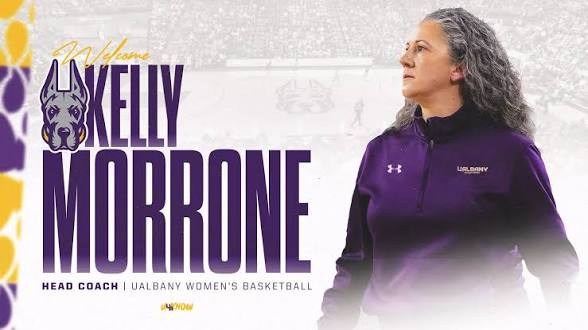
The South Carolina women’s basketball family continues to expand its footprint in the coaching world. Kelly Morrone, a former Gamecock standout who has spent more than two decades building programs at every level, has been named the next head coach of the Albany Great Danes — and the résumé she carries into that job reflects both the player she was and the coach she has become.
What She Is Walking Into
Albany finished the 2025-26 season at 14-16 overall and 4-12 in the America East Conference, losing in the first round of the conference tournament. It is a rebuilding situation — the kind that requires patience, program-building instincts, and a coaching identity strong enough to change a culture from the ground up.
Morrone has done exactly that before.
What She Has Already Built
Her most recent position — six seasons as head coach at Merrimack — tells the story most clearly. She oversaw the Warriors’ entire transition from lower-division to Division I competition, the most challenging institutional rebuild a coach can navigate. You are not just teaching basketball. You are building a program’s identity, recruiting infrastructure, and competitive standards simultaneously while competing against established programs in a Power Conference environment.
This past season, Merrimack posted a 19-13 record — the program’s best win total at the Division I level. Morrone went 15-5 in conference play and was named Coach of the Year in the Metro Atlantic Athletic Conference. The growth she produced at Merrimack is the clearest evidence of what she is capable of doing at Albany.
Before Merrimack, she spent seven years leading John Carroll University, and earlier served as an assistant at William & Mary, Rhode Island, Davidson, and Buffalo. The breadth of that experience — across multiple programs, multiple conferences, and multiple levels — gives her a coaching toolkit that goes well beyond any single system or philosophy.
The Player Behind the Coach
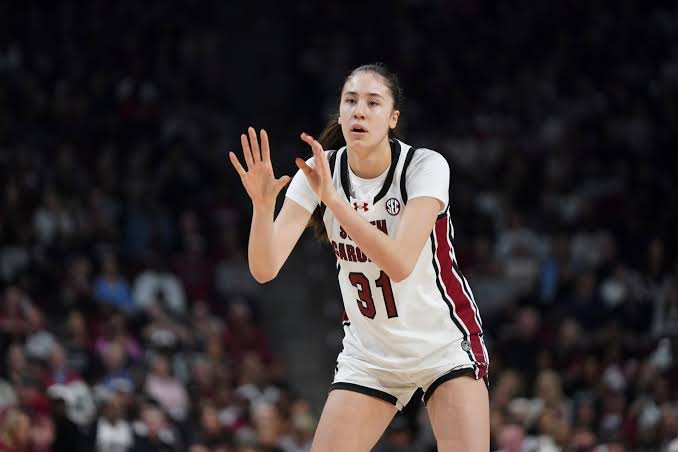
To understand why Morrone’s coaching identity is what it is, you have to understand the player she was at South Carolina from 1999 to 2004 under former head coach Susan Walvius.
She was a multi-year captain and starter — the kind of player programs build around, not around others. She was a prolific three-point shooter: 238 made outside jumpers, which places her third in program history. More remarkably, her 111 three-pointers in SEC play remains the most any Gamecock has ever made in conference competition. No one has broken it. She also accumulated 339 assists, placing her just outside the program’s all-time top ten — numbers that speak to a player who could both create for herself and elevate those around her.
The combination of scoring and playmaking she displayed as a player mirrors the program-building philosophy she has demonstrated as a coach: she has always understood that winning requires both individual production and collective function.
What Her Era at South Carolina Represented
Morrone’s playing career coincided with one of the most significant stretches in the program’s pre-Staley history. The 2001-02 Gamecocks won 25 games — a total that remains the program’s best mark outside of the Dawn Staley era — and advanced to the Elite Eight, the first time South Carolina had ever accomplished that feat. The following season brought another NCAA Tournament appearance, giving Morrone back-to-back postseason experiences that clearly shaped her understanding of what competitive women’s basketball demands.
She jumped into coaching almost immediately after her playing career ended, which suggests someone who knew exactly where her passion lay. Twenty-plus years later, she is now the head coach of a Division I program with a track record that demonstrates she was right to trust that instinct.
The Broader Significance
The South Carolina women’s basketball program has produced a remarkable number of coaches who have gone on to lead programs at the college level — a reflection of the culture Staley has built and, before her, the foundation that coaches like Walvius laid. Morrone belongs to that lineage, and her appointment at Albany adds another branch to a coaching tree that continues to grow.
For Albany, this is an investment in a coach who has already proven she can build from scratch, develop players, and win at the conference level. For Morrone, it is the next chapter of a career that has been quietly building toward exactly this kind of opportunity.
The Great Danes are getting a Gamecock who has been preparing for this moment her entire coaching life.