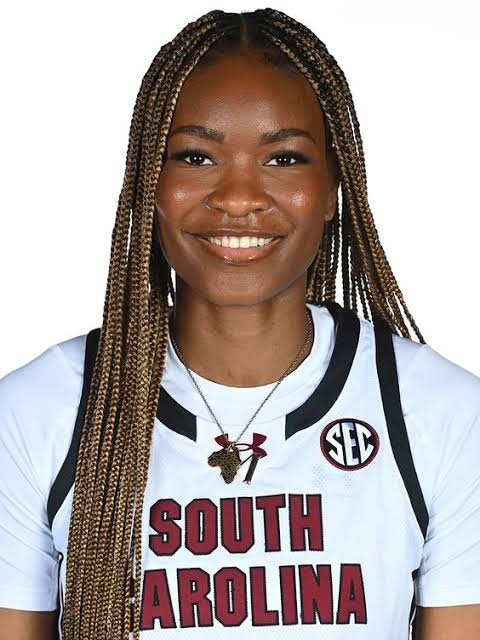
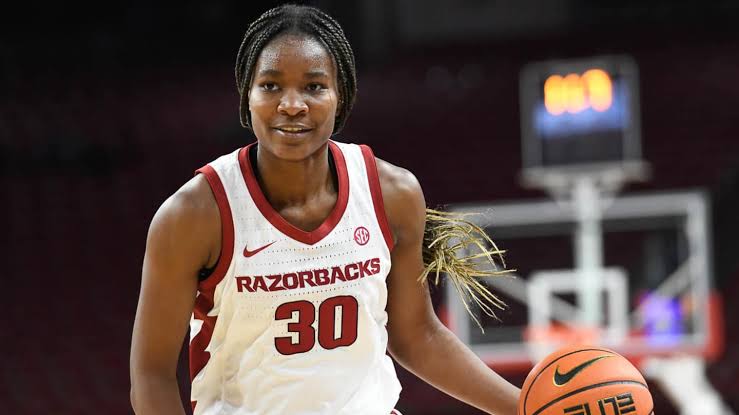
More Than a Box Score: Maryam Dauda and the Championship Character South Carolina Couldn’t Replace
PHOENIX — The storylines coming into this Final Four were easy to write. Raven Johnson and Ta’Niya Latson, high school teammates reunited in garnet and black, orchestrating one last run together before turning professional. It was a compelling narrative, and it was true.
But it was not the complete story of what made South Carolina’s season possible.
The Player the Numbers Never Captured
Maryam Dauda’s final college box score reads like a footnote: three points, two rebounds, 13 minutes against UCLA in the national championship game. Her two-year averages at South Carolina — 2.4 points and just over 2.5 rebounds per game — are the kind of numbers that disappear in the statistical noise of a program that regularly deploys future WNBA Draft picks.
None of that tells you who she actually was to this team. Dawn Staley did.
“I have to credit Maryam with just being a high-character individual. Super-competitive and just being probably the greatest teammate through not playing, through being a senior, and, I mean, she’s never packed it in. She’s always come to play.”
Consider the weight of what Staley is describing. Dauda was a senior, a graduate transfer who had earned genuine production at the Division I level, watching games she was entirely capable of contributing to from the bench. That situation breaks players. It breeds resentment, disengagement, and the quiet poison of unmet expectations that seeps into locker rooms and corrodes team chemistry. Dauda’s response was the opposite of all of that.
The Arkansas Detour and What It Reveals
Understanding Dauda’s South Carolina story requires understanding where she came from. At Arkansas in 2022-23, before her transfer to Columbia, she averaged 10 points and 6 rebounds per game — numbers that justified genuine optimism about what she might bring to a Final Four program. Staley herself publicly praised Dauda after a game against the Razorbacks, which suggests the admiration that preceded the recruitment was real and specific.
But the translation from Arkansas to South Carolina was never going to be simple. Dauda was producing those numbers in over 28 minutes per game within an offensive system built around her usage. South Carolina’s roster — loaded with current and future professionals — operated on entirely different principles. Minutes were not guaranteed. Touches were not allocated by reputation. You earned your place in the rotation every day in practice, and the competition for that place was relentless.
Even Dauda acknowledged that the statistical outcome of her final two seasons was not what anyone anticipated.
“I’m just cool with being a teammate. I felt like coming here and having the mindset of, like, winning. And then if I’m not on the court, I’m cheering on my teammate. And if I’m on the court, they reciprocate the same energy for me.”
That acceptance — genuine acceptance, not resignation dressed up as perspective — is rarer than any shooting percentage. The players who arrive at a program ranked ahead of them and choose collaboration over competition are the ones that championship teams are quietly built around.
The First Sub Off the Bench and the Recruiting Floor
What the raw numbers also don’t reflect is the role Dauda grew into as the season progressed. By the final quarter of the season, she had become the first substitute off the bench — a recognition from Staley’s staff that her presence on the floor, even in limited minutes, carried value that went beyond what she was being asked to score.
More significantly, Staley identified something about Dauda’s impact that extends well beyond this season’s roster. Every recruit South Carolina brought into the program over the past two years encountered Maryam Dauda as one of their first genuine points of contact with what this program’s culture actually looks like up close.
“She’s just a great teammate, a great friend, a great… just special. Probably every recruit that over the past two years that we’ve had come into our program, Maryam has impacted. So it’s not just who she is, it’s her contributions to our program, and I know she probably wanted to contribute a lot more from a basketball standpoint, but what she’s done off the court? Unmatched.”
That last word is the one to hold onto. Unmatched. From one of the most decorated coaches in the history of women’s basketball, describing a player who averaged 2.4 points per game. The disconnect between those two facts is the entire point.
What She Chose, and Why It Matters
The most telling detail of Dauda’s South Carolina chapter is the one she offered herself. Knowing how the statistics would read. Knowing the minutes would be limited. Knowing she was walking into a program where production was never guaranteed regardless of what she had done before. She said she would do it again.
The pull was not playing time. It was purpose. Winning, in the most complete sense of the word — not just the scoreboard, but the standard, the culture, and the experience of being part of something larger than individual performance.
That is a choice that requires a specific kind of self-awareness and maturity that has nothing to do with age. Some players never arrive at it. Dauda had it from the moment she stepped onto South Carolina’s campus.
The Legacy That Doesn’t Fit in a Stat Sheet
Championship programs are not built solely by the players whose names trend after games. They are built, in significant part, by the players who do the invisible work — the ones who push starters in practice every day, who make the locker room environment one that recruits want to enter, who demonstrate by example that the program’s values are not just talking points but lived commitments.
Maryam Dauda was that player for South Carolina across two seasons. She will leave Columbia without the statistical legacy her talent probably warranted, and with something considerably more durable — the genuine, unqualified respect of one of the greatest coaches the game has ever produced, and the knowledge that her presence shaped a program that will be competing for national championships long after this season is a memory.
The reunion of Johnson and Latson was the story everyone wanted to tell. Dauda was part of the story that made it possible.