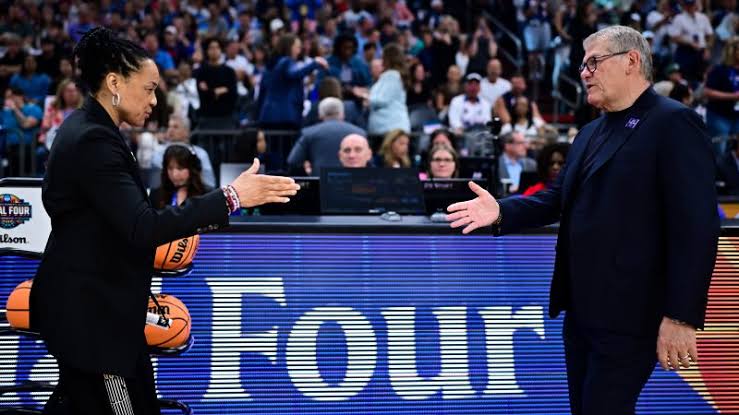
The confrontation was real, it was public, and it was ugly. But what followed it — in the days after South Carolina’s Final Four victory over UConn — may ultimately say more about both coaches than the sideline altercation ever could.
Dawn Staley has drawn a line. Not around the incident, but through it. Move on, she told the public. Turn the page. And in doing so, she demonstrated the kind of institutional leadership that has made her one of the most consequential figures in the history of women’s basketball.
What Happened, and What It Actually Was
The sequence is worth reconstructing clearly. UConn entered the Final Four as the most dominant team in the country — undefeated in the regular season, the No. 1 overall seed, and carrying the full weight of Geno Auriemma’s championship pedigree into Phoenix. South Carolina ended all of that with a 62-48 victory that was more comprehensive than the margin suggested.
In the aftermath, Auriemma cited frustration over the pre-game handshake — specifically, that South Carolina’s coaching staff took too long. What followed was a heated, visible exchange that required assistant coaches from both sidelines to intervene before either head coach walked away. The footage circulated immediately. The reaction was swift and largely critical of Auriemma.
And then Staley did something unexpected. She defended him.
Staley’s Statement: Generous, Strategic, and Entirely Intentional
Staley’s public response was not the statement of someone who had forgotten what happened or minimized her own experience. It was the statement of someone who made a deliberate choice about what the moment required of her — and of the sport.
“The standard at UConn is what it is because of him, and that’s something this game has benefited from.”
That line alone is worth examining carefully. Staley did not have to say it. She had every right to let the public criticism of Auriemma run its course. She had been falsely accused, publicly criticized in a live sideline interview while having no platform to respond, and subjected to a confrontation in the handshake line that she did not initiate. The moral high ground was entirely hers.
She chose to use it to protect the person who had put her in that position.
“So, I’m asking everyone to turn the page. Let’s refocus on what matters most — continuing to elevate our game, creating opportunities and pushing it forward.”
This is the language of someone who understands that women’s basketball’s continued growth depends on its most prominent figures modeling something better than what the news cycle rewards. Every day the confrontation remained the dominant story was a day the sport’s momentum — the attendance records, the television ratings, the cultural breakthrough that this tournament represented — got buried beneath a coaching dispute. Staley understood that. She acted on it.
Auriemma’s Response: Following a Lead He Should Have Set First
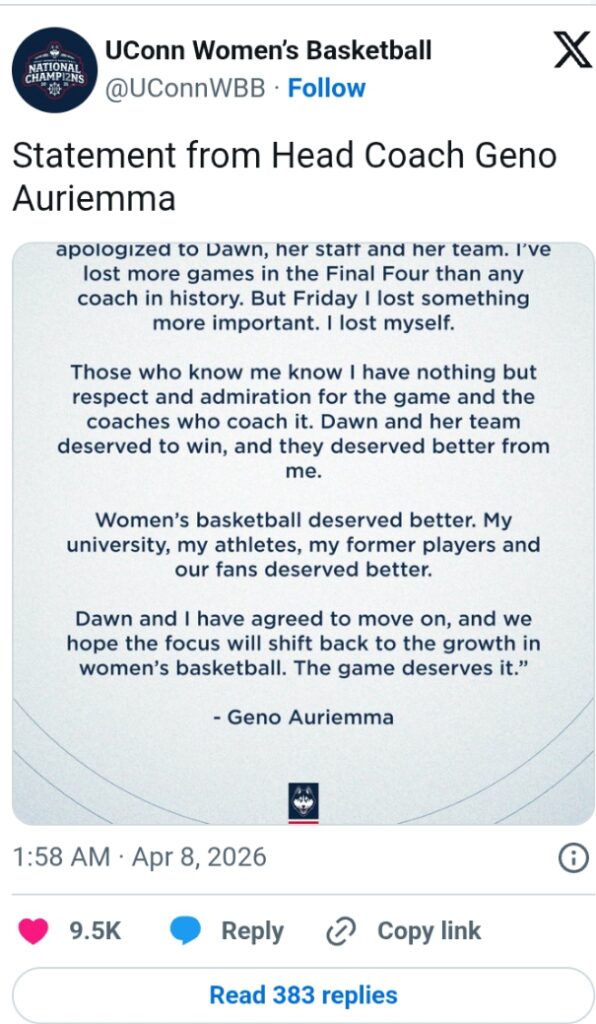
To his credit, Auriemma followed. He released a statement confirming that he had spoken directly with Staley, offered a personal apology to her and her staff, and acknowledged that he could have handled the situation more gracefully. His closing framing echoed Staley’s:
“Dawn and I have agreed to move on, and we hope the focus will shift back to the growth in women’s basketball. The game deserves it.”
The timing matters here. Auriemma’s public statement came after Staley’s — not before it. It was a response to her lead, not an independent act of accountability. That distinction does not erase the apology’s sincerity, but it does clarify who drove the resolution. Staley set the terms. Auriemma accepted them.
What the sequence reveals is something important about the power dynamic between these two programs in this particular moment. South Carolina is the sport’s reigning standard-bearer. Staley dictated the narrative not through volume or confrontation, but through deliberate, principled restraint. That is a different and more durable form of authority.
What This Means for the Sport
The broader context of this resolution matters as much as the resolution itself. Women’s basketball just concluded its most watched, most discussed, most culturally significant tournament in history. The sport is at an inflection point — the kind that only comes around once in a generation, where sustained momentum can translate into permanent structural growth in visibility, investment, and opportunity.
Staley’s instinct to protect that moment — to refuse to let a coaching confrontation become the defining story of the tournament’s aftermath — reflects a level of stewardship that goes beyond personal interest. She was not the one who needed to extend grace. She extended it anyway, because the sport needed her to.
The two programs will face each other again next season at a neutral site, which adds a compelling competitive dimension to what has now become one of the most watched rivalries in college basketball. Auriemma, who addressed retirement speculation directly by confirming he will return and is under contract through 2029, will bring UConn back with something to prove. Staley will bring South Carolina back with everything she always brings — preparation, defensive identity, and the quiet confidence of a program that has reached six consecutive Final Fours.
The Larger Takeaway
Passion in competition is not a character flaw. The fact that two of the most accomplished coaches in the history of the sport got into a heated confrontation at the end of an intensely competitive game is, in some sense, evidence of how much both of them care. Staley’s own framing acknowledged as much — this was an off-guard moment fueled by competitive intensity, not a window into either coach’s fundamental character.
What defines character is what comes after. Staley chose reconciliation over righteousness. She protected the person who had wronged her, protected the sport she has spent her career building, and walked away from a moment that most people would have weaponized. Auriemma, for his part, met that generosity with a direct apology and a public commitment to move forward.
The page has been turned. And women’s basketball — bigger, louder, and more consequential than it has ever been — is better for it.