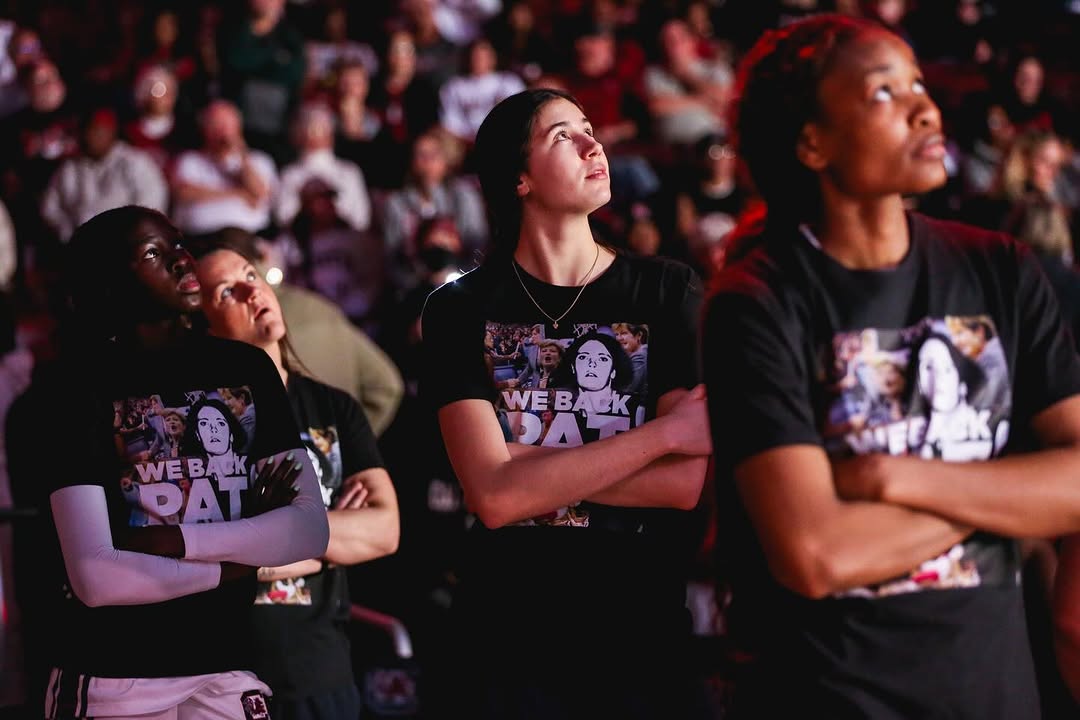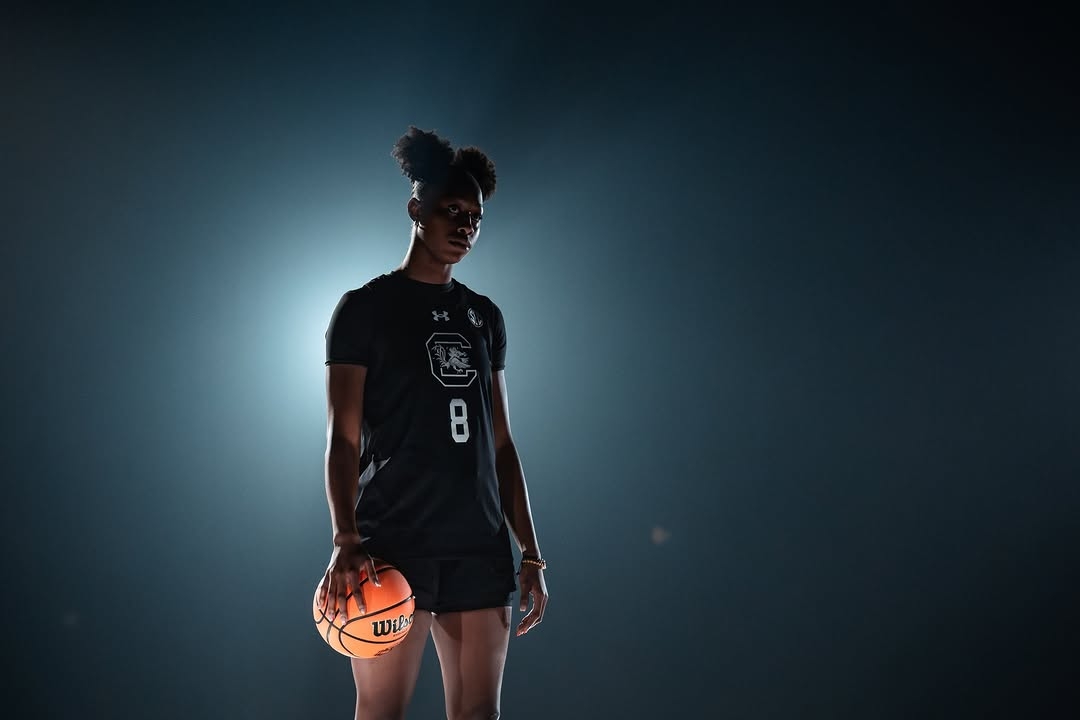
PHOENIX — You do not need to ask Joyce Edwards how she is feeling. You just need to look at her.
“We like to joke and say that anything she feels you’ll see it on her face before it comes out of her mouth, it’s just always been like that,” said sophomore Adhel Tac.
It is an endearing quality in a teammate and a revealing one in a leader. Because this season, South Carolina needed Edwards to do something that did not come naturally — to translate what she saw and felt on the court into words that could guide a frontcourt full of players looking to her for direction. The story of how she navigated that challenge is inseparable from the story of how South Carolina became a Final Four team again.
The Leadership Void Nobody Expected
Edwards arrived at South Carolina as a freshman last season and thrived quietly in a supporting role. She did not need to talk much. Sania Feagin handled the communication in the frontcourt. Chloe Kitts filled the gaps. Edwards could simply play — and playing, it turned out, was something she did exceptionally well.
Then Feagin graduated to the WNBA. Kitts stepped into the vocal leadership role over the summer, her voice the loudest in the building during preseason workouts. Then, before the season even began, Kitts tore her ACL in practice.
The chain of succession collapsed in an instant, and Edwards — a sophomore who had spent her first year specifically not being asked to lead verbally — was suddenly the anchor of a frontcourt that included Maryam Dauda, who averaged 6.4 minutes last season; Adhel Tac, who averaged 3.8; Madina Okot, a transfer center in just her second year of American basketball; and eventually Alicia Tournebize, an 18-year-old from France who joined the team in January. Every one of them was looking at Edwards for guidance.
“I definitely think she didn’t want it. She just wants to play basketball, just get out there and do her thing,” Tac said.
Edwards did not dispute the characterization.
“I mean, they’re kind of right. I do just want to ball, but I feel like at the end of the day, I have good stuff to say and have to say it to help the team,” she said.
Learning to Speak
The challenge for Edwards was not simply a matter of personality. It ran deeper than introversion.
“I come from a very blunt, honest family, and you can’t be like that to everybody,” she said. “Since middle school, I had trouble conveying what I meant.”
That kind of self-awareness is itself a form of growth. Knowing that your natural communication style does not translate cleanly to every relationship — and actively working to bridge that gap — is a skill most people spend years developing. Edwards has been doing it in real time, under SEC and NCAA Tournament conditions, at 19 years old.
“I had to step into a leadership role and I’m not really necessarily that vocal on the court,” Edwards said. “I feel like I just read off of people. It’s kind of hard for me to say things sometimes, and I don’t know what people need to hear, but just finding that balance of being vocal, still just playing basketball and not being too controlling over other people.”
The stakes of getting it wrong were high. South Carolina lost six players to injury or absence at various points this season — Kitts was the first, but far from the last. Each departure compressed the remaining roster and elevated the importance of Edwards’s voice. Tac articulated the stakes with particular clarity.
“She’s growing up in the fact that you can’t not talk, because a lot of the stuff we do is through you,” Tac said. “Our energy starts with you. Coach has told her and we’ve told her that she’s an anchor for us. When she’s good, we’re good. When she’s not, we’re not. The information that comes out of her mouth is very valuable and she recognized that. She’s taken such a huge leap.”
The On-Court Transformation
The leadership growth is inseparable from an equally striking statistical leap. Edwards is averaging 19.7 points this season — up from 12.7 as a freshman. She has posted two double-doubles in the NCAA Tournament. She is no longer quietly thriving off the bench; she is the offensive engine of a team with Final Four aspirations.
The connection between the two developments is not coincidental. When Edwards is fully present — reading defenses, communicating what she sees during timeouts, identifying what is and is not working — the entire team operates at a higher level. The on-court and off-court growth are feeding each other.
Dawn Staley has watched the entire arc with the appreciation of a coach who knows what accelerated development looks like.
“Joyce’s progress from Year 1 to Year 2 has been outstanding,” Staley said. “I think that progress got sped up a little bit more because of Chloe going down early in the season, and I think Joyce just took it upon herself to want to win. She studies the game. She knows what things she needs to correct from last season to this season, and she’s doing that in real time.”
Ta’Niya Latson, who played AAU basketball with Edwards before joining her at South Carolina as a transfer this season, has had the unique vantage point of watching this specific version of Edwards emerge.
“She’s having a breakout year, and I’m so proud of her, just to see her flourish every step, it’s been beautiful to see,” Latson said. “Her voice is very powerful. So whatever she says, the locker room is listening, and it’s a lot of pressure for a young kid to have that, but I feel like she carries it well and she’s doing her best.”
Still Figuring It Out — And That’s the Point
Edwards has not declared the leadership challenge solved. She describes it as an ongoing calibration — finding the balance between being vocal and being controlling, between knowing what she sees and knowing how to say it in a way that helps rather than overwhelms.
“It doesn’t make me uncomfortable, it’s just a little bit of an inconvenience in my opinion,” she said of the communication demands placed on her.
That phrasing is very Joyce Edwards — direct, slightly understated, completely honest. She is not performing comfort she does not feel. She is acknowledging the inconvenience of growth and doing it anyway.
The Gamecocks face UConn on Friday night at 7 p.m. ET in Phoenix, and Sarah Strong will be the most complete defensive challenge Edwards has faced this season. But South Carolina is not asking Edwards to be perfect. They are asking her to be present — on the court, in the huddle, in the moments when the team needs an anchor to hold everything steady.
Watch her face. She will tell you everything you need to know.