MuFive years in Baton Rouge. A national championship. Elite Eights. And still, the Gamecocks won’t budge. Mulkey’s postgame press conference was equal parts accountability, coaching philosophy, and painful honesty.
THE FOUL THAT WASN’T
The game was still winnable. Forty-five seconds left, down five, and LSU had two fouls to give. The plan was set — go trap, force a mistake, claw back into it. It never happened.
Kim Mulkey didn’t sugarcoat it.
“We were going to go trap. We didn’t do it. There’s just a small margin of error that you can have to beat elite teams. We think we’re an elite team, but we’re not there to win those close games against the South Carolinas, the UConns.”
That sentence — we think we’re an elite team, but we’re not there — is remarkable for its precision and its honesty. Mulkey wasn’t throwing her players under the bus. She was diagnosing the program’s exact developmental position with surgical clarity. LSU is talented enough to compete with the best in the country. They are not yet conditioned, mentally or habitually, to execute when everything is on the line against those teams.
“That margin of error are little things like that. We had two fouls to give, and, man, we were going to go for a steal right there, a quick trap. You don’t get it, use one of the fouls. We just — I don’t want to say lose our composure, but we just don’t do it.”
The distinction Mulkey is drawing matters. This wasn’t a talent gap. It wasn’t a scheme problem. It was a moment where the plan — a good plan, an executable plan — simply didn’t get carried out. And against South Carolina, those are the moments that decide games.
Her response to her players in the locker room wasn’t punishment. It was instruction.
“So that’s why you stay in a locker room tonight. Not to get — to teach. You guys that were on the floor, tell me why we didn’t do that, okay? Tell me why, when you come out of that time-out, we didn’t run this play. Just teaching moments in a big — on a big, big stage like this.”
That is the voice of a coach who has won before, who knows what winning requires, and who refuses to let a loss go to waste.
THE EXPERIENCE GAP SHE WON’T IGNORE
When pressed on where the mental lapses originate — particularly frustrating given the veterans in the lineup — Mulkey offered an answer that was more philosophical than deflective.
“Maybe just being in that moment numerous times. Experience. I don’t really know because you’ve got seniors in that time-out. You’ve got juniors in that time-out. You’ve got sophomore and you’ve got new players, freshmen. They all just have those lapses like that. I don’t know.”
The admission that she doesn’t fully know is telling in the best way. Mulkey isn’t manufacturing excuses. She’s grappling honestly with one of basketball’s most persistent puzzles — how do you manufacture clutch? How do you build the kind of composure that South Carolina’s roster has institutionalized over 18 years under Dawn Staley?
She returned to that theme repeatedly throughout the press conference. Looking at the stat sheet, she noted just how evenly matched these teams were — and then identified exactly where the margins broke down.
“Look at the stat sheet, how similar. Look at the stat sheet. So what are those little things, maybe that one last tough rebound. Maybe that one last tough defensive presence. Those are things that don’t show up on the stat sheet, but those are the things that 18 years of being at South Carolina — and Raven’s a senior. Latson is a senior. Is Okot a senior? That’s what you’re talking about, because they have that experience. They have that toughness. They don’t get rattled. That comes with time.”
This is the core of Mulkey’s argument, and it’s an intellectually honest one. The things that separate these programs in the final minutes aren’t drawn up in practice — they’re accumulated over years of high-stakes repetition. South Carolina’s seniors have been in these moments. They know what it feels like. That knowing is not transferable through film sessions or timeouts.
THE DAWN STALEY COMPARISON — AND THE FIVE-YEAR REALITY CHECK
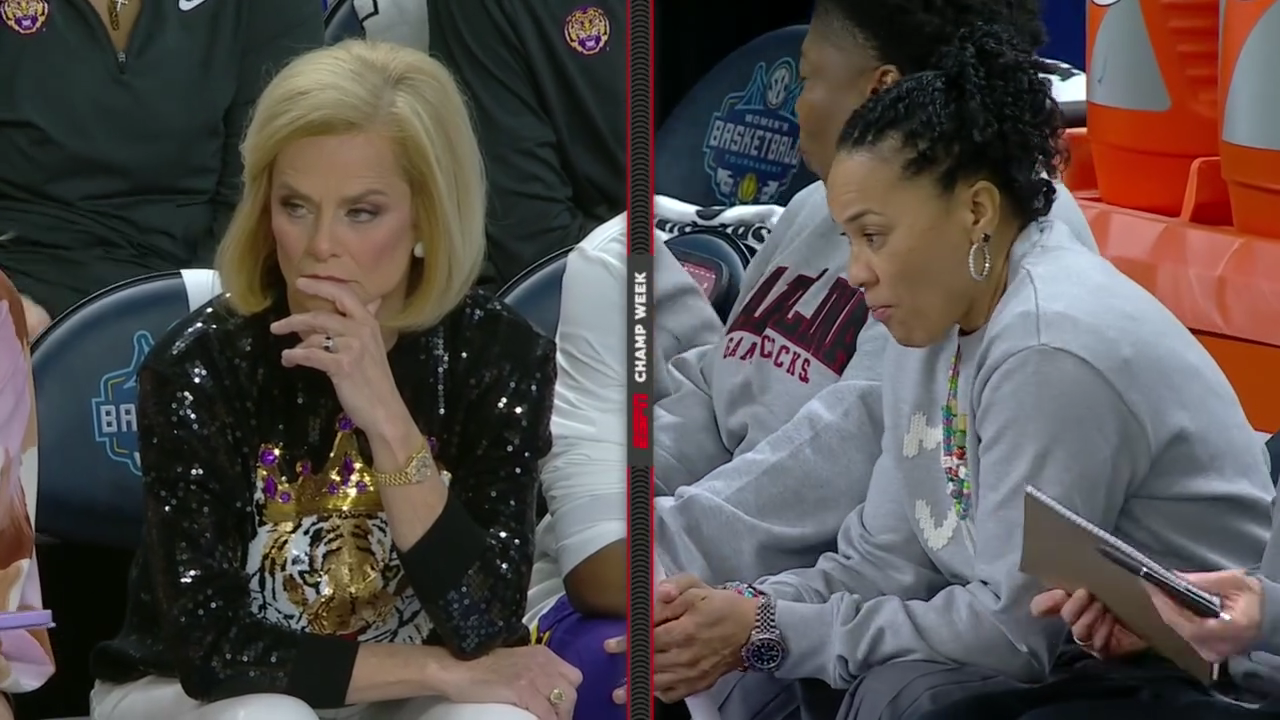
When a reporter noted that LSU still hasn’t beaten South Carolina under Mulkey’s watch, she responded not with frustration but with perspective — and a pointed question of her own.
“How long has Dawn been at South Carolina?”
Eighteen years, came the answer.
“18 years. I was at Baylor 21 years. It takes time to lay that foundation. Man, has she laid it and, man, are they good. I’ve been at LSU five years. We’ve won a National Championship, right? We’ve been in numerous Elite Eights. It takes time. And, man, we are just clawing and trying our best. I think we’re doing pretty good. We’re so close. We’re so close.”
The repetition of we’re so close is not denial. It’s the measured frustration of a coach who can see the gap clearly and knows the only answer is time — while also knowing that time is the one resource you can’t recruit or scheme your way into.
Mulkey’s Baylor reference is instructive. She didn’t build that dynasty overnight either. The patience required to construct a program that wins in the final minutes of SEC Tournament semifinals is generational work. Five years at LSU, with a national title already on the shelf, is not failure. But it’s also not yet South Carolina.
THE TRANSFER ERA COMPLICATION
Mulkey added one more layer to the development challenge that cuts deeper than the X’s and O’s. Building long-term toughness is harder now than it has ever been.
“What’s the negative? Today’s college athletic world? You don’t know who you’re going to coach next year. Man, you don’t know who’s transferring, who’s staying, who’s going. So it’s kind of tougher now than it was 10 or 15 years ago.”
This is a point that doesn’t get enough attention in the conversation about elite program building. Staley’s 18-year foundation at South Carolina was built in an era where rosters had far more stability. The player-development pipeline that creates senior leaders who “don’t get rattled” is genuinely harder to maintain when the transfer portal reshuffles rosters every spring. Mulkey isn’t complaining — she’s identifying a structural reality that affects every program trying to close the gap on entrenched dynasties.
RAVEN JOHNSON, FLAU’JAE, AND TACTICAL HONESTY
Mulkey’s tactical assessments throughout the press conference were refreshingly direct. On Raven Johnson’s 40% three-point shooting and eight-assist performance, she offered nothing but respect.
“It’s very difficult. She’s their leader. She’s their leader. She not only scored from the 3, she had eight assists to one turnover. She’s a Defensive Player of the Year in this league. That’s what you want. You want leaders like that, and she makes everybody else better.”
On Flau’jae Johnson going 1-for-8 from the field, Mulkey was characteristically blunt — and characteristically constructive.
“She was not shooting it well. What was she, 1 for 8? 1 for 8, made her free throws. Do other things. When you’re not shooting it well, this game has lots of parts to it, go rebound, defend. Do some other things when your shot’s not falling. You’re not going to have good shooting nights all the time. So go contribute in other ways.”
That’s not a criticism. That’s a coaching principle. Stars go cold. Great teams survive it. LSU, on this night, could not.
On MiLaysia Fulwiley’s 24-point performance against her former team, Mulkey was loving but clear-eyed about what it ultimately means.
“MiLaysia’s game is such that she’s going to do something you’ve never seen before on the floor. So don’t blink. Then she’s going to make you pull your hair out the next time.” She paused, then added the sharpest line of the night: “But she doesn’t really care about that tonight. What she cares about is she lost. She cares about her team losing and how good she played here. What does that really mean if you lose?”
In one sentence, Mulkey reframed Fulwiley’s entire night through the only lens that matters to a competitor — the final score.
THE BOTTOM LINE
Kim Mulkey’s postgame press conference was a masterclass in coaching accountability. She identified the exact play that cost her team. She explained the experience deficit without hiding behind it. She credited South Carolina without diminishing her own program. And she articulated, with complete clarity, exactly what LSU needs to become to take the next step.
The gap between these programs is real — but it is not talent. It is not coaching. It is not ambition. It is time, repetition, and the kind of institutional toughness that only comes from years of doing it together on the biggest stages.
Mulkey knows this. She built it once before at Baylor over 21 years.
She’s got five years in Baton Rouge. The blueprint is already drawn.