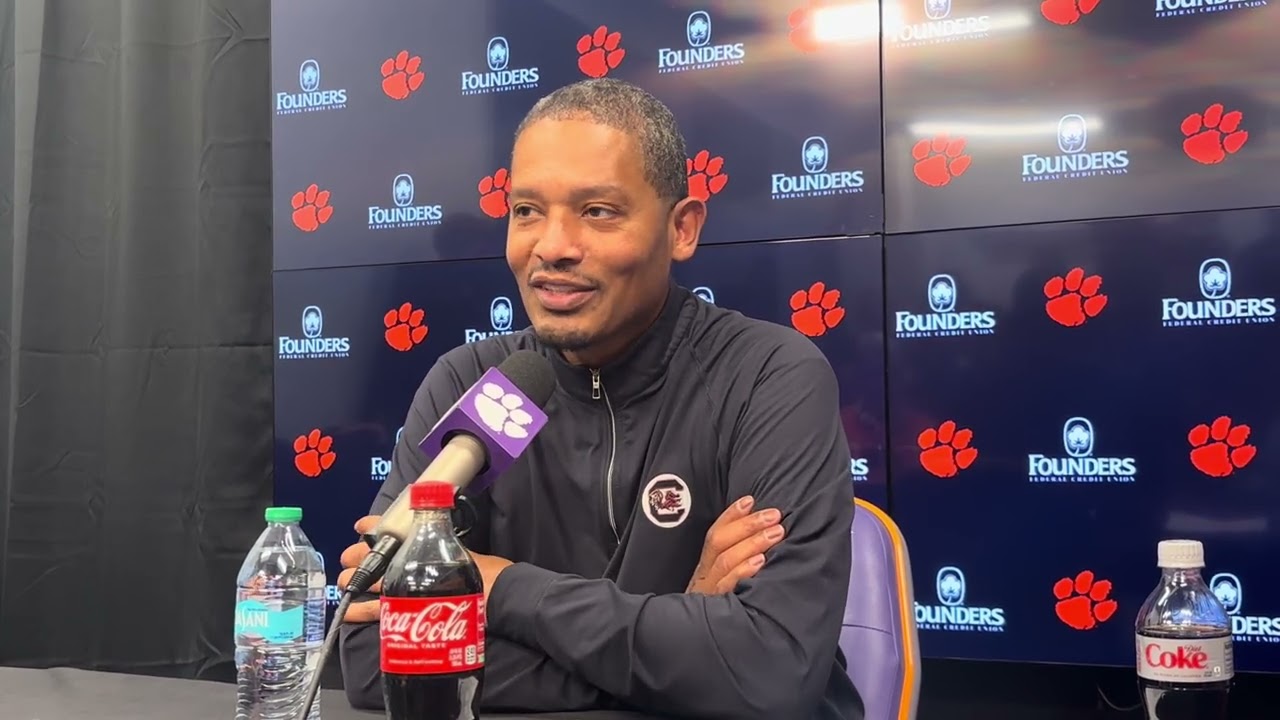
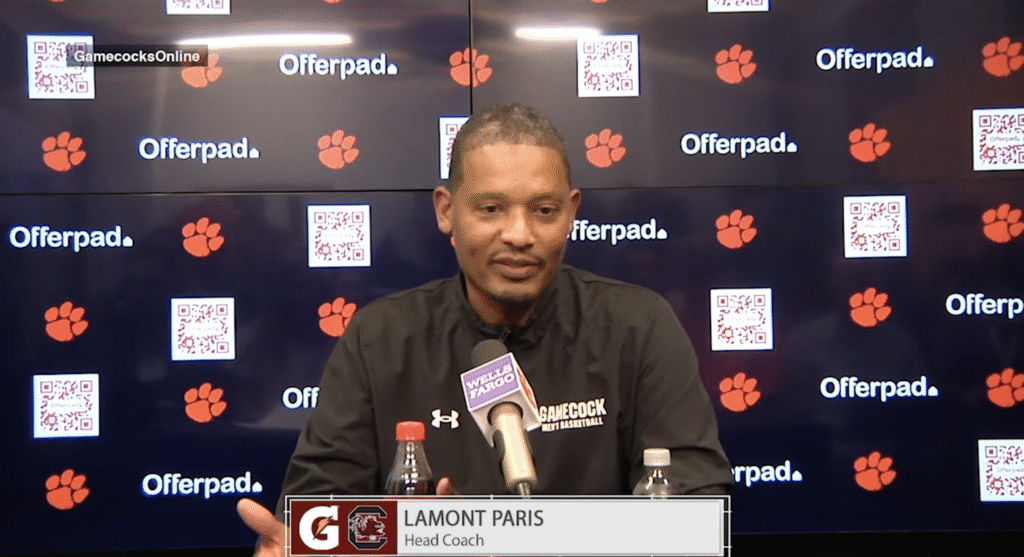
South Carolina men’s basketball head coach Lamont Paris addressed the media Monday night after the Gamecocks dropped a 68–61 road decision to Clemson, offering a candid assessment of his team’s effort, offensive struggles and areas that still need growth.
Below is a paraphrased and original rewrite of everything Paris shared, with all quotes preserved.
Opening Statement
Paris began by acknowledging his team’s effort level, while also making it clear that effort alone wasn’t enough.
“Well, we played hard. I think we at least checked that box,” Paris said. “I’m not a, ‘Oh, we played hard, everything must have went great.’ I only acknowledged that to our team because I think we played harder than we had been, particularly in terms of physicality on the defensive side.”
While pleased with the increased toughness, Paris emphasized that it must be paired with better execution.
“But then you have to combine that with playing a little better, also. So, we didn’t do that. You come into an environment like this on the road, against a good team… you don’t have to play great… but you’re going to have to play hard, you’re going to have to play smart… and you’re going to have to play halfway decent offensively.”
That offensive standard wasn’t met, according to Paris.
“We did not achieve that in terms of our overall performance offensively. Their pressure bothered us a little bit at times… but ultimately we did have some clean looks, and cumulatively we did not perform.”
On the Continued Struggles from Three-Point Range
Asked whether the team’s missed three-pointers are more mental than mechanical, Paris admitted the answer isn’t yet clear.
“That’s a good question. I don’t know. We’re going to try and get to the bottom of it.”
Paris explained that the roster was intentionally built to rely on volume shooting, especially given the modern style of play.
“Our team was constructed, in a way, with that part. I mean, that’s what basketball is today… our league is taking the most three-point attempts of any high major conference out there.”
However, the inconsistency remains puzzling.
“On the days we shoot well it seems like everyone shoots a pretty high percentage. On the days that we don’t, it seems like no one is able to shoot.”
Paris pushed back on the idea that one player’s misses affect another’s.
“Contrary to popular belief, your performance from the three-point line doesn’t really affect what my performance from the three-point line is.”
He added that some players may be pressing.
“We got a couple of guys that are probably overdoing it in terms of how many shots they are getting up… trying to shake off a little shooting rust.”
On Being Outscored Off the Bench
Clemson held a significant bench scoring advantage, and Paris cited multiple factors, including the absence of Eli Ellis.
“Yeah, they were physical. We didn’t play as many guys as many minutes… Eli averages almost 30 minutes in.”
Physical defense limited off-ball movement and cutting.
“They were physical in terms of stopping us from cutting; we were discouraged by that.”
Paris also noted rotation decisions and missed opportunities near the rim.
“We got the ball around the basket a couple of times, then Christ [Essandoko] missed one or two around the basket and a couple of other guys.”
Still, Paris downplayed bench scoring comparisons.
“In the short term, it’s probably one of the least meaningful stats to me… at the end of the day, it turns into your final score to their final score.”
He acknowledged Ellis’ absence was felt beyond scoring.
“A lot of that is Eli… he also gets a few assists every game and generates offense with his penetration.”
On Improved Physicality and Interior Defense
Paris credited the team’s rebounding and paint defense to a renewed emphasis on toughness.
“I’m just waiting for the game that you can win without any level of physicality.”
He pointed to earlier games as a wake-up call.
“The Butler game was the first time that it was like, ‘Whoa, this is what it looks like for real physical guys.’”
Before the Clemson matchup, Paris made the message clear.
“If you’re not going to play physical basketball against these guys… we could have saved all the travel costs.”
That message resonated.
“Maybe for some level they were prepared to do that because they bought what I was selling in that instance.”
On Late-Game Offensive Adjustments
As South Carolina trimmed the deficit late, Paris said the shift toward attacking the basket was intentional.
“When you really need baskets to happen quicker… we gotta get straight to the business.”
The Gamecocks leaned more heavily on ball screens late.
“Our offense isn’t constructed that way generally… but when you’re trying to generate quicker shots, that’s really what it is.”
Paris liked the aggressiveness, even if the results weren’t perfect.
“We drew some fouls… Meechie got down and made a couple of strong moves at the end.”
On Quad 1 and Quad 2 Losses
Despite falling short again against a high-level opponent, Paris remains focused on development.
“I’m concerned with improving more than anything.”
He emphasized that SEC play will offer no shortage of opportunities.
“Our mettle will be tested in the SEC like no one else’s… that’s the toughest league from top to bottom.”
Paris isn’t worried about résumé opportunities.
“Every road game… I can’t imagine a road game that’s not going to be a Quad 1.”
“It’s not concerning to me. We have to continue to improve.”
On the Late-Game Zone Defense and Eli Ellis’ Status
Paris confirmed South Carolina did switch to zone defense late.
“We did. We went to the zone. They didn’t score against the zone if I recall.”
The decision was driven by fouls and rebounding concerns.
“That was kind of the ultimate domino that made me say, ‘Let’s go to the zone.’”
He was encouraged by the execution.
“With not as much prep on it, we went out there and executed the zone fairly well… it created a little indecision.”
As for Ellis, Paris explained why the guard ultimately did not play.
“Eli went through shootaround today… but I personally was not that optimistic.”
After consulting with trainers, Ellis made the call.
“He didn’t think he was able to go and be able to do things.”
Paris believed sitting him was the right decision.
“Why would we do that? … It just seemed to make sense that he wasn’t out there.”
Despite the loss, Paris left encouraged by incremental progress, especially in toughness — but acknowledged that significant improvement is still required as SEC play looms.


