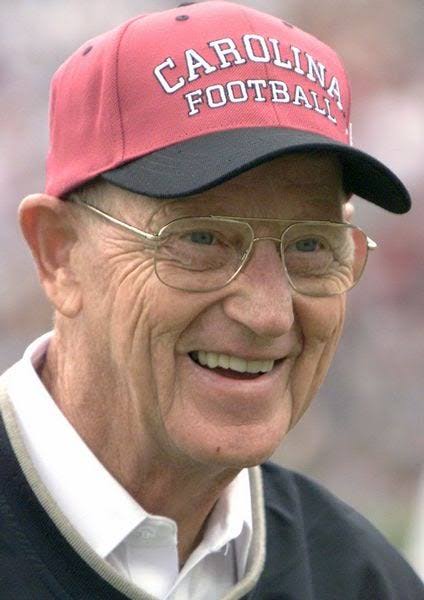
Lou Holtz — College Football Hall of Famer, national champion, motivational icon, and one of the most consequential coaches in the sport’s history — passed away on Wednesday, March 4, 2026, at his home in Orlando, Florida. He was 89 years old, surrounded by his family. Notre Dame University confirmed his passing; a cause of death was not provided by the family.
His death ends a life defined by an almost paradoxical combination of humility and greatness. He was a man who joked that he had a face made for radio and a voice made for print — yet those who sat in his locker room knew there was no more commanding presence in college football. He stood barely five feet, ten inches, wore thick glasses and spoke with a trademark lisp. None of it mattered once he started talking.
Over 33 seasons as a college head coach, Holtz compiled a record of 249–132–7, led six different programs to bowl games — a feat no other coach in history has matched — and reached the summit of the sport with Notre Dame’s 1988 National Championship. He is survived by his four children: Luanne, Lou Jr. (“Skip”), Kevin, and Elizabeth. He was preceded in death by his wife of more than 50 years, Beth Barcus Holtz, who passed away in June 2020.
His family’s formal statement read, in part:
“Louis Leo ‘Lou’ Holtz, legendary college football coach, Hall of Famer, bestselling author, and one of America’s most influential motivational voices, has passed away at the age of 89 in Orlando, Florida, surrounded by family. Born January 6, 1937, in Follansbee, West Virginia, Holtz rose from humble beginnings to become one of the most respected figures in college athletics. Holtz is remembered for his enduring values of faith, family, service, and an unwavering belief in the potential of others.”
A Legacy Built on Resurrection
What set Lou Holtz apart from nearly every coach of his era was not simply his ability to win — it was his ability to transform. When Holtz arrived at a program, he typically inherited wreckage. When he left, he typically left behind a foundation. He did this not once or twice but repeatedly, across decades and across conferences.
He turned William & Mary into a Southern Conference contender. He took NC State to four consecutive bowl games — something the program had never accomplished — and posted a 33–12–3 record in four seasons. At Arkansas in 1977, his very first year as Razorbacks head coach, Holtz went 11–1 and engineered one of the great upsets in bowl game history, defeating top-ranked Oklahoma in the Orange Bowl. He was named national Coach of the Year. The man had just arrived.
After two seasons at Minnesota — where he again revived a dormant program, recorded a 10–12 mark and secured a bowl bid before departing for South Bend — Holtz arrived at Notre Dame in 1986 and assembled one of the most dominant sustained runs in the sport’s modern era.
Notre Dame: The Making of a Legend
Notre Dame had not won a national championship since Ara Parseghian in 1973. The program, once the undisputed throne of college football, had drifted. Holtz was hired as the 25th head coach in program history and began quietly reshaping the culture, the roster, and the expectations.
By 1988, the transformation was complete. The Fighting Irish went 12–0, capping a perfect season with a 34–21 victory over West Virginia in the Fiesta Bowl to claim the National Championship. That championship launched a 64–9–1 run — an .871 winning percentage over six seasons — that included a 23-game winning streak, back-to-back 12-win seasons (the first in school history), and nine consecutive bowl appearances. Holtz stands third all-time in program victories at Notre Dame with 100, behind only Knute Rockne (105) and Brian Kelly (113).
Notre Dame acknowledged his role in establishing the famous “Play Like A Champion Today” sign at the base of the locker room steps — a tradition so embedded in the program’s culture that players still tap it before every home game. He also removed player names from the backs of jerseys during the regular season, an enduring statement about collective identity over individual achievement that Notre Dame continues to this day.
Former Notre Dame quarterback Brady Quinn, who enrolled seven years after Holtz left, nonetheless captured the essence of his legacy: “Holtz was a Notre Dame man, had the heart of a champion and embodied the Notre Dame spirit.”
The Pro Detour — and a Revealing Exit
In the mid-1970s, between his college success at NC State and his resurrection of Arkansas, Holtz accepted the head coaching position with the New York Jets in 1976. He went 3–10 and resigned before the season formally concluded. It was a brief and instructive chapter.
His candid self-assessment became one of the most quoted lines of his career: “God did not put Lou Holtz on this earth to coach in the pros.” The remark was not bitterness. It was clarity. He returned to college football in 1977 and never looked back. Within one year, he was national Coach of the Year.
Columbia: Proof of What Was Possible
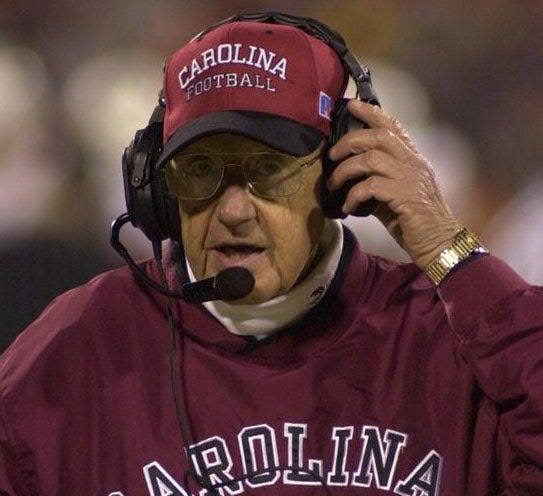
For South Carolina fans, Holtz’s legacy occupies a separate and deeply personal chapter. When Athletic Director Mike McGee hired him in 1999 — in what would be one of two transformative coaching appointments McGee made at the institution — the Gamecocks had just finished 1–10 in Brad Scott’s final season and were mired in a 21-game losing streak. The program was, by most reasonable assessments, at its lowest point in decades.
Holtz’s first season in Columbia produced an 0–11 record — a continuation of the losing streak driven in large part by a relentless wave of injuries that tested the roster’s depth at every position. The scoreboard did not change immediately. But something beneath the surface did. Holtz installed his system, imposed his standards, and refused to let the program settle for what it had become. The losing streak continued in body, but it had already ended in spirit.
In 2000, South Carolina went 8–4 and defeated Ohio State in the Outback Bowl. The following year, the Gamecocks went 9–3 and won the Outback Bowl again. Back-to-back New Year’s bowl victories, back-to-back seasons above .500 — from an institution that had not had either in years. It stands as one of the most dramatic two-season turnarounds in modern college football history.
Holtz’s final three seasons (5–7, 5–7, 6–6) revealed the program’s continued structural limitations — limitations that would require the investment and charisma of another visionary to solve. He retired following 2004. But the proof of concept he established in Columbia proved essential. When McGee brought in Steve Spurrier — Holtz’s longtime friend and his second blockbuster hire — the infrastructure and belief system that Holtz had installed provided the platform for South Carolina’s golden era: an SEC East division title in 2010 and three consecutive 11-win seasons from 2011 to 2013.
Faith, Family, and the Medal of Freedom
Holtz was a man of deep Catholic faith, and that faith informed everything — his philosophy, his program-building, his philanthropy. At Notre Dame especially, it was part of the fabric of his coaching identity.
The Holtz family made substantial gifts to Notre Dame over decades: funding the renovation of residence hall chapels, establishing scholarships for students with financial need, and donating to the Hesburgh Library, which named its grand reading room for Beth and Lou Holtz in 2021. Holtz also co-founded Holtz’s Heroes, a charitable foundation supporting former student-athletes facing hardship.
In December 2020, Holtz received the Presidential Medal of Freedom from President Donald Trump. He described it as the most humbling accolade of his life. Yet even as he received the nation’s highest civilian honor, Holtz’s most personal reflections returned not to football but to fatherhood: “Most important thing I learned as a father was to never say a negative word to your wife in front of your children. To this day, my children are saints and my wife (was) a saint.”
The Statue, the Sign, and the Send-Off
Holtz was inducted into the College Football Hall of Fame in 2008. That same year, a bronze statue of the coach in his signature cap — flanked by two players — was dedicated outside Notre Dame Stadium. He was, in a literal sense, permanently part of the landscape of college football’s most storied venue.
After retiring from coaching in 2004, Holtz joined ESPN as a college football analyst, where his storytelling, wit, and willingness to say what others wouldn’t made him a beloved presence on Saturday programming for years. Though he had stayed largely distant from the South Carolina program in retirement, he attended the 2022 Gator Bowl when the Gamecocks faced Notre Dame — a reunion of two chapters of his coaching life, brought together one last time on a football field.
In the fall of 2025, Holtz returned to the Notre Dame campus to present the colors before kickoff at a home game. It was his final public appearance at the school he loved most. Weeks later, he entered hospice care. On March 4, 2026, at the age of 89, college football lost one of its last irreplaceable figures.
Notre Dame’s statement captured the full weight of the loss: “Notre Dame mourns the loss of Lou Holtz, a legendary football coach, a beloved member of the Notre Dame family and devoted husband, father and grandfather. Whenever Notre Dame called to ask for his help, Lou answered with his characteristic generosity, and he will be sorely missed.”
Lou Holtz | January 6, 1937 – March 4, 2026
He is survived by his four children, nine grandchildren, and two great grandchildren. A Mass of Christian Burial will be held at the Basilica of the Sacred Heart at the University of Notre Dame.
Sources: Notre Dame Athletics, CBS Sports, Associated Press, Fox News, On3, WSBT, Newsweek