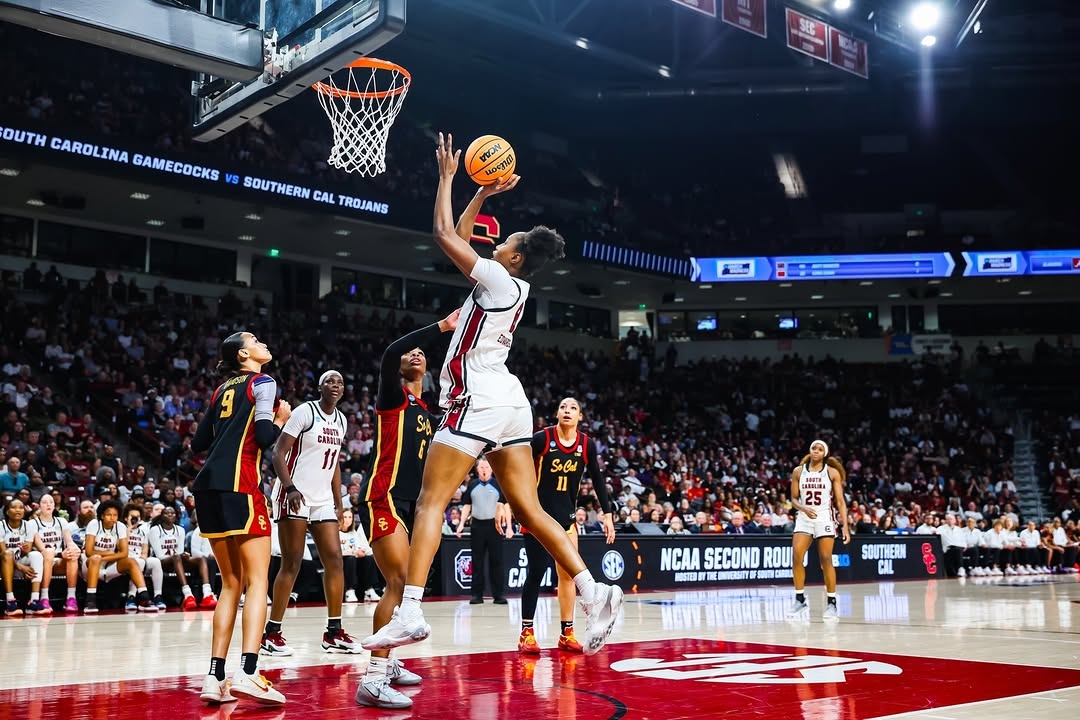
When South Carolina and TCU tip off Monday night at Golden 1 Center, the stakes are clear: a Final Four berth in Phoenix against UConn awaits the winner. For South Carolina, it would be a sixth consecutive Final Four appearance — a run of sustained dominance that has no peer in the modern era of women’s college basketball. For TCU, it would be the program’s first ever.
Those aren’t just narrative details. They represent the gap in institutional experience these two programs carry into Monday night.
The State of Both Teams Heading In
South Carolina arrives off a 94-68 demolition of Oklahoma — a performance that was less a close call than a statement. The Gamecocks have flirted with three 100-point performances this tournament, yet their players insist they haven’t yet reached their ceiling. That combination — dominant results paired with genuine belief that more is available — is what makes this team genuinely dangerous.
TCU’s path has been more turbulent. The Horned Frogs survived Virginia 79-69 in the Sweet 16, a scoreline that required considerably more effort than South Carolina’s margin suggests. Before that, TCU showed vulnerability against Washington — a data point that becomes significant when measuring how TCU might respond to the kind of sustained, suffocating pressure South Carolina applies over 40 minutes.
The Matchup Grid
The individual battles across the floor tell the story of this game’s complexity.
Raven Johnson vs. Olivia Miles is the marquee duel — two of the five finalists for the Nancy Lieberman Point Guard of the Year Award, playing against each other with a Final Four trip on the line. Miles is averaging a triple-double in tournament play. Johnson is the SEC Defensive Player of the Year. Neither will make it easy for the other.
Marta Suarez vs. Joyce Edwards is the forward matchup that could quietly decide the game. Edwards leads South Carolina at 19.9 points per game and draws constant double and triple-teams, which is precisely what creates opportunity for South Carolina’s guards. If Suarez — who scored 33 points in the Sweet 16 — can force similar attention, TCU’s offensive burden becomes more distributed. If she can’t, the load falls almost entirely back on Miles.
Clara Silva vs. Madina Okot is the battle in the post that TCU specifically built its offseason around. Silva was brought in from Kentucky precisely because of the size disadvantage TCU felt against South Carolina in December. Okot had 14 rebounds in the Sweet 16. This matchup will likely determine which team controls the glass — and Campbell has made clear he views rebounding as a prerequisite, not an advantage, for having any chance against the Gamecocks.
What the Analysts Are Saying
Both analysts covering this game for their respective publications land on South Carolina — but with meaningfully different reasoning.
Lulu Kesin of The Greenville News sees this as the tournament’s most competitive test for the Gamecocks yet, while still expecting them to advance:
“This could be the closest game for South Carolina this tournament and will come down to execution. But despite almost three 100-point games, the Gamecocks say they still have room to grow with their best basketball left to play.”
Kesin’s framing is analytically honest. South Carolina has been dominant, but TCU — with Miles and Suarez capable of producing historic individual performances — is not Oklahoma. The margin for error shrinks, and execution becomes the determining factor rather than raw talent differential.
Tia Reid of The Clarion Ledger takes a sharper position, pointing to TCU’s tournament résumé as evidence the gap may be wider than the seeding suggests:
“South Carolina is clicking on all cylinders at this point in the tournament, and it just seems unlikely that this TCU team that struggled against Washington and Virginia will have a chance against the Gamecocks.”
Reid’s skepticism is grounded in a legitimate observation. TCU has won, but not convincingly. South Carolina has won, and done so while rotating 10 players and holding its leading scorer to eight points in the Sweet 16 while still winning by 26. Those are not equivalent tournament performances.
Score Predictions
Lulu Kesin: South Carolina 84, TCU 72
Tia Reid: South Carolina 87, TCU 62
The spread between those two predictions — 12 versus 25 points — captures the genuine analytical disagreement about whether TCU can make this competitive. Kesin sees a game that stays close because of Miles and Suarez. Reid sees South Carolina’s depth overwhelming a thin Horned Frog rotation before the second half is over.
Both outcomes are plausible. The 25-point blowout scenario becomes most likely if TCU’s foul trouble materializes early, forcing Campbell deeper into a bench that has averaged just 13.5 points per game. The 12-point game becomes likely if Miles and Suarez avoid foul trouble and sustain the kind of two-player offensive dominance they demonstrated in the Sweet 16.
Game Information
Date: Monday, March 30
Time: 9 p.m. ET
Location: Golden 1 Center — Sacramento, California
TV: ESPN
Streaming: ESPN+, ESPN app, Fubo (free trial available for new subscribers)
Broadcast team: Courtney Lyle, Stephanie White, Kris Budden and Violet Palmer
The Bottom Line
South Carolina enters as the prohibitive favorite — and rightfully so. Six consecutive Final Fours don’t happen by accident, and this Gamecock team may be better constructed than any of the previous five. Their depth is real, their guard trio is elite, and their frontcourt has the size to match TCU’s most significant offseason investment.
But TCU is not here by accident either. Miles and Suarez have demonstrated the capacity to carry a team to places conventional roster analysis suggests it shouldn’t reach. If there is a path to an upset, it runs through those two players staying on the floor, staying out of foul trouble, and delivering another combined masterpiece — this time against the best defensive program in the country.
Monday night will reveal whether TCU’s two-player brilliance can outlast South Carolina’s five-player depth. History, roster construction, and tournament trajectory all point the same direction. But that’s what makes Miles and Suarez so compelling — they’ve already done things this tournament that history said shouldn’t be possible.