On March 30, 2025, Raven Johnson and South Carolina escaped with a 54-50 Elite Eight win over Duke in Birmingham. Johnson’s stat line was quietly impactful — seven points, five rebounds, three steals, a block, and an assist — but she posted the team’s best plus-minus at +10, and delivered a clutch steal and free throws when it mattered most in the fourth quarter.
It had been a difficult personal season. Johnson had posted career lows in assists and shooting percentage, and the frustration showed in her postgame candor.
“I do see all the stuff on Twitter, people saying I can’t score the ball, things like that,” Johnson acknowledged, “but I find a way to win. I don’t need to score the ball. I have players one through 12 in this building that can score the ball. But when I need to score the ball, I can score the ball.”
The criticism, she admitted, was not easy to absorb. “Sometimes that stuff hurts my feelings because I’m human, and people don’t know what it’s like to be in my shoes and how hard it is to run this type of team.” Still, she refused to retreat. “I’m going to keep winning,” she promised, “and I’m going to keep proving them wrong.”
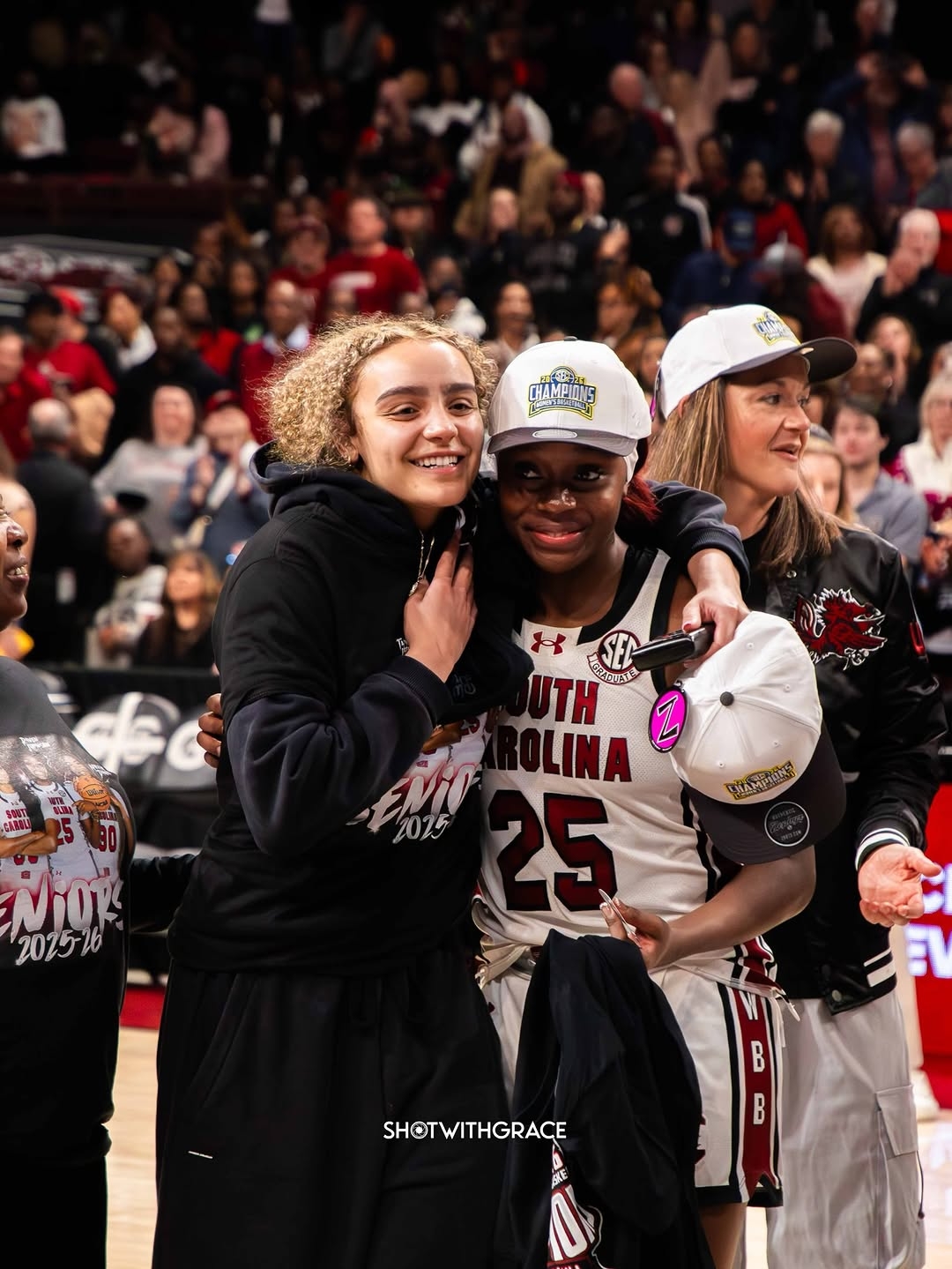
Exactly one year later, on March 30, 2026, nobody is questioning her ability to score. The crowd at Colonial Life Arena chanted her name after her final home game. The transformation begs a simple question: what changed?
Accountability First
The foundation of Johnson’s turnaround was honesty — starting with herself. After leading South Carolina to an undefeated national championship as a sophomore, punctuated by her iconic defensive performance against Caitlin Clark, Johnson admitted she lost her edge. Head coach Dawn Staley did not mince words about what happened next.
“She got happy,” Staley said plainly. “She didn’t put the work in. She did not put the work in, and she knew it. I had to remind her during that year, you didn’t put the work in. You can’t get it back now, so you just have to suffer through this year and figure out how we can continue to win, and you continue to make plays when it’s there. But after the season, you have to really put the work in.”
The diagnosis was blunt, but Johnson accepted it. She spent the offseason working out with NBA star Anthony Edwards, a fellow Atlanta prep product, and reunited with best friend and former high school teammate Ta’Niya Latson, who helped her reframe the social media noise through the lens of faith.
The shift in perspective was profound. “If I was in the shoes I was in three years ago, I wouldn’t see myself where I am right now,” Johnson reflected. “I think it was all God, all glory to God. I let go and I let God, honestly.”
On the criticism that once stung, she offered a measured takeaway: “With the social media things, I think everything happens for a reason. I think the social media, it made me realize what social media is. It’s fake. It’s literally fake. And social media can break you or make you. I don’t think it does either of that towards me. So I think I learned a lot with the social media thing, and I think I learned a lot about myself.”
The Numbers Follow the Work
The results this season have been impossible to ignore. Johnson shot 3-of-5 from three in the opener, tying her career high for made threes in a game. She recorded two double-doubles in her first four outings. She scored a career-high 19 points at LSU, then eclipsed it with 22 against the Tigers in the SEC Tournament. After averaging 5.6 points per game across her career, she is averaging 10.2 points this season.
Staley, characteristically, found some humor in what it took for the broader public to catch up to what she already knew. “Everybody thinks she’s probably a little smarter because she’s scoring the ball a little bit more,” Staley joked. “I knew she’s smart, from day one. It took some other people to catch on to see the little nuances that she does for our basketball team.”
Opposing coaches, who have always had a clearer view from the other sideline, have been effusive in their praise. Missouri’s Kellie Harper, who has also coached against Johnson as Tennessee’s head coach, captured her arc well.
“Raven is a winner,” Harper said. “Just watching her journey here, she’s been one of our favorite players to just watch. She’s improved, and she’s accepted her role, or at least it looks as though she has accepted her role throughout her career. And she is so confident, and she is so poised, and she leads that team. I’m glad she’s a senior. But she’s a terrific basketball player. It’s been fun to watch her journey.”
TCU’s Mark Campbell was more concise: “She’s just a winner. It’s what she’s done her whole career.”
LSU’s Kim Mulkey, who has coached against Johnson repeatedly, offered one of the more nuanced assessments. “She’s their leader,” Mulkey said. “She’s a Defensive Player of the Year in this league. That’s what you want. You want leaders like that, and she makes everybody else better. She doesn’t come down and jack up a shot. She will shoot it if left open. She’ll definitely shoot it if the shot clock is winding down.” Mulkey also identified the thread running through Johnson’s entire career: “Each year she’s been at South Carolina, her role has stayed the same. What she has to do on the court changes somewhat, depending on her personnel.”
Still Raven Johnson
Underneath the improved shooting numbers and the restored reputation, though, the most important thing about this season may be what did not change at all. Johnson’s personality — goofy, mild-mannered, disarmingly funny — remained exactly intact. An NIL deal with Aflac, earned during this NCAA Tournament run, was built entirely on her humor.
Staley has spoken about how, on any team, smaller social circles naturally form within the locker room. Johnson is the rare player who belongs to all of them. If a teammate has a rough game, Johnson will not acknowledge it — she simply keeps the energy level where it needs to be.
“Raven is just really consistent with how she comes in every day,” Staley said. “She is incredibly funny, without even trying. Like, without even trying. Some of the stuff that comes out of her mouth, it brings me joy. Like, it really brings me joy. And she’s just so mild-mannered. She doesn’t have any ill-will to her. She’s just her. And she’s a joy to be around. And she’s who she is — she’ll actually say if something bothers her, she’ll say if she’s good. And that’s what I like about her. She knows who she is and she doesn’t mind speaking or living to that truth of hers.”
Teammate Joyce Edwards acknowledged that Johnson’s competitive focus is not always running at maximum throttle — and that when it is, there is little anyone can do about it. “There’s games where Raven’s just BSing sometimes, I’m not gonna lie,” Edwards said. “But when she’s locked in, nothing — I mean, nothing — is stopping her.”
Four Elite Eights, One Identity
Monday will be Johnson’s fourth Elite Eight appearance. She won the first three, and was watching from the bench on crutches — recovering from a torn ACL — when South Carolina won another in 2022. She has seen this stage from every angle possible.
“Each year I had to play a different role for the team, which is leading or scoring or defending,” she said. “But I don’t think nothing drastically has changed. I think with an Elite Eight game, it’s hard. It’s hard to play an Elite Eight game to get to the Final Four. It’s about the little things, the Xs and Os, and the intangible part. I know that part.”
Her college career will conclude somewhere in the next seven days, with at most three games remaining. The social media criticism, the down season, the grind of the offseason — all of it led here. She made adjustments, put in the work, and leaned on her faith. But through all of it, the consistency that defined her was simply the consistency of being herself.
“At the end of the day,” Johnson said, “I am looking at myself in the mirror, and I know who I am.”
That, more than any stat line or scoring average, may be the most important thing Raven Johnson figured out.