InCOLUMBIA — There are losses that fade quickly, and there are losses that linger. For the South Carolina Gamecocks, the overtime defeat in Norman, Oklahoma on January 22 falls firmly in the latter category.
It wasn’t just a loss. It was the only SEC loss of the season — a game the Gamecocks had well within their grasp before it slipped away in the final seconds of regulation. Now, in a matchup that feels almost karmic, the No. 1 seed Gamecocks (33-3) and No. 4 seed Oklahoma Sooners (26-7) will meet again in the NCAA Tournament’s Sweet 16 on March 28 (5 p.m. ET, ESPN) in Sacramento, California — with a berth in the Elite Eight against TCU or Virginia on the line.
Both teams arrived at this stage on different trajectories. Oklahoma dispatched No. 5 seed Michigan State 77-71 the day before South Carolina dismantled No. 9 seed Southern Cal 101-61, a display of dominance that signaled the Gamecocks are building toward something. But dominance in the first two rounds means little if the team can’t solve the opponent that already beat them once this year.
How it Went Wrong the First Time
To understand what’s at stake in Sacramento, it helps to revisit what happened in Norman.
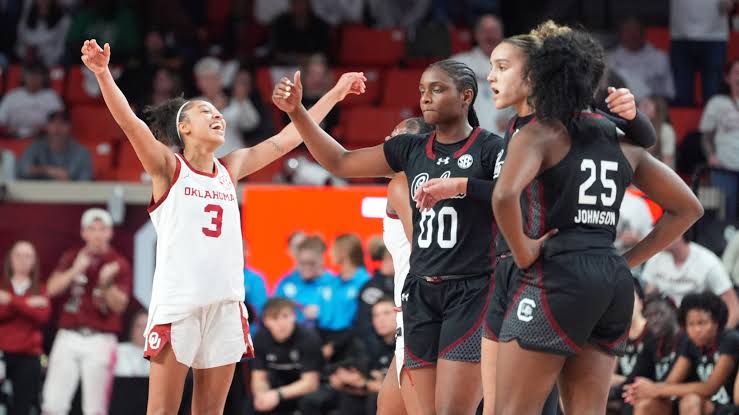
South Carolina trailed 71-65 with 4:17 remaining in regulation — a deficit, but a manageable one for a team of this caliber. The Gamecocks responded with an 8-0 run that reclaimed the lead, a burst of energy that looked like it might define the night. Then Oklahoma center Raegan Beers made a layup with 18 seconds left to tie the game and send it to overtime.
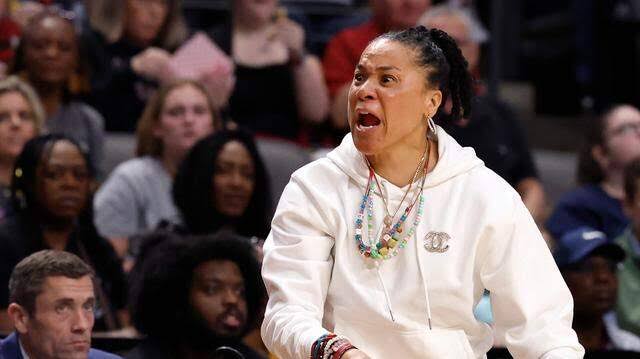
Coach Dawn Staley drew up a final regulation play designed around point guard Raven Johnson taking the last shot. Instead, Johnson handed off to Joyce Edwards, two defenders collapsed, Edwards lost the ball, and the possession — and likely the win — evaporated.
In overtime, Oklahoma freshman Aaliyah Chavez took over. She scored 15 of her 26 points in the extra period, and the Sooners pulled away 94-82.
Staley was candid in her assessment of why it happened. “I thought we played wanting it for about a two-minute stretch to get it tied up and then we really had a chance to win it in regulation, but didn’t come up with a good look. We turned the basketball over,” she said. “So it was just a battle of wills and their will was much stronger than ours in that particular game.”
That kind of honesty from a head coach — acknowledging a motivational and competitive gap rather than deflecting — speaks to a program culture that confronts hard truths rather than avoiding them. But it also underscores the real challenge: this wasn’t a fluke loss born of a bad shooting night. It was a game where the Sooners simply wanted it more, at least in the moments that mattered most.
Context matters here, too. Staley acknowledged the dynamic Oklahoma was playing with heading into that January game: “I mean they were on, I think, a three-game losing streak, and they wanted to win. I mean, it was imperative that they win the game that we played them, just for morale, just for making a run in our league. I thought they wanted it more, and they played that way.”
A desperate team on home court, fighting for momentum — South Carolina walked into a trap, and paid for it.
The Beers-Okot Problem, and How Staley Addressed It
Beyond the late-game execution issues, the January loss exposed a specific matchup problem. Raegan Beers dominated Madina Okot in the post, finishing with 18 points and 14 rebounds while Okot managed just six points and four boards. In a game decided by physical presence and interior scoring, that disparity loomed large.
Staley’s response was pragmatic and psychologically astute. She pulled Okot from the starting lineup for several games — not as a punishment, but to relieve pressure and help her reset. The move, by most accounts, had the intended effect.
The question now is whether Okot can be a different player in the rematch — one capable of checking Beers and contributing offensively in a high-stakes environment. Staley knows the interior battle will likely be decisive.
“The stakes are higher,” Staley said. “Obviously, I know Madina wants to play well. In order for her to play well, we have to play well, we have to put her in position to play well. We’ll work on that throughout this week, and hopefully we can fly out there and play our best basketball because we have yet to play that.”
That last phrase is perhaps the most telling. The No. 1 seed in the country, winner of 33 games, acknowledges they haven’t yet shown their best basketball. That’s either a quiet warning to the rest of the bracket — or a sign that South Carolina, despite everything, is still searching for a complete performance when it matters most.
What Makes This Rematch Different
Tournament basketball carries a weight that regular season games do not. Oklahoma no longer has the emotional fuel of a losing streak to draw from. South Carolina, meanwhile, carries the specific hunger of a team that knows exactly how it failed and has had two months to think about it.
Chavez’s overtime explosion will also be a focal point for Staley’s preparation. Containing a freshman who scored 15 points in overtime on a national stage requires both tactical adjustments and the kind of composed execution that deserted the Gamecocks in the final regulation seconds of the first meeting.
The path to a potential national title for South Carolina almost certainly runs through moments like this — games where the margin is thin, where execution under pressure separates champions from contenders. The January loss in Norman wasn’t just a blemish on the record. It was a test the Gamecocks failed. Sacramento is the retake.