The most important players in women’s basketball are not always the ones who lead the box score. Some players define games in ways that resist easy quantification — through decisions made before the shot clock expires, through defensive rotations executed before the play develops, through the intangible weight of their presence on a floor that simply functions better when they are on it. Raven Johnson is that kind of player. And as the 2026 WNBA Draft approaches, a growing chorus of voices — now including former Division I women’s basketball staffer and draft expert Rashard Hall — is making the case that she belongs in the first round.
What Scoutside Is and Why It Matters
Hall, known primarily for his power rankings and mock drafts, has launched a new series called Scoutside — individual player assessments designed to provide the kind of inside perspective that traditional statistical analysis cannot capture. The concept is straightforward and valuable: Hall brings his background as a former Syracuse women’s basketball staff member to bear on prospects who deserve deeper examination than their raw numbers typically receive. These are evaluations built on film study, positional understanding, and the specific lens of someone who has spent years inside a high-level college program watching how coaches and front offices think about talent.
Johnson is the first subject, and the choice is not coincidental. She is simultaneously one of the most discussed and most underappreciated prospects in this draft cycle — a player whose impact on winning is undeniable but whose statistical profile does not scream lottery pick in the conventional sense. That tension between what the numbers show and what the eye test reveals is precisely the kind of gap that a series like Scoutside is designed to close.
The Gap Between the Numbers and the Truth
Every draft cycle produces its version of the box-score debate — the argument over which players deserve first-round consideration based on production that does not fit neatly into traditional categories. Johnson is the most compelling version of that argument in the 2026 class. Her season averages — 9.8 points, 5.4 assists, a 3.4 assist-to-turnover ratio, 45.5% three-point shooting — paint the picture of a highly efficient, excellent point guard. They do not fully capture what she does to a basketball game.
The defensive metrics come closer to the truth. South Carolina’s already-elite defense improves from 42.4% to 38.4% in opponent field goal percentage when Johnson is on the floor. When she is the primary defender on SEC top-10 scorers, she holds them to 25% field goal efficiency. When she is active, the Gamecocks surrender just .706 points per possession. These are not supplementary statistics. They are structural arguments for her value — numbers that describe a player who changes the architecture of how a defense functions simply by being present.
Hall’s assessment frames the broader argument precisely: the numbers alone do not tell the full story, but the trajectory of her career and the way she impacts winning make a compelling case for the first round.
The Trajectory Argument
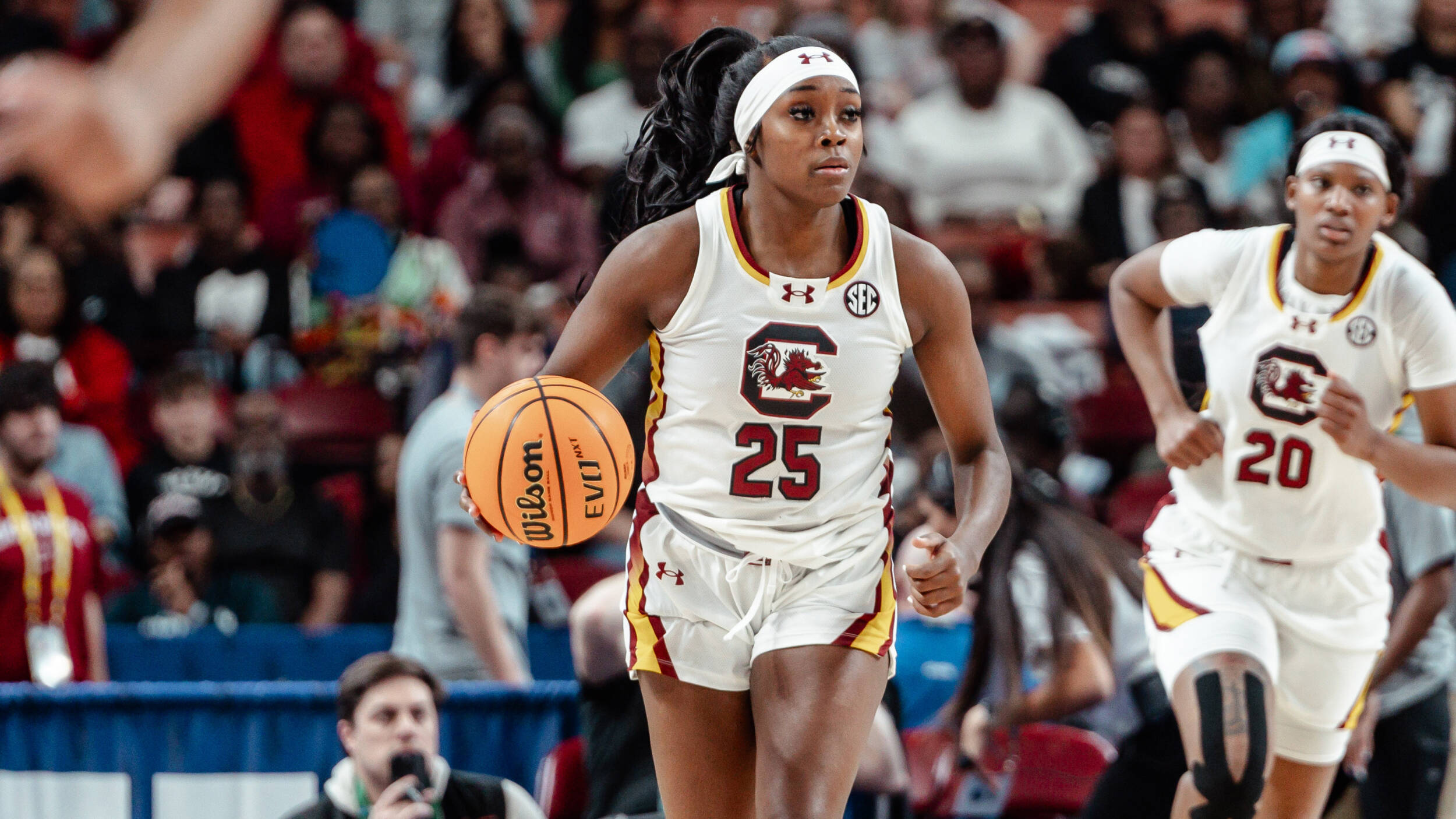
What makes Hall’s evaluation particularly meaningful is its emphasis on trajectory — the arc of Johnson’s development rather than a snapshot of where she currently stands. This is a player who spent her true freshman year rehabbing a torn ACL and still went on to start and lead South Carolina from the point guard position for four full seasons. She has gone 136-7 as a starter, won two national championships, and is playing the best individual basketball of her career in her final season — averaging career highs in points, assists, field goal percentage, and three-pointers made per game simultaneously.
That kind of career-long upward trajectory is precisely what WNBA front offices are evaluating when they assess a prospect’s ceiling. Johnson is not a player who has peaked. She is a player who has continued to grow into each successive level of competition, a quality that translates directly into professional projection. The player who showed up at South Carolina as an ACL rehabilitation project and departed as a two-time national champion averaging career-best numbers at every turn has demonstrated, repeatedly and convincingly, that she raises her game when the environment demands it.
What WNBA Teams Are Actually Looking For
The professional game places a premium on point guards who can make decisions at pace, defend multiple positions, and lead without requiring the ball. Johnson checks every box. Her 3.4 assist-to-turnover ratio — ranking fifth nationally and among only three SEC players above the 2.5 threshold — reflects the decision-making discipline that WNBA coaches demand from franchise point guards. Her defensive versatility and on-ball pressure translate directly to the professional level, where the speed of the game separates players who merely understand positioning from those who can execute it instinctively.
Hall’s Scoutside series is built on the premise that great players reveal themselves most clearly to people trained to watch for specific things — and that the evaluation of players like Johnson requires precisely that trained eye rather than a casual glance at the stat sheet. Ole Miss head coach Yolett McPhee-McCuin provided the most compelling external validation of that premise when she said, without hesitation, “Raven Johnson doesn’t get the credit that she deserves. I think she is the best point guard in the country.” That assessment did not come from a spreadsheet. It came from 40 minutes of watching Johnson take her team apart from both sides of the ball.
The Verdict
The first-round conversation around Raven Johnson is not built on sentimentality or reputation. It is built on the specific, measurable ways she makes teams better — defensively, offensively, and culturally — and on a career trajectory that has pointed consistently upward for five years running. Hall’s decision to lead Scoutside with her case is an acknowledgment that she represents exactly the kind of player this kind of analysis was designed to illuminate: a prospect whose value exceeds what the conventional metrics suggest, and whose impact on winning is visible to anyone who has spent serious time watching her play.
The 2026 WNBA Draft will ultimately determine where Johnson lands. But the case for her first-round selection is not merely compelling — it is, on the evidence of five years at South Carolina, one of the strongest in this draft class.