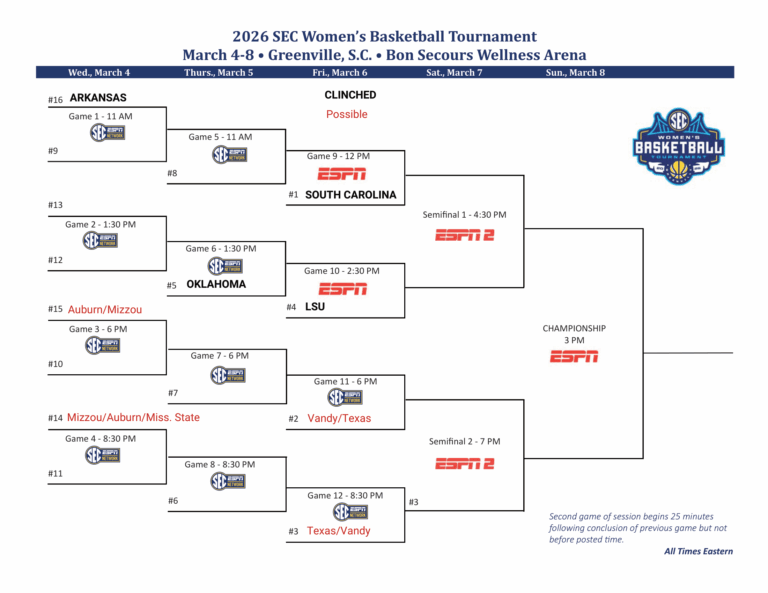
COLUMBIA, S.C. — With the final weekend of the SEC regular season upon us, the conference tournament seeding picture is coming into focus — but only partially. South Carolina has already locked up the top line. Arkansas has already locked up the bottom one. Everything in between ranges from essentially settled to genuinely chaotic, and for a cluster of teams in the middle of the standings, Sunday’s games carry consequences that could determine whether they receive a first-round bye or are forced to play an extra game on Wednesday.
Here is a complete breakdown of where things stand, what can still change, and why seeds six through eleven deserve your full attention this weekend.
What’s Already Decided
South Carolina (14-1) enters the SEC Tournament as the outright regular-season champion and the uncontested No. 1 seed — a position that has become so familiar in Columbia that it barely registers as news anymore. The Gamecocks’ fifth consecutive regular-season title is secured. Their path through Greenville begins on Thursday as the conference’s top seed.
At the other end of the bracket, Arkansas (0-15) has clinched the 16th seed. The Razorbacks host Auburn on Sunday with the chance to avoid a distinction that carries genuine historical weight. Arkansas would become just the second program to go winless across a 16-game SEC schedule — a format that has been in place since the 2009-10 season — and just the 15th winless team in the 44-season history of the conference overall. The footnote here matters: Vanderbilt technically went 0-3 in 2020-21 before canceling the remainder of their season due to COVID, injuries, and opt-outs, and Auburn went 0-15 that same season due to a canceled makeup game. Those circumstances were extraordinary. Arkansas’s situation is not.
LSU (11-4) and Oklahoma (10-5) have each clinched their seeds — fourth and fifth respectively — regardless of what happens Sunday. Their bracket positions are fixed.
The Second and Third Seed: Vanderbilt vs. Texas
The most straightforward of the remaining competitions involves Vanderbilt (12-3) and Texas (12-3), who share identical conference records and are competing for the second and third seeds with a clear set of scenarios.
Vanderbilt holds the tiebreaker by virtue of winning the head-to-head matchup against Texas, which means the Commodores currently occupy the second seed. For that to remain true, Vanderbilt needs either a win on Sunday or a Texas loss. Texas can claim the second seed only with a win and a simultaneous Vanderbilt loss — a parlay that requires things to break precisely right. The inverse applies for the third seed: Vanderbilt claims third with a loss and a Texas win; Texas claims third with a Vanderbilt win or a loss of their own.
The practical difference between second and third seed in Greenville is meaningful but not dramatic. Both teams receive a first-round bye and begin play on Thursday. The distinction matters primarily in terms of bracket positioning and the potential path to a championship game.
Seeds Six Through Eleven: Where the Real Drama Lives
This is where Sunday’s games have maximum consequence, and where the tiebreaker procedures become genuinely complicated.
The critical dividing line runs between the eighth and ninth seeds. Seeds six through eight receive a bye to Thursday. Seeds nine and below must play on Wednesday — an extra game that adds fatigue, reduces preparation time for subsequent rounds, and represents a meaningful competitive disadvantage for programs with Final Four or championship aspirations.
Kentucky, Ole Miss, and Tennessee are each 8-7 and currently seeded sixth, seventh, and eighth respectively based on tiebreaker procedures. The circular nature of their head-to-head results — Kentucky beat Ole Miss, Ole Miss beat Tennessee, Tennessee beat Kentucky — makes precise scenario mapping essentially impossible without knowing Sunday’s outcomes. The honest prescription for each of these teams is simple: win, and let the bracket sort itself out.
Alabama and Georgia are each 7-8, with Alabama currently holding the ninth seed via tiebreaker. Texas A&M (6-9) sits 11th and cannot fall below that position — the Aggies defeated both Florida and Missouri, giving them a floor regardless of Sunday’s results.
The tiebreaker procedures themselves deserve a brief explanation given their complexity. In a three-team tie, the process begins with winning percentage in head-to-head games among the tied teams, proceeds through records against the highest available seed, then road conference records, point differential in head-to-head games, winning percentage against Quad 1 opponents, Quad 2 opponents, and finally NCAA NET ranking if everything else remains equal. The commissioner’s coin flip, apparently a beloved historical artifact of conference tournament seeding, has been removed from the procedures — a development that is, depending on your perspective, either a triumph of analytical rigor or a genuine loss for chaos enthusiasts.
Seeds Twelve Through Fifteen: Settled Enough
The practical differences between the 12th and 15th seeds in a conference tournament are minimal enough that extended analysis is not particularly warranted. Florida (5-10) holds the tiebreaker over Mississippi State (5-10). Missouri (4-11) has the tiebreaker over Mississippi State. Auburn (3-12) has the tiebreaker over Missouri. The order may shift at the margins, but for programs whose primary focus has shifted to NCAA Tournament positioning and postseason preparation, these distinctions are largely administrative.
The Full SEC Standings Picture
| Seed | Team | Record |
|---|---|---|
| 1 | South Carolina | 14-1 |
| 2 | Vanderbilt | 12-3 |
| 3 | Texas | 12-3 |
| 4 | LSU | 11-4 |
| 5 | Oklahoma | 10-5 |
| 6 | Kentucky | 8-7 |
| 7 | Ole Miss | 8-7 |
| 8 | Tennessee | 8-7 |
| 9 | Alabama | 7-8 |
| 10 | Georgia | 7-8 |
| 11 | Texas A&M | 6-9 |
| 12 | Florida | 5-10 |
| 13 | Mississippi State | 5-10 |
| 14 | Missouri | 4-11 |
| 15 | Auburn | 3-12 |
| 16 | Arkansas | 0-15 |
What Sunday Means
For South Carolina, Sunday’s road game at Kentucky is the final regular-season tune-up before Greenville — a chance to sharpen rotations, test depth, and enter the SEC Tournament with momentum. The result will not change their seeding or their status. It will, however, matter to the Gamecocks in the specific way that every game matters to Dawn Staley’s program: as a standard to be met, regardless of what is or is not at stake in the standings.
For the teams clustered between sixth and eleventh, Sunday is considerably more consequential. The difference between a Wednesday start and a Thursday bye is not merely logistical. It is a competitive variable that can determine bracket survival in a conference where the middle of the standings is genuinely deep. Kentucky, Ole Miss, Tennessee, Alabama, and Georgia all have programs capable of making tournament noise — but only if they arrive in Greenville rested and on a schedule that allows them to build momentum rather than exhaust it.
The SEC Tournament begins March 6th in Greenville, South Carolina. By Sunday evening, the bracket will be set. Between now and then, every game matters — for some teams, more than anything that has come before it.
Source:on3