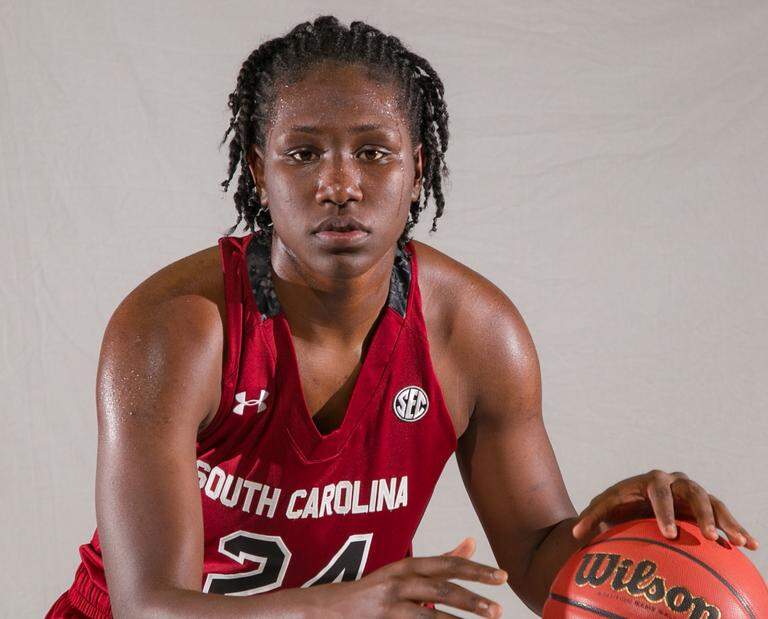
COLUMBIA, S.C. — Eleven years ago, almost to the day, confetti fell from the ceiling of Verizon Arena in North Little Rock, Arkansas. South Carolina women’s basketball had just won its first SEC Tournament championship, and the names of the All-Tournament team were being announced over the loudspeakers.
Kentucky’s Makayla Epps. Tennessee’s Cierra Burdick and Jordan Reynolds. South Carolina’s Alaina Coates and Aleighsa Welch.
Then came the moment nobody — least of all Welch herself — saw coming.
“I remember when they were doing the buildup of it, I’m looking around, I’m like, ‘Oh, who are they going to call?'” Welch recalled.
They called her name.
“I was shocked. I didn’t think I was gonna win it. … I was like ‘Me?'”
The genuine disbelief in that reaction speaks to everything that defined Welch as a player — and everything that makes her story worth telling now, more than a decade later, as South Carolina prepares to add yet another chapter to one of the most dominant dynasties in women’s college basketball history.
The Numbers Behind the Shock
Welch’s surprise was authentic, but the performance that earned her the MVP was not accidental. Across three SEC Tournament games, she averaged 10.3 points and 7.3 rebounds — contributions that were quiet, consistent, and critical. Against LSU in the semifinals, she recorded a double-double with 11 points and 10 rebounds. In the championship game, her 14 points were second on the team only to Tiffany Mitchell.
For a player who never chased recognition, the numbers told a story she wasn’t telling herself.
“I knew I played well across the entirety of the weekend, but I think I was always that type of player and that type of person where I didn’t focus on the stat sheet,” Welch said. “I focused on winning, I wanted us to win. So I never really took time to say, hey, Lisa, you had a really good SEC tournament. … We had so many players that it could have been divvied up to, I had no idea. So when they called my name I just remembered genuine shock.”
That selflessness — the deliberate choice to subordinate individual recognition to collective success — is precisely the kind of culture-setting behavior that championship programs are built on. Welch wasn’t just a good player. She was the right kind of player for a program in the process of becoming something historic.
Dawn Staley’s First In-State Signee
To fully appreciate what Welch meant to South Carolina, the story must start at the beginning — not just of her college career, but of the program’s modern identity. Welch was Dawn Staley’s first-ever in-state signee, committing in 2011 after a performance that, in retrospect, reads like something scripted.
Playing in the South Carolina high school state championship for Goose Creek, Welch delivered 36 points and 15 rebounds — the best game of her life at any level, she says. She didn’t know it at the time, but Staley was in the building watching.
“Coach Staley happened to be there and I didn’t know it at the time,” Welch recalled. “We played Spring Valley and I played the best game I’ve ever played in my career literally, at any stage. I played the best game I ever played and that same weekend, I got a scholarship offer … To be recruited by her, to be wanted by that program, for her to see something in me that at the time I didn’t even see in myself, talk about a defining moment for me. At the time, I was 16 years old, so she saw the career that I didn’t even see for myself.”
That last line is worth sitting with. Staley has built South Carolina’s program on a foundation of seeing potential before it fully announces itself — identifying not just what a player is, but what they could become. Welch was the first in-state expression of that philosophy, and her career validated it completely.
Building the Ladder Rung by Rung
Welch’s four years at South Carolina were not simply a prelude to the dynasty — they were the construction of it. The milestones accumulated steadily, each one raising the program’s ceiling higher than it had ever been.
In her freshman year, South Carolina made the NCAA Tournament for the first time under Staley — and the program’s first appearance in nearly a decade. That alone was significant. Returning a program to the national stage after years of absence requires more than talent; it requires belief, and Welch’s class helped supply it.
By her junior year, Welch had become an All-SEC player averaging a career-high 13.7 points per game while pulling down 7.6 rebounds per contest. More importantly, she helped lead the Gamecocks to their first SEC regular season title in program history and a No. 1 seed in the NCAA Tournament — another landmark moment on the program’s upward arc. A Sweet 16 exit at the hands of North Carolina stung, but the direction was unmistakable.
Her senior season produced a 27-2 regular season record, another SEC regular season title, and an undeniable sense of inevitability heading into the conference tournament. The Gamecocks didn’t just want to win the SEC Tournament that year — they expected to.
“We had a lot of momentum, and we gelled, we clicked. We had a lot of talent, but we also had a lot of trust in each other,” Welch said. “…So we felt very confident, we knew we had the capability. It was just a matter of putting it all together.”
South Carolina beat its three tournament opponents by an average of 18.6 points. The program’s first SEC Tournament title wasn’t a surprise — it was a confirmation.
A Final Four and a Passing of the Torch
Welch’s 137-game career as a Gamecock ended not with a championship, but with a Final Four loss to Notre Dame — South Carolina’s first-ever appearance at that stage of the NCAA Tournament. It was a painful ending on a personal level, but Welch processed it with a perspective that proved prophetic.
She didn’t leave feeling like the moment had passed. She left feeling like it was only beginning.
“I knew it wasn’t a one-off,” Welch said with a grin.
Two years later, South Carolina won its first national championship. Then another. Then another. The dynasty Welch helped build from the ground up became one of the most decorated programs in the history of women’s college basketball.
The Legacy of Being First
The numbers that have followed Welch’s graduation are staggering in their scope. Since she left Columbia, South Carolina has won 10 SEC regular season titles, nine SEC tournament championships, made six more Final Four appearances, and claimed three national championships. The program she helped build has become, as she put it, a cornerstone of the sport.
Six more Gamecocks have won SEC Tournament MVP honors in the years since Welch was first called: Tiffany Mitchell, A’ja Wilson (twice), Mikiah Herbert-Harrigan, Aliyah Boston (twice), MiLaysia Fulwiley, and Chloe Kitts most recently. The list reads like a who’s who of women’s basketball excellence — and Welch’s name sits at the top of it.

Not because she was the most decorated. But because she was first.
“I’m not someone who probably gives myself enough flowers for what I was able to accomplish in my career,” Welch said. “… I always am super proud of it. But more than anything, more than I’m proud of it for myself, (I’m proud of) what the program has continued to be, what it has continued to build on, and what it will continue to be. It is a cornerstone of women’s basketball.”
Welch now works for Pierce County Parks and Recreation in Washington state — far from the arena lights and confetti of Verizon Arena, far from the program she helped transform. But the foundation she laid in Columbia remains. Every banner, every championship, every MVP announcement echoes back to the moment eleven years ago when a shocked young woman from Goose Creek heard her name called and couldn’t quite believe it.
She should believe it. She earned every bit of it — and so much more.