The Intensity Question Is Real — And South Carolina Knows It
Talent and depth will only carry a team so far. What separated South Carolina’s Sweet 16 performance against Oklahoma wasn’t just execution — it was the quality of their preparation and the sharpness of their focus. The Gamecocks came in ready for everything Oklahoma threw at them, neutralizing a fast and physical style that has troubled other opponents all season. That level of readiness didn’t happen by accident.
The challenge now is sustaining it.
This is not a trivial concern for South Carolina, because the historical pattern exists and the players themselves have acknowledged it. After beating Texas in January, the Gamecocks came out flat in their very next conference game and lost at Oklahoma. After winning an emotionally draining SEC Tournament semifinal against LSU, they emerged lethargic in the championship game against Texas. Both letdowns followed high-intensity wins — the exact circumstance they find themselves in now.
Dawn Staley has clearly identified this tendency and addressed it directly. Her messaging between the second-round win over Southern Cal and the Sweet 16 rematch against Oklahoma was deliberate: this is not about revenge. It is simply the next step on the road to the Final Four, with another step immediately following. By reframing each game as a process rather than a destination, Staley is attempting to prevent the emotional peaks and valleys that have occasionally cost her team momentum at critical junctures.
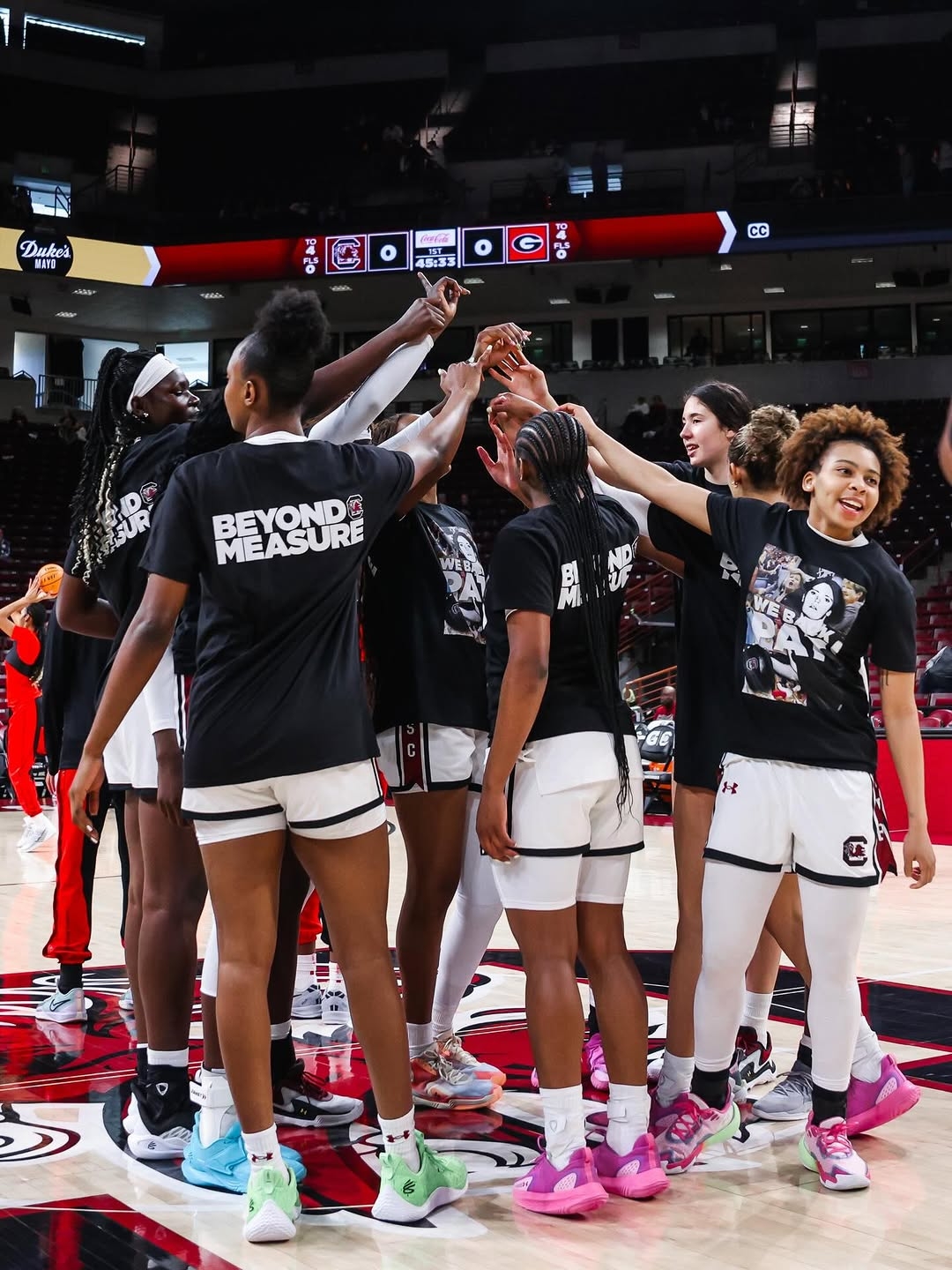
The early evidence from Sacramento suggests it’s working. Sunday’s media availability gave a revealing window into the team’s psychological state — and it painted a picture of a group that has found the balance between loose and locked in. Tessa Johnson commandeered a television crew’s microphone and interviewed her teammates. She then ran a game of hangman for the assembled media. Joyce Edwards attempted — unsuccessfully — to squeeze in a pregame nap. Adhel Tac gave her most extensive postseason interviews yet. Maryam Dauda joined the hangman game.
None of that signals a team that is tight or overwhelmed by the moment.
But the focus was equally apparent beneath the levity. Edwards broke down the game plan in precise detail without revealing specifics. Raven Johnson and Agot Makeer spent time dissecting Olivia Miles’ tendencies. That dual quality — relaxed enough to play hangman with reporters, disciplined enough to do detailed film breakdown — is the hallmark of a team that has genuinely internalized its preparation process.
So much so that Staley canceled a scheduled practice on Friday. When a coach pulls back on preparation time, it’s because she trusts what her team already knows. That level of confidence in collective readiness is significant.
The Miles Problem — And South Carolina’s Answer
The tactical reality of Monday’s game is straightforward, even if the execution is anything but: TCU runs through Olivia Miles. Limit her, and you likely win. That is not a secret — it is the shared understanding of every team that has faced the Horned Frogs this season. The difficulty is that few have actually managed to do it.
South Carolina’s primary weapons against her are Raven Johnson, the SEC Defensive Player of the Year, and Agot Makeer, who has emerged as one of the tournament’s most impactful reserves. But as Staley has made clear, containing Miles will require a collective effort — rotating bodies, mixing looks, and refusing to allow her to settle into a rhythm. Johnson and Makeer are the centerpieces of that plan, not the entirety of it.
Availability Report: South Carolina’s Losses Are Known, TCU’s Are Deeper
On the injury front, South Carolina enters Monday without Chloe Kitts and Adhel Tac — absences that have been consistent throughout the tournament and are factored into how Staley deploys her rotation.
TCU’s situation is considerably more complicated. Sarah Portlock, Maddie Scherr, Aaliyah Roberson, and Emily Hunter are all expected to be out. Portlock and Hunter were offseason additions specifically recruited to address South Carolina’s size advantage — their absence meaningfully narrows TCU’s frontcourt depth heading into the one game where that depth matters most. Scherr’s loss has been felt all season; her 5.3 points per game represent a significant portion of TCU’s already-thin bench production.
Taliyah Parker adds another layer of uncertainty. She was listed as unavailable for the first and second-round games, then disappeared from the availability report ahead of the Virginia game — but still didn’t play. Her status for Monday remains unclear, making her the most consequential question mark on either roster.
For a team already operating with seven players and two reserves who combined for under 10 minutes in the Sweet 16, every additional absence tightens a rotation that has almost no margin left to tighten. South Carolina knows this, and their strategy of wearing down Miles and Marta Suarez through depth and foul pressure becomes even more viable with each TCU roster question mark that remains unresolved.