The NFL has a way of humbling quarterbacks quickly and quietly. Players who arrive with enormous expectations find themselves cycling through rosters, adjusting expectations, and searching for the right situation at the right time. Spencer Rattler knows this better than most. He has spent his entire career — collegiate and professional — proving that the situation he is in does not define the player he is capable of being.
Now, entering his third NFL offseason, the former South Carolina standout finds himself at another crossroads. And according to at least one prominent ESPN analyst, the next chapter could unfold in New York.
From New Orleans to New York?
Rattler was selected by the New Orleans Saints in the fifth round of the 2024 NFL Draft and became a part-time starter, leading the team 14 total times across the 2024 and 2025 seasons. With the Saints now pivoting toward Tyler Shough as their primary signal-caller in 2026, Rattler’s path forward in New Orleans has narrowed considerably — a development that opens the door to the kind of opportunity several around the league believe he has earned.
On Thursday, ESPN analyst Seth Walder released his projections for all 32 starting quarterback positions in 2026, and Rattler made the list. Walder’s analysis identified the New York Jets as a potential landing spot — and the reasoning was grounded in more than speculation.
“Though he ultimately gave way to rookie Tyler Shough, Rattler was solid last season in New Orleans,” Walder wrote. “He recorded a 50.3 QBR and a plus-3% completion percentage over expected, and his 9% off-target rate was the lowest among all QBs with at least 100 pass attempts. The 2024 fifth-round pick is entering his third season, so he could still improve. And Rattler likely would cost less on the trade market than Jones, as well.”
Walder acknowledged the Jets’ situation is genuinely complicated, noting that New York “certainly could be a landing place for a non-Mendoza rookie quarterback” and floated candidates ranging from Kirk Cousins to Derek Carr to trade options including Mac Jones, Tanner McKee, and Rattler himself. “The Jets were the hardest team for me to predict in this exercise,” Walder admitted. “There are so many feasible candidates.”
But the case for Rattler — cost-effective, young enough to develop further, and backed by legitimate production — is a coherent one.
The Numbers Beneath the Narrative
What Walder’s analysis does is force the conversation away from narrative and toward performance. Rattler’s 9% off-target rate leading all quarterbacks with at least 100 pass attempts is not a marginal statistical footnote. It is a direct measure of throwing accuracy and decision-making under pressure — the precise qualities that determine whether a quarterback can sustain production at the NFL level.
A 50.3 QBR and a positive completion percentage over expected add further texture to a profile that has been too easily dismissed because of draft position and the circumstances of his exit from New Orleans. Fifth-round picks are not supposed to post those kinds of efficiency numbers. The fact that Rattler did — while operating behind an offensive line that was far from elite and in an organization that was simultaneously auditing its roster — makes the performance more impressive in context, not less.
The broader NFL community has been slower than the data to recognize this. But the recognition is beginning to arrive from credible voices.
What the League Is Saying
Before New Orleans made the decision to prioritize Shough’s development, Rattler was generating praise that went well beyond polite acknowledgment. Former NFL defensive back and current ESPN analyst Ryan Clark said plainly that Rattler “deserves to be a starting quarterback in this league” — the kind of assessment that carries weight coming from someone who spent years as a professional attempting to make quarterbacks uncomfortable.
San Francisco 49ers defensive coordinator Robert Saleh went further, projecting that Rattler will be a “household QB” soon enough. Long-time sports writer John Frascella argued that Rattler might be the most underrated player in the entire NFL — a claim that, given the statistical foundation Walder identified, is harder to dismiss than it might initially appear.
The emerging consensus among those who study the position closely is that Rattler has produced enough to warrant a legitimate starting opportunity. What he has lacked, thus far, is the stable organizational context in which to fully demonstrate it.
The Precedent: Columbia Changed Everything
If there is a reason to believe Rattler can thrive in a new environment, it is that he has already done exactly that once before — under more difficult circumstances.
When things unraveled at Oklahoma, he transferred to South Carolina, a move that might have looked like a step back from the outside. Rattler reframed it himself. He called that difficult transition a “blessing in disguise” — and in retrospect, the phrase understates what the experience actually produced.
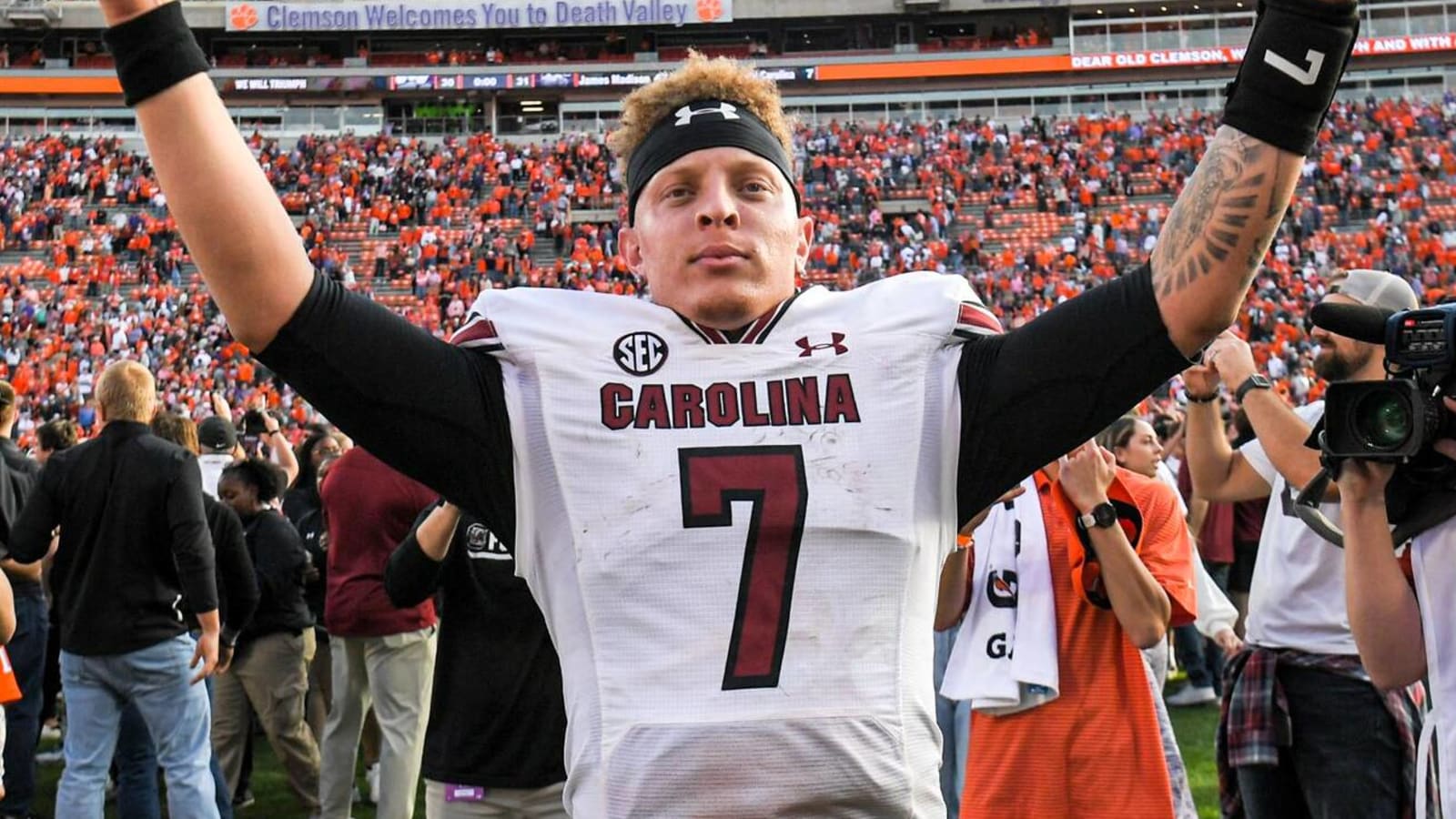
At South Carolina, playing for Dawn Staley’s university and Shane Beamer’s football program, Rattler became one of the most effective quarterbacks in program history. Despite a complicated relationship with his first offensive coordinator in Columbia, he delivered what remains one of the most remarkable individual performances in recent Gamecock history — throwing for six touchdowns in a blowout win over top-10 Tennessee in 2022, setting a single-game program record in the process. He followed that with an even more complete 2023 season, retiring as the holder of South Carolina’s career completion percentage record at 67.5%.
The South Carolina chapter did not just rescue Rattler’s career trajectory. It revealed something about his character that pure talent evaluation cannot measure — the capacity to absorb adversity, adjust, and elevate. He arrived in Columbia from a difficult situation and left having exceeded every reasonable expectation. That pattern is directly relevant to whatever comes next.
Why the Jets Conversation Makes Sense
New York represents one of the most scrutinized quarterback situations in professional football — a market that consumes quarterbacks and narratives in equal measure. The Jets have cycled through high-profile names without finding stability, and their fan base has developed a well-earned skepticism about organizational quarterback evaluation.
But Rattler as a trade acquisition — rather than a franchise-defining free agent signing — reframes the proposition. He is inexpensive relative to the other options Walder identified. He has demonstrated the efficiency metrics that justify a starting opportunity. He is young enough, at 25, to be entering what should be his developmental prime. And he has shown, both at South Carolina and in New Orleans, that he is capable of performing under pressure when given the chance.
The Jets do not need another expensive, high-profile solution. They need a quarterback who has earned a genuine opportunity — someone whose production has outpaced his profile and whose ceiling remains genuinely open. By that definition, Rattler fits.
A Career Built on Second Acts
Spencer Rattler’s story, from Norman to Columbia to New Orleans to wherever comes next, is fundamentally a story about what happens when talent is given the right environment. Every time a door has closed, he has found one that opened — and he has consistently performed better on the other side of it.
If Walder’s projection proves accurate and the Jets come calling, it will not be a surprise to those who have followed Rattler closely. It will be the next logical chapter in a career that has always been more about resilience than reputation.
The question was never whether Rattler could play at this level. The question was always whether the league would give him a fair stage on which to prove it. New York, for all its difficulty, would be exactly that.