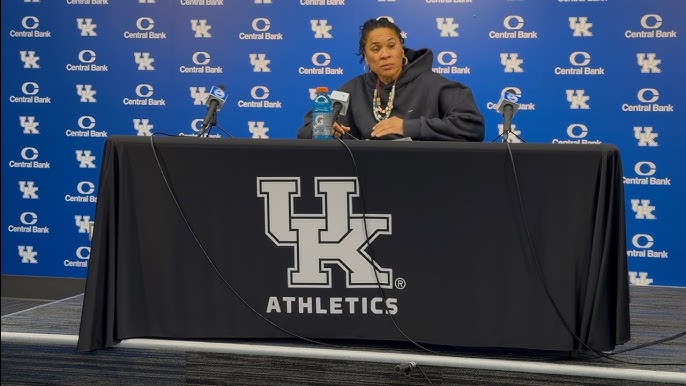
There is a particular kind of press conference that follows a narrow escape — one where the coach must simultaneously defend her team’s wobble, credit the opponent’s fight, and project confidence heading into the postseason. Dawn Staley navigated all three on Sunday with the kind of candor and layered analysis that has made her one of the most compelling voices in women’s basketball.
South Carolina survived Kentucky 65-60 in a game that will be remembered less for the final score and more for what the fourth quarter revealed — both about the Gamecocks’ vulnerabilities and their capacity to close under pressure. Staley held nothing back at the podium.
How Kentucky Got Back In — And Why South Carolina Nearly Let It Happen
When asked what specifically allowed Kentucky to claw back from a 13-point deficit, Staley went straight to the root cause without hesitation.
“Missing shots. We got into a scramble situation after those missed shots in transition. Then, (Clara) Strack did a great job. They really got her the ball in her spots and she delivered.”
The diagnosis is deceptively simple, but the implications are significant. When South Carolina missed shots in the fourth quarter — going a catastrophic 3-of-16 from the floor — they didn’t just lose points on the offensive end. They surrendered the floor to Kentucky’s transition, disrupted their own defensive rhythm, and created chaos in a game that had been orderly for thirty minutes. The snowball effect of poor shooting down the stretch is a pattern that cannot repeat itself in March, where a single bad quarter can end a season.
Clara Strack’s emergence as the catalyst for the Kentucky rally was something Staley addressed with genuine respect. When pressed on what makes the Kentucky center so difficult to guard, the Gamecocks’ head coach offered a meticulous breakdown.
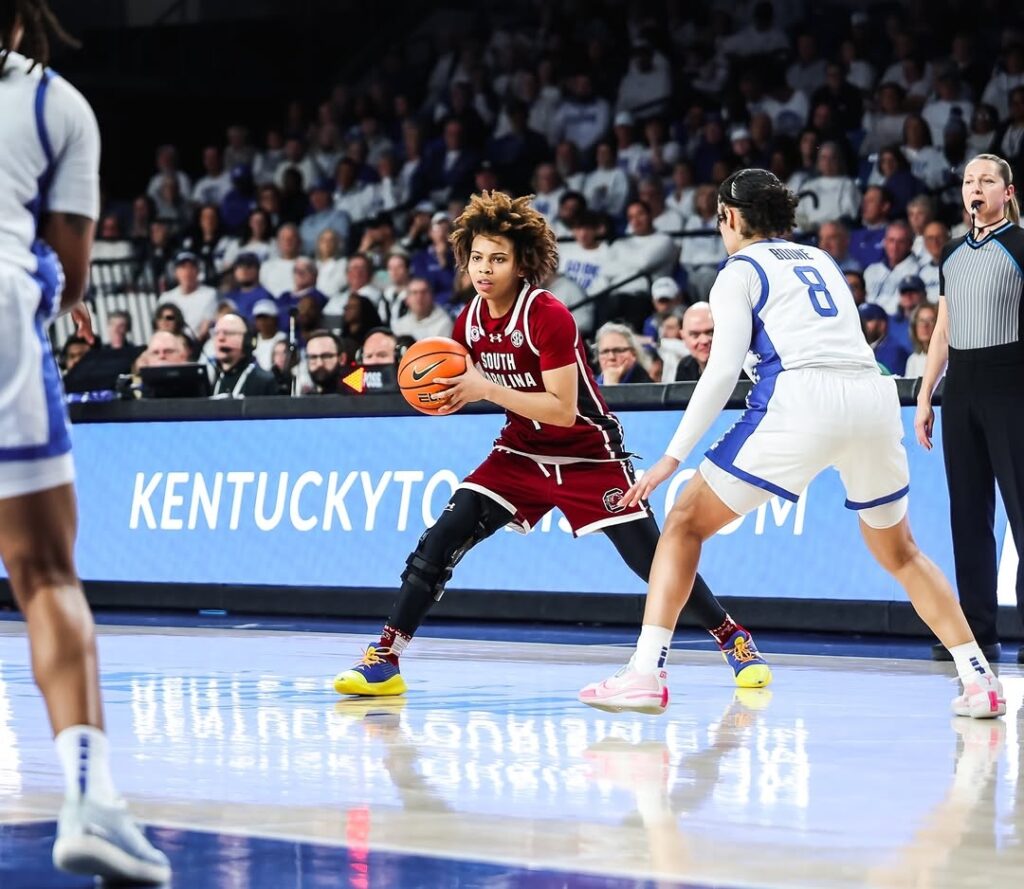
“She’s big, she’s long. She’s got a high-arching shot that’s hard to get to. She’s very mobile. She can put it on the floor, can score on all three levels, and keeps the defense off balance. Once she got her shot going, it allowed her to put the ball on the floor and get to the basket and score.”
This is the anatomy of a problem: a player who becomes exponentially more dangerous the moment she finds her rhythm. Kentucky’s coaching staff understood this, intentionally feeding Strack in her preferred spots until her confidence built to the point where her interior scoring opened up driving lanes that South Carolina’s defense couldn’t fully recover from. It is a blueprint that future opponents will study carefully.
Tessa Johnson and the Shooting Struggles — A Coach’s Grace Under Pressure
One of the more revealing moments of Staley’s press conference came when she was asked about the defensive adjustments Kentucky used to disrupt South Carolina’s offensive flow.
“I don’t think it was any different than what we’ve seen. A little bit of zone they mixed in, we didn’t hit shots. We got some great looks. Tessa (Johnson) doesn’t shoot the way she always shot. I know she had some pretty open looks. I thought she took some that was quick, but we can take that from Tessa. We bit the bullet and took some quick shots at the end.”
The phrase “we can take that from Tessa” is one of the most instructive things Staley said all afternoon. It reflects the kind of trust-based coaching philosophy that elite programs are built on — the recognition that a player who shoots 45.5 percent from three on the season is entitled to a bad day, and that shielding her from undue criticism in a public forum protects both her confidence and the team’s chemistry heading into the postseason. Staley didn’t throw her All-SEC guard under the bus. She contextualized it and moved forward.
The Fatigue Factor — Honesty About the Lull
When asked directly whether the fourth-quarter fade was purely a shooting problem or whether focus had wandered in the final regular-season game, Staley offered one of her most honest and self-aware answers of the press conference.
“I thought both teams got a little bit tired. I think when you exert as much energy as both of us did on both sides trying to get a win, it takes gutting up. Sometimes the gutting up makes your shot a little short, and sometimes it makes you step a little bit slow. I thought at times, when the game was flowing, it went for us and against us. It played a part. I think we built our lead because they got a little bit fatigued. They came back off of a little bit of our fatigue, and it was just that kind of battle.”
This is the kind of statement that resists simple narratives. Staley refuses to reduce the fourth quarter to either pure effort failure or pure bad luck. Instead, she acknowledges the physical reality that sustained high-level intensity extracts a physiological cost — from both teams. The lead was built on Kentucky’s fatigue; the lead nearly evaporated because of South Carolina’s own. It is a cyclical, human truth about the game that too often gets lost in analytical breakdowns.
“Big Mama Did Her Thing” — Madina Okot Cements Her Status as the Team’s Anchor
If the fourth-quarter shooting struggles were the night’s cautionary tale, Madina Okot was its hero. Twenty-one points. Thirteen rebounds. Decisive presence on both ends. And a closing basket that sealed the game. Staley’s praise was warmly unsurprising to anyone who has watched Okot develop this season.
“Big Mama did her thing. Big Mama scored 21 points and got 13 rebounds. I told her she’s got the stamina to play four or five more minutes. She might be able to add to her stamina, but she’s playing extremely well and composed. I thought she did a great job for us. Anchoring on both sides of the basketball.”
The nickname carries weight in that locker room, and Staley’s use of it publicly is a deliberate act of elevation. For a program that has asked Okot to step into an increasingly central role this season, moments like Sunday — when the 6-foot-6 center physically dominated one of the SEC’s best post players and then calmly converted the game-clinching basket in the final seconds — are the building blocks of March confidence.
The word “composed” is not accidental. Staley has emphasized all season that composure under pressure is the quality that separates players who thrive in the tournament from those who crack. Okot delivered exactly that.
Inside-Out Defense: The Strategic Blueprint Against Kentucky
Staley also pulled back the curtain on the defensive game plan, offering a detailed breakdown of how South Carolina tried to neutralize Kentucky’s offensive threats.
“We just want to go inside. Anytime that we got in a scramble mode situation, they made us pack it in. We can afford ourselves those three if in half-court we’re not allowing them to get clean looks. We really wanted Strack to be the one who playmakes. Her efficiency is inside the three. You could two us rather than three us. We just tried to do that. And if they’re able to play both inside and outside the three, you probably are going to win this basketball game. I think they average about eight, so we cut it down to five. That creates just a small advantage for us to win.”
The math is deliberate and revealing. By reducing Kentucky’s three-point attempts from their season average of eight down to five, South Carolina created just enough margin to survive. It wasn’t dominant. It wasn’t comfortable. But it was intelligent, and in a league this competitive, intelligence is often what separates wins from losses.
The decision to make Strack the primary playmaker — rather than letting her be a pure finisher — was a calculated concession. South Carolina essentially said: we trust our interior defense enough to invite this. That they nearly paid the price for it in the fourth quarter doesn’t make the plan wrong; it makes the execution imperfect.
Limiting Tonie Morgan — Cutting Off the Head of the Snake
Disrupting Kentucky’s point guard was identified as another pillar of the game plan, and Staley’s analysis was characteristically direct.
“She’s the head of the snake. We really want to make it hard for her. She missed some easy should-bes at the basket that she really does not miss. We are very fortunate that that happened. If she makes those baskets, we’re probably talking a little bit differently. It is important that we disrupt the flow of what they were trying to do, and we know that she probably won’t play that way again.”
The final sentence is the most important. Staley is not celebrating Morgan’s poor game — she is acknowledging its fragility as a strategic foundation. The acknowledgment that “she probably won’t play that way again” is a reminder that Sunday’s win benefited from some good fortune, and that any future meeting with Kentucky in the postseason would likely look different.
Staley Goes to Bat for the SEC — and for Kentucky’s Tournament Seeding
The most unexpected and nationally significant moment of the press conference came when Staley was asked whether Kentucky deserves to host in the NCAA Tournament. What began as a question about one program quickly became a full-throated defense of the entire conference.
“I know there is a (Top 16) reveal before the game. I see there are a lot of other conferences that are in there. It’s nothing against any other conference, but what we have been through in this conference, it’s hard to measure where we stack up in that top 16. I do think we could have a little bit more. I think Kentucky has done a great job with its resume. If you take some of what has happened in our league and what our league is doing, it’s hard to measure. I hope they take a different metric to gauge us because it’s tough. This is hard. It is really hard. And I know, the committee members do a great job. But I think this is our present. No other year has been like this year in the SEC. So we can’t use the same metric that we used for the top 16.”
This is one of the most substantive things Staley has said publicly all season. Embedded in her answer is a genuine argument about evaluative methodology — the idea that the sheer depth and competitiveness of the 2026 SEC means that traditional metrics like NET rankings and record may inadequately capture how difficult it has been to win games in this conference. In a league where losses carry enormous context — where teams are beating each other in ways that would produce major upsets in any other conference — Staley is asking the committee to look beyond the numbers and account for the environment.
It is an argument that has merit. And it is one that SEC fans and coaches have been making quietly for weeks. On Sunday, Staley made it loudly and clearly on behalf of all of them.
A Human Moment: No Update on Mitchell, Harrigan, and Littleton
In what was the most emotionally sobering part of the press conference, Staley was asked for an update on former Gamecocks Tiffany Mitchell, Mikiah Herbert Harrigan, and Destiny Littleton — the three players currently caught in the Israel conflict.
“No updates. Still, everything’s the same, but we are getting some help from some people who are in decision-making positions, but there’s nothing you can do. You can still hear the things that are going on, the sirens and everything that goes on in a warzone.”
The words landed like a weight in an otherwise basketball-focused room. Staley had just coached a pivotal regular-season finale, navigated a near-collapse, and conducted a detailed tactical press conference — and underneath all of it, she was carrying the very real worry of three young women she loves, still trapped in a warzone thousands of miles away. The fact that she mentioned sirens — that she is receiving real-time information about the conditions her former players are enduring — speaks to the depth of connection this program maintains long after the jersey comes off.
What Comes Next
Staley and the Gamecocks will tip off their postseason run on Friday in Greenville, opening the SEC Tournament against another conference opponent in the quarterfinals. South Carolina enters as one of the most dangerous teams in the country — a No. 1 seed nationally, anchored by a transcendent post player, led by one of the game’s greatest coaches, and battle-tested by the most grueling conference schedule in women’s basketball history.
Sunday was not their finest hour. The fourth quarter will be addressed, the film will be watched, and the lessons will be applied. If Madina Okot continues to anchor both ends the way she did in Lexington, if Tessa Johnson rediscovers her shot, and if the collective focus sharpens as the calendar turns to March, this team has every tool required to make a deep run in Phoenix.
But they must execute for forty minutes — not thirty. Sunday made that clear. Dawn Staley knows it. Now her players must show it.
South Carolina opens SEC Tournament play on Friday in Greenville. Selection Sunday is March 15, 2026, at 8 p.m. ET on ESPN.