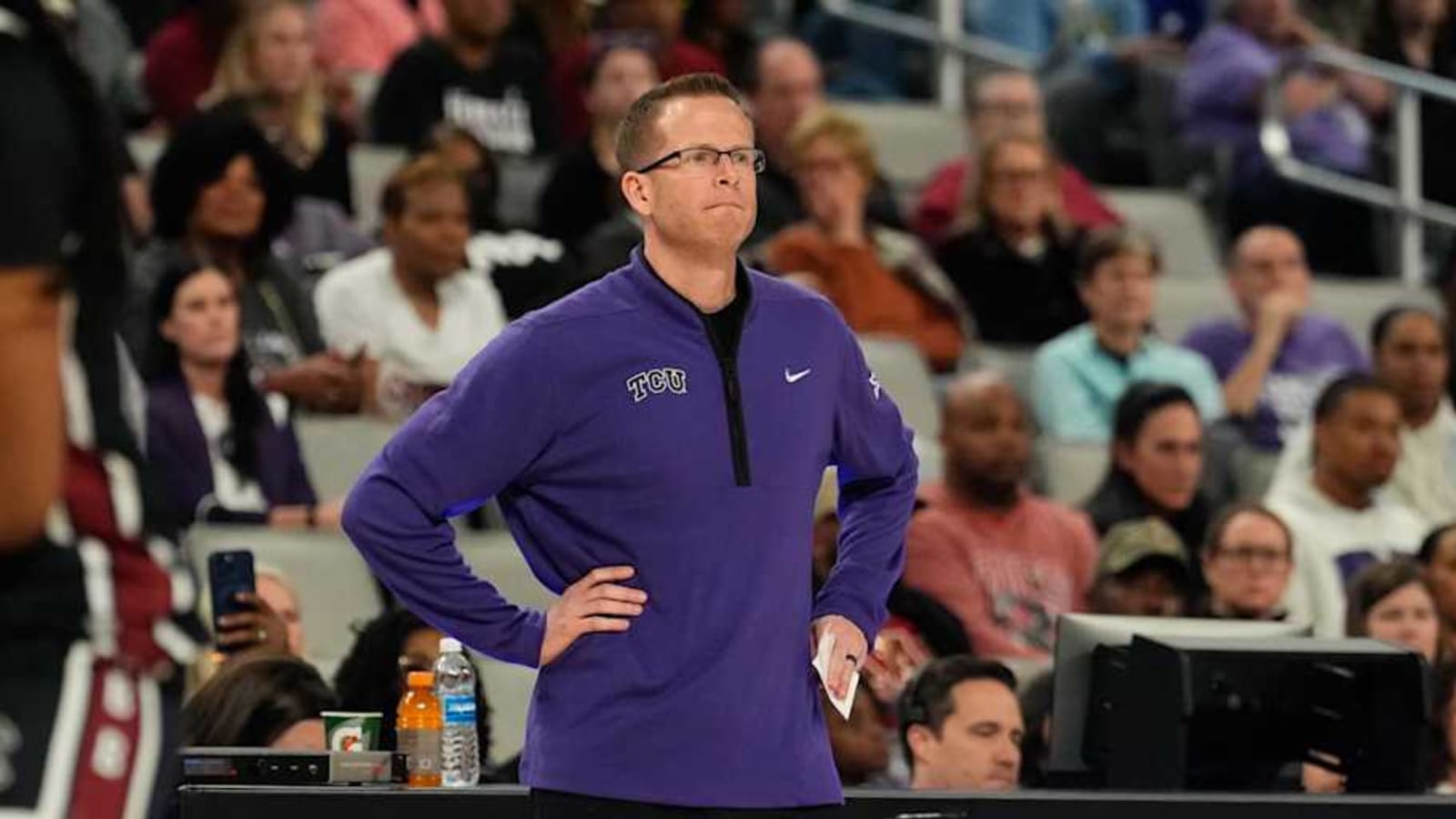
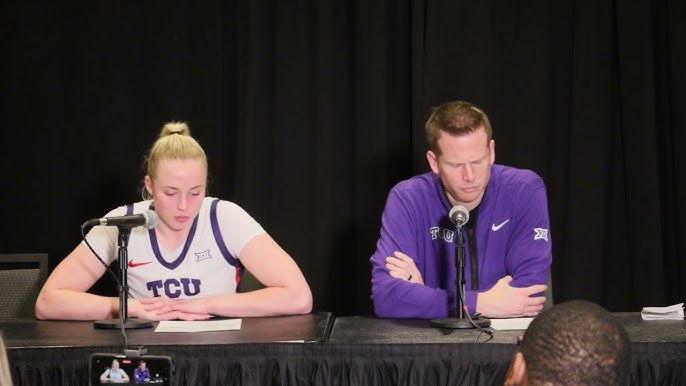
SACRAMENTO, Calif. — When Mark Campbell sat down at the postgame podium after a 78-52 loss to South Carolina, he did not look like a coach who had just been beaten by 26 points. He looked like a coach who understood exactly what his program had just accomplished — and refused to let one difficult night erase it.
“Just want to open up and congratulate South Carolina on a really well-played game. Wish them nothing but the best as they head to Phoenix and compete for a national championship,” Campbell said. “I’m so proud of this team and this group. They took our program and our university on just another magical, special season. This one game will not define our season.”
He meant it. And the numbers back him up.
Ten New Players, One Remarkable Run
The most important context for evaluating TCU’s 2025-26 season is the roster construction that made it possible. Campbell did not return a cohesive unit with shared experience and established chemistry. He rebuilt almost from scratch.
“What this group accomplished, with 10 new players that came together and never played for TCU basketball in June, and 10 months later, we’re a game away from the Final Four — it’s been an amazing journey together,” Campbell said. “And I could not be more proud sitting up here with these guys.”
Ten new players. Ten months. An Elite Eight appearance and a 32-win season. For a program that was 1-and-17 in the Big 12 four years ago and holding open tryouts from the recreation center three years ago, that trajectory is not just encouraging — it is one of the most remarkable turnaround stories in recent women’s college basketball history.
Campbell made that point with a statistic that deserves wider attention. “I think there’s five teams in America that have won 30 games in the last two years,” he said. “Four of them are in the Final Four, and I think the other fifth team is TCU.” The company TCU is keeping in that conversation — South Carolina, UConn, UCLA, Texas — tells you everything about where this program now stands.
A Full-Circle Moment in Sacramento
The setting carried personal meaning for Campbell, who previously coached at Sacramento State. The week of the Elite Eight became something of a homecoming, reconnecting him with colleagues and relationships built during his time there.
“It’s been a full-circle moment,” Campbell said. “I absolutely loved my time at Sac State, primarily because of the people. Just getting to bring our team back here and be on this stage at the Golden 1 — obviously we used to play the Causeway Classic here against our rival, UC Davis. So all of it has just been a really special week.”
That kind of emotional grounding matters. Campbell was not just coaching a basketball game in Sacramento this week — he was bringing his program to a place that shaped him, in front of people who watched him develop as a coach. That the journey ended on the same floor where the Causeway Classic was once contested adds a layer of narrative symmetry that is hard to manufacture.
What Went Wrong — and What Didn’t
For three quarters, TCU gave South Carolina genuine problems. The Gamecocks entered halftime with a manageable lead, and the game remained an eight-point contest heading into the fourth quarter. Then, in the span of roughly three minutes, it became a 20-point game.
Campbell was precise in his diagnosis, and notably resistant to framing the collapse as a failure of effort or game plan.
“I wouldn’t use the word ‘got away,'” he said. “Your margin for error against South Carolina, UConn, Texas, UCLA is almost zero. Our kids fought and battled. It was an eight-point game heading into the fourth quarter. And with this level — the South Carolinas of the world — a bad shot, a turnover, a missed blockout, it just escalates rapidly.”
He identified the specific vulnerability that proved decisive: “22 offensive rebounds against a team like them — you can’t give them that many opportunities at second shots. I think that’s the biggest takeaway from not being able to be in the fight heading down the home stretch of the game.”
That is a coaching staff doing honest, clear-eyed work in a painful moment. Campbell is not searching for excuses. He is identifying the precise mechanism by which a close game became a lopsided one — and in doing so, giving his program something concrete to build on.
Progress That Cannot Be Dismissed
When asked about year-over-year progress, Campbell pushed back thoughtfully on the framing. Last year’s TCU team — which pushed Texas in a memorable battle — cannot be directly compared to this one, because the personnel was almost entirely different.
“We’ve got 10 players that are brand new, never played together, never played for our staff,” Campbell said. “And you’ve got to get that group to come together and try to make another run. So if you’re asking about progress, I would say what this team has accomplished is magical, special.”
That is not coach-speak. It is an accurate read of a program that has compressed what normally takes five or six years of roster building into a single offseason — and produced a Big 12 championship and Elite Eight appearance on the other side of it.
The journey ended in Sacramento. But TCU women’s basketball is no longer a program anyone can overlook — and Mark Campbell has made sure of that.