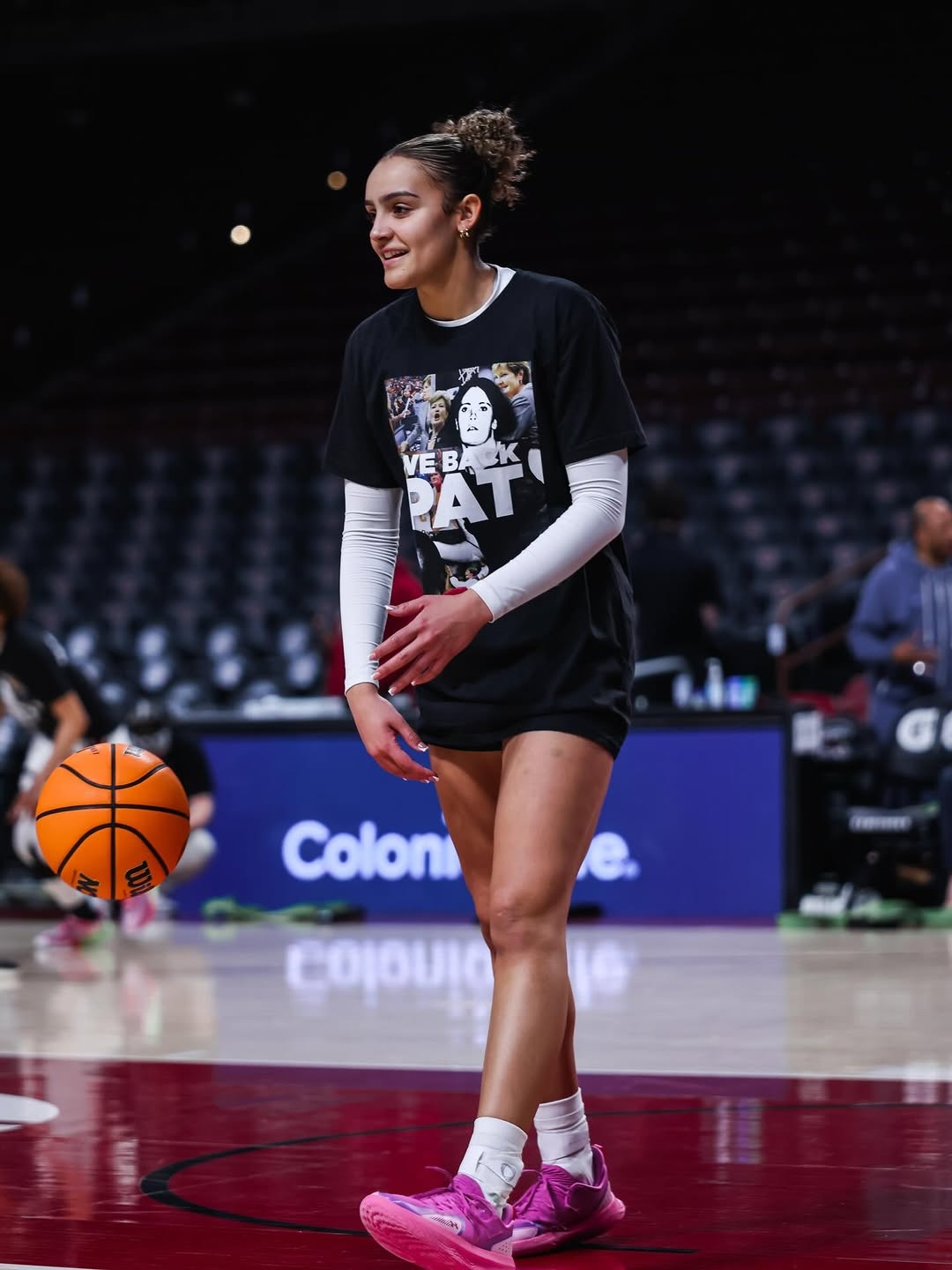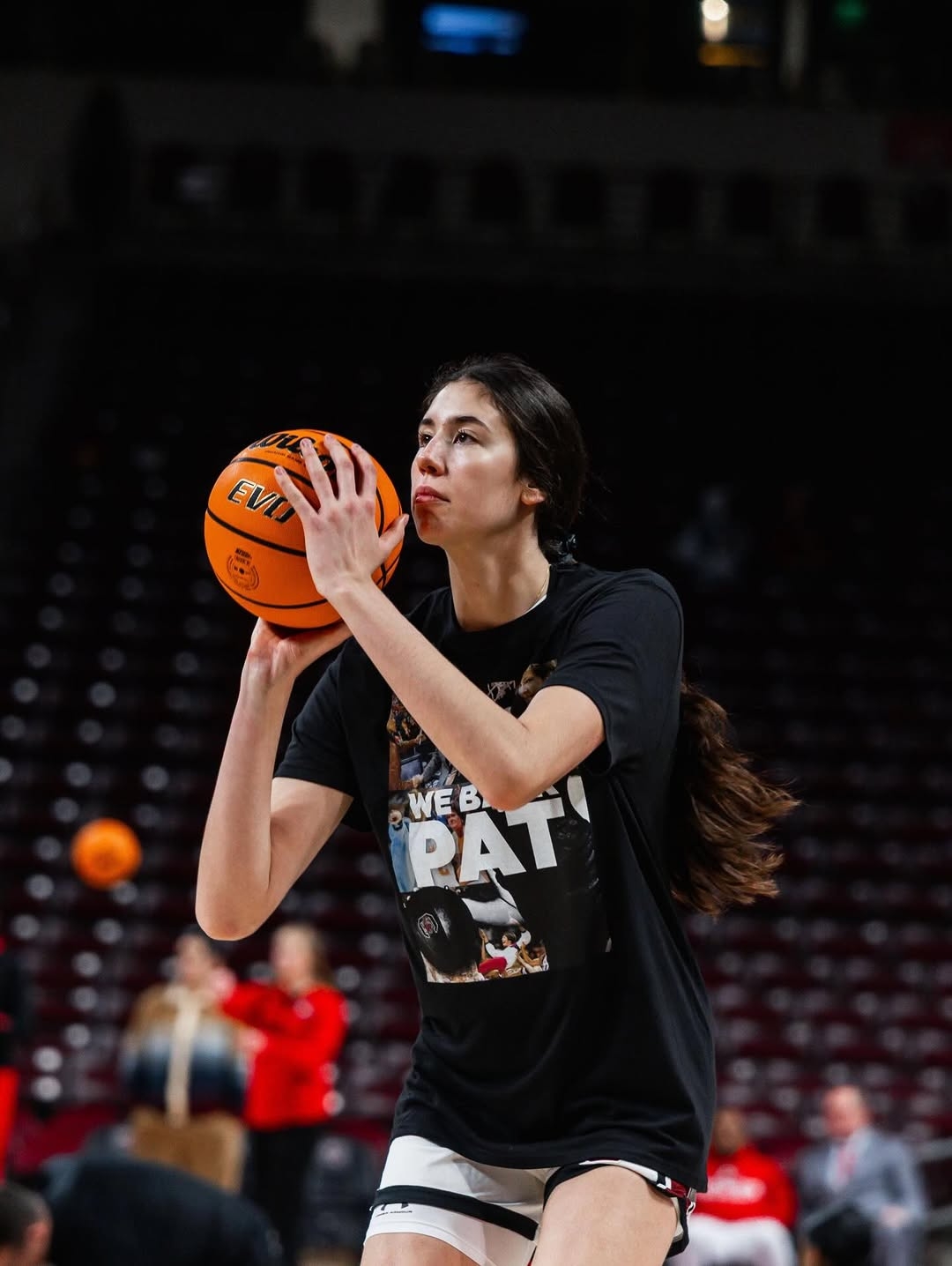
The recruitment of Alicia Tournebize wasn’t just a roster move — it was a calculated gamble on an unproven process, executed with the precision of a program that has won three national championships.
The Cryptic Post That Started Everything
Dawn Staley didn’t announce the recruitment of Alicia Tournebize with a press release. She did it with a blurry photo and a smirk.
The October social media post was deliberately vague — a zoomed-in shot of pink Nike A’Ones, A’ja Wilson’s signature shoe, with a caption that read: “Currently checking out a recruit somewhere near Paris but not in Paris … and would you look at what’s on her feet!” It was a breadcrumb, not an announcement. Staley was building anticipation before the college basketball world even knew what it was waiting for.
A month later, after South Carolina’s season-opening win against Grand Canyon, Staley was asked about the Gamecocks returning to Paris for the 2026-27 season opener. She smiled and said she hoped “we have a French player on our roster to take home.” The implication was clear to anyone paying attention.
By the end of November, the mystery was solved. The recruit was Alicia Tournebize — a 6-foot-7 French forward who had been playing professionally for Tango Bourges Basket. When she appeared on the sideline at Williams-Brice Stadium for South Carolina’s football game against Coastal Carolina, and then sat behind the bench during an exhibition victory over Queens, the Colonial Life Arena crowd didn’t wait for an official announcement. They were already chanting “We want Alicia!”
On December 22, they got her.
“Since I was a kid I had the dream, the idea to maybe come one day to the States,” Tournebize told The State. “So when I had the opportunity, and I talked with Coach, I wanted to come here.”
The Recruitment: A 32-Hour Flight for a Warmup Session
What makes the Tournebize recruitment analytically fascinating isn’t just the result — it’s the process. This was not a conventional college basketball recruitment. Every standard variable was complicated: the language barrier, the time difference, a prospect living two hours from her own home with a professional club, and a family support system operating from a different continent on a different schedule.
The recruitment originated not from a scouting report or a recruiting service, but from a personal tip to associate head coach Lisa Boyer, Staley’s long-time assistant. Boyer heard about Tournebize from a friend last summer and immediately went to work.
“We started looking her up and of course, she’s pretty amazing,” Boyer said. “We got on the internet, we saw all kinds of clips. The first one that comes up is that two-hand dunk. Pretty impressive. She’s got really good touch. She’s got great form. She knows how to play the game. She’s been well-honed by her mom and the French national team.”
That scouting process is worth examining carefully. Boyer didn’t lead with a phone call to the player. She built intelligence first — film, context, background — and then identified the most important person in the recruitment: Isabelle Fijalkowski, Tournebize’s mother. Fijalkowski is not a peripheral figure. She was a basketball star at Colorado, played professionally in the WNBA and overseas, and will be inducted into the Women’s Basketball Hall of Fame in June. She understood college basketball’s value system from firsthand experience, and she had always intended for Tournebize to pursue the collegiate path in the United States. Boyer’s ability to build authentic credibility with Fijalkowski — a former elite player who could see through any recruiting performance — was arguably the most decisive factor in landing the commitment.
The defining moment of the recruitment came in October, when Boyer and Staley flew to France specifically to watch Tournebize play for Tango Bourges. Tournebize didn’t play that day. The two coaches essentially flew across the Atlantic, watched a warmup, and flew back to Columbia in under 32 hours.
“The point is that she knew that we were obviously very interested to come over there and see her,” Boyer said. “It was like less than a 32-hour trip, but well worth it. The more we talked to her and to her mother, the more of a relationship you get.”
That decision — to take a transatlantic flight for a warmup session with no guarantee of return — is the kind of thing that separates elite recruiting programs from the rest. It wasn’t about watching film. It was about sending an unmistakable message: you matter enough to us that we will get on a plane tonight. Every prospect, regardless of nationality, understands that language.
Why Tournebize Chose South Carolina
Tournebize’s professional situation accelerated a timeline that Boyer had initially projected to extend until April or May.
“As her season went along, she probably was not getting as much burn as she wanted to,” Boyer said. “So they decided, somewhere in November, that she was going to come over and take visits.”
In seven games for Tango Bourges, Tournebize averaged just 7.4 minutes. For a 6-foot-7 forward with professional-level skill and an elite pedigree, that playing time represented a ceiling, not a development path. The decision to accelerate the timeline and take official visits — including stops at Kentucky and South Carolina — was a rational recalibration.
The Kentucky visit came first. South Carolina came next. Senior forward Maryam Dauda, who hosted Tournebize during the visit, offered the clearest window into how that weekend unfolded.
“We kept asking her, ‘How does the visit compare to Kentucky?’ And she was like, ‘Well, it’s about the same thing, but I just want to win, and I want to win championships, and I want to compete.’ And we’re like, if you want that, then here would be the perfect place for you,” Dauda said.
That exchange is analytically significant. Tournebize wasn’t choosing between marketing pitches or campus aesthetics. She was choosing between competitive environments. Her language — I want to win championships — reflects a player shaped by her mother’s career and the French national team system. She arrived in Columbia already knowing what elite basketball culture looks and feels like. What she needed was confirmation that South Carolina’s culture matched her own internal standard.
Staley’s pitch reinforced that dynamic directly and honestly. The Gamecocks entered the season with just ten healthy players after Ashlyn Watkins took the year off and Chloe Kitts tore her ACL. Rather than obscure the injuries, Staley made them an asset.
“I told her, she’ll definitely play for us,” Staley said. “It won’t be like she’ll just come sit on the bench. That’s when things start escalating a little bit.”
Tournebize confirmed the visit was decisive: “Coming from another country, another continent, I was like, I need to see how it really is here, and meet people, talk to them in real life. It was very important to me to see. I’m glad I came for the visit. I’m glad I’m here now.”
The Early Enrollment Challenge
Signing Tournebize on December 22 was the beginning of a logistical operation. She arrived in Columbia on January 1. Her debut against Texas came on January 15. In the two weeks between arrival and first game, the program was simultaneously processing visas and immigration paperwork while integrating a player who had never practiced a single day with this team into a system built and refined since June.
Boyer described that window with characteristic understatement: “She was at practice, she was watching, she was listening. She’s a really smart kid. She remembers stuff, we threw a lot at her. This team has been together since June — think of all the plays and stuff we’ve put in. … She’s a very intuitive kid when it comes to the game.”
The cognitive load placed on Tournebize during those two weeks was genuinely extraordinary. This wasn’t a typical early enrollee learning a college playbook for the first time. This was a 19-year-old from France, navigating a new country, a new legal status, a new language in its full cultural context, and an advanced basketball system — simultaneously, on a two-week clock.
That she made it to the floor at all is notable. That teammates report she’s been thriving is remarkable.
Life Off the Court: The Americanization of Alicia Tournebize
The adjustment Tournebize has made extends well beyond basketball. Point guard Maddy McDaniel offered perhaps the most human portrait of how that transition has unfolded.
“On the court, she’s getting way stronger. She’s slowing the game down for herself. She’s able to see more. She’s crashing the boards hard. She’s just playing harder, more aggressive. Off the court, she’s getting very Americanized. It’s crazy. By the day, she’s learning new words. She’s using slang, stuff like that. It’s crazy, but it’s good to see. It’s a cool thing,” McDaniel said — joking that teammate Agot Makeer deserves most of the credit for Tournebize’s cultural education.
Tournebize’s ability to adapt quickly is not accidental. She left home for basketball when she was still in high school and has been living independently ever since.
“Since I was in high school, I’m not at home, I’ve been playing basketball away from home,” she said. “Obviously, I’m way further now, it’s not the same thing … but I’m used to already experiencing this.”
Makeer, for her part, made no effort to hide the team’s emotional investment in the recruitment: “We wanted her really bad. We were at a point where we didn’t know who we were gonna have on the court, just with injuries and stuff. So having her come here 6-foot-7, can dunk and everything — can shoot too. I think it’s been really cool.”
The Statistical Picture and March Madness Projection
In 17 games for South Carolina, Tournebize is averaging 4.3 points, 3.2 rebounds and 12.6 minutes per game. Those numbers, in isolation, do not tell the full story of her value.
The relevant context is this: she arrived mid-January into a team that had been building chemistry since June. She was learning a new system while simultaneously adjusting to a new country, a new culture and a new language in real time. The fact that her playing time has increased during the postseason — precisely when rotations tighten and coaches trust only what they know — is a far more meaningful data point than any per-game average.
Against the backdrop of South Carolina’s injury-depleted frontcourt, Tournebize’s physical profile alone changes what opposing defenses must account for. A 6-foot-7 forward with a documented two-handed dunk, shooting touch, and professional experience — even limited professional experience — occupies space differently than any other player on this roster.
“I’m very excited,” Tournebize said of the NCAA Tournament. “I was seeing the tournament from the outside and all the excitement around it. So now, being inside [the tournament] I’m really, really excited to play the games.”
The Bigger Picture: What This Recruitment Signals
The Tournebize recruitment is worth examining beyond the immediate competitive value it provides. It represents something structurally significant for South Carolina and for women’s college basketball more broadly.
Staley and Boyer pursued an international prospect not as a fallback option, but as a genuine first-choice target in response to a specific roster need. They flew across the Atlantic for a warmup session. They built a relationship with a Hall of Fame inductee. They processed a mid-season international enrollment on a two-week timeline. And they delivered a player who is already drawing praise from teammates and coaches for her basketball IQ, physical development, and cultural adaptability.
That is a complete recruiting operation — one that most programs don’t have the infrastructure, confidence or institutional credibility to attempt. The fact that Tournebize arrived wearing A’ja Wilson’s signature shoe before Staley ever made contact is perhaps the most telling detail in the entire story. South Carolina’s brand, built on championships and the culture Staley has constructed over 18 years, reached France before the coaching staff ever boarded a plane.
That’s what a dynasty looks like from the outside.