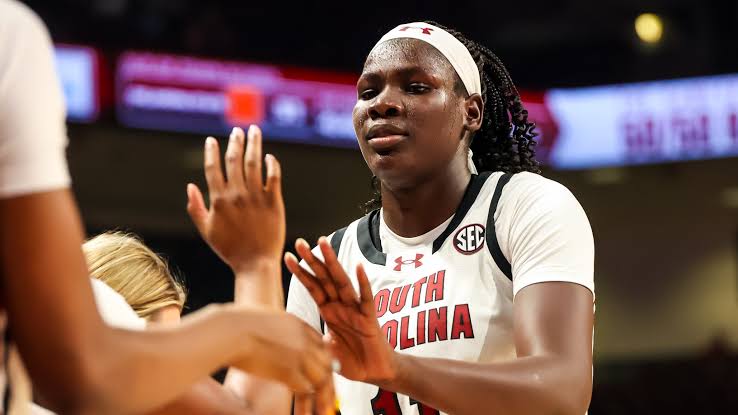
COLUMBIA — The appeal was always a long shot. On April 8th, three days after South Carolina’s season ended in Phoenix, the NCAA made it official — Madina Okot’s request for another year of eligibility was denied. She will not return to Columbia. She will instead turn her attention to the WNBA Draft on April 13, where first-round projections from multiple outlets suggest her professional future is bright.
But the door closing on Okot’s college career deserves more than a procedural announcement. It deserves context — about where she came from, what she built in one season, and what her departure means for a South Carolina program already deep into the work of reshaping its roster.
A Journey That Began in Kenya
Okot’s path to the national championship game is among the more remarkable origin stories in recent college basketball history. She is from Mumias, Kenya, and did not begin playing basketball until 2020 — at Kaya Tiwi Secondary School. From there she played at Zetech University before making the jump to the United States, first to Mississippi State for one season, then to South Carolina.
The eligibility argument Staley’s staff made to the NCAA centered on exactly this unusual trajectory. The case was straightforward in principle: time spent playing basketball outside of the NCAA structure, in a Kenyan secondary school and university setting, is categorically different from burning a year of American college eligibility. The NCAA disagreed, and with that decision, Okot’s amateur career ends.
Staley’s statement on the news captured both the personal and the institutional dimensions of what Okot represented:
“Early in her basketball career, Madina made courageous choices not just to pursue just the sport, but also to better her life. Her path included just a short time with us in Columbia, but we are grateful to be part of her story. She made our team and our sport better.”
The word courageous carries real weight in that sentence. Leaving Kenya, navigating a new country, a new program, and a new level of competition, and producing at the level Okot produced — that is not a story about basketball talent alone. It is a story about character and resolve that the box score reflects but does not fully explain.
What She Did in One Season
The numbers Okot produced in her single year at South Carolina hold up against any measuring stick you apply to them.
She averaged 12.8 points and an SEC-best 10.6 rebounds per game, shot a team-high 57.5% from the floor, and finished third in the nation with 22 double-doubles — tying for the national lead among power conference players. In the NCAA Tournament, she averaged 9.5 points and 8.8 rebounds per game while starting every game of South Carolina’s March Madness run, including the national championship game against UCLA.
Those are not numbers that require qualification or context to be impressive. They are dominant across every relevant category — scoring, rebounding, efficiency, and interior presence. Okot also expanded her offensive game during the season to include a reliable top-of-the-key jumper, which meaningfully widened her professional profile and gave South Carolina a dimension on offense that opposing defenses had to account for at the perimeter.
What the numbers cannot fully capture is the defensive tone she set — the altered shots, the forced help rotations, the way her presence changed what South Carolina could do on both ends of the floor simply by occupying the paint. The Gamecocks needed a dominant post after losing Kamilla Cardoso, identified Okot through the transfer portal, and watched her fill that void more completely than anyone had a right to expect in a single season.
The WNBA Draft and What Comes Next
With the eligibility door closed, the WNBA Draft on April 13th becomes Okot’s immediate next chapter. CBS Sports projected her at No. 13 to the Atlanta Dream. The Sporting News had her at No. 11 to the Washington Mystics. Either projection places her in the first round — a reflection of how her combination of size, rebounding, interior scoring, and developing perimeter game translates to the professional level.
Notably, both the Atlanta Dream and Washington Mystics have organizational needs at the center position that Okot’s profile addresses directly. Former Gamecocks Allisha Gray and Te-Hina Paopao already play for the Dream, which would place Okot within a program already familiar with South Carolina’s development model if that projection holds.
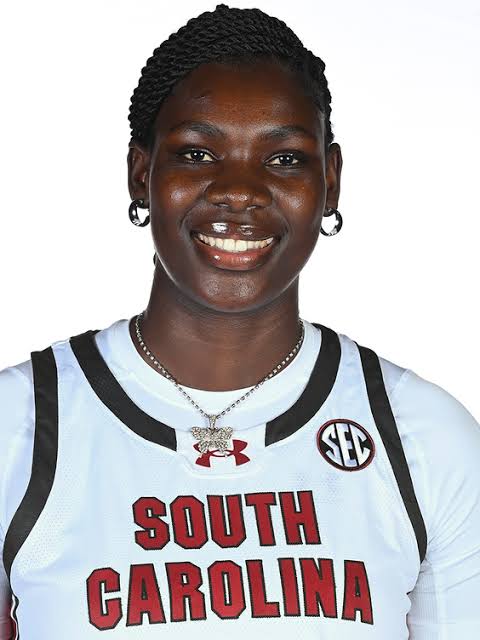
Her professional ceiling is genuinely significant. At 6-6 with elite rebounding instincts, improving offensive range, and the kind of competitive drive that carried her from Kenya to a national championship game in two years of American basketball, she enters the draft as a player who has barely scratched the surface of what her tools can produce.
What South Carolina Loses — and What Comes Next
Okot’s departure without a return creates the most pressing roster need on South Carolina’s offseason checklist. The returning roster, pending transfer portal additions, currently projects as follows:
Tessa Johnson (Senior, Guard), Chloe Kitts (Senior, Forward), Ashlyn Watkins (Senior, Forward), Maddy McDaniel (Junior, Point Guard), Joyce Edwards (Junior, Forward), Adhel Tac (Junior, Forward), Agot Makeer (Sophomore, Guard), Ayla McDowell (Sophomore, Guard), Alicia Tournebize (Sophomore, Post), Jerzy Robinson (Freshman, Guard), Kelsi Andrews (Freshman, Forward), and Kaeli Wynn (Freshman, Forward).
That is a twelve-player roster with genuine depth and talent at multiple positions — but with a notable interior vacancy where Okot’s production lived.
Ashlyn Watkins’ return from her torn ACL is the most natural answer to that void. When healthy, Watkins was South Carolina’s best interior defender — a player Staley once described as superior to SEC Defensive Player of the Year Kamilla Cardoso at the rim. She plays bigger than her listed 6-3, she anchors a defensive system that is built around interior physicality, and her return alone changes the complexion of the frontcourt.
But Watkins is coming off a serious injury, and counting entirely on her to absorb Okot’s production is a risk no championship-caliber program accepts passively. The Iowa State transfer portal conversation around Audi Crooks — who averaged 25.8 points and 7.7 rebounds per game on 64.9% shooting — remains active and represents the most direct available answer to the Okot-shaped void.
Alicia Tournebize, the 18-year-old who arrived from France in January and flashed genuine potential despite limited preparation time, projects as a long-term answer at the post position rather than an immediate one. Her ceiling is among the highest on the roster. Her readiness to carry the interior burden of a championship contender in 2025-26 is a separate question.
The Larger Lesson
Madina Okot’s South Carolina career lasted one season. The NCAA ensured it could not last two. But the argument that her time in Kenya should not have counted against her American eligibility is one that deserves continued attention — not just for her sake, but for the players who will come after her. International players who develop in non-NCAA environments before arriving in the United States are increasingly common at the highest levels of women’s college basketball. The framework for evaluating their eligibility has not kept pace with that reality, and Okot’s case is the most visible recent illustration of why that gap matters.
She leaves Columbia as one of the most impactful one-year transfers in program history, a WNBA Draft prospect, and a player whose story — from Mumias to the national championship game — is about something considerably larger than basketball.
Staley said she made the team and the sport better. The numbers agree. So does everyone who watched her play.