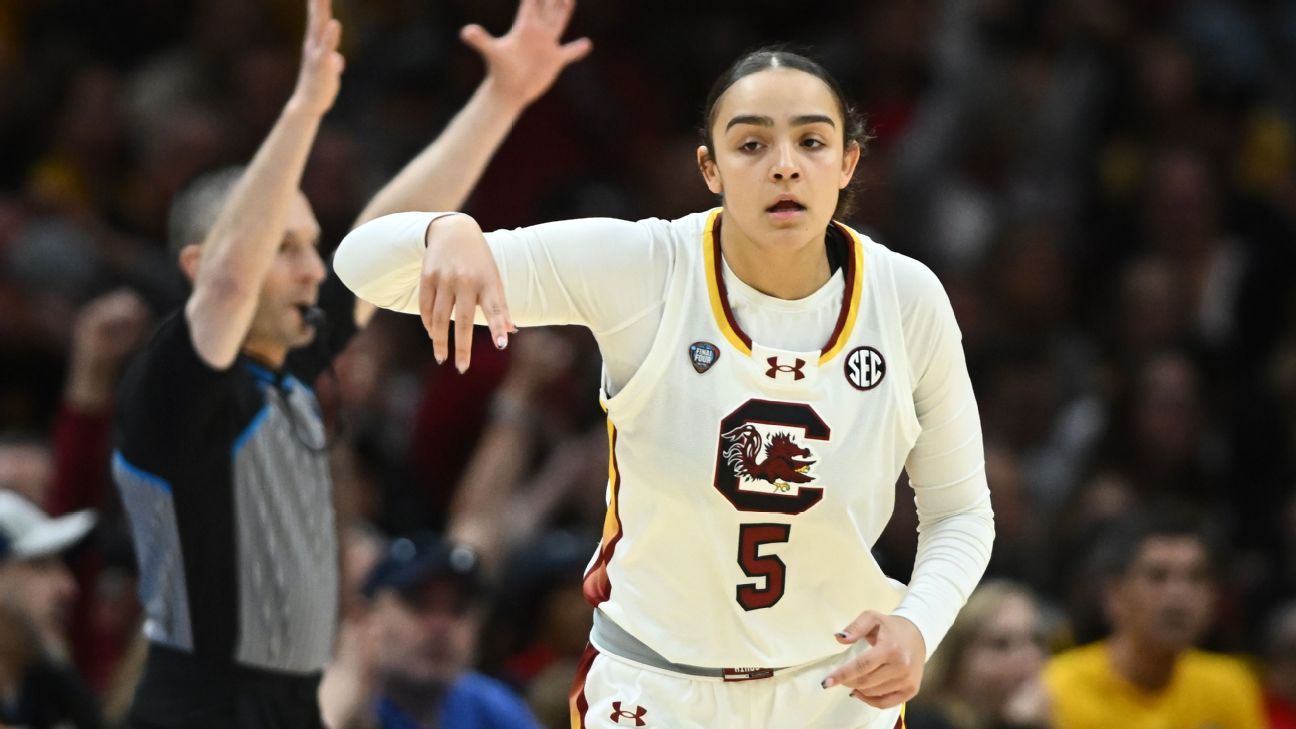
When analyzing South Carolina’s 78-61 loss to Texas in the SEC Tournament Championship, the postgame conversation centered on turnovers, fatigue, and defensive breakdowns. But there may be a less-discussed variable worth examining closely — the health of Tessa Johnson and what her compromised availability quietly cost the Gamecocks.
The Signs Were There
Johnson scored just eight points and played only 18 minutes on Sunday — numbers that fall well below her standard impact. The visual cues on the bench were hard to ignore. While sitting out, Johnson rested on two large cushions and was frequently seen holding her left knee. She was unavailable for postgame availability on both Saturday and Sunday, spending that time receiving treatment instead.
Those aren’t the indicators of a minor tweak. That’s a player managing something real.
What Her Absence Actually Means
Johnson is not a peripheral piece for South Carolina — she’s a primary weapon. When she is at full capacity, she stretches defenses, creates off the dribble, and provides a scoring dimension that opens the floor for Ta’Niya Latson and others. In 18 limited minutes on Sunday, she didn’t look like herself, which raises a pointed question: how much of South Carolina’s offensive shrinkage was scheme, and how much was personnel?
Dawn Staley addressed Latson’s quiet afternoon by explaining that Texas forced dribble entries and limited wing entries, causing the offensive package to shrink. That’s a legitimate tactical explanation — but a fully healthy, assertive Tessa Johnson changes the calculus. Her ability to operate on the wing and attack closeouts would have created alternative entry points that weren’t available Sunday.
Depth Suddenly Looks Thinner
Staley acknowledged fatigue as a potential factor in the loss, noting that starters logged heavy minutes throughout the tournament. What she didn’t explicitly address was how Johnson’s compromised health directly impacts depth management. If Johnson can’t go at full intensity, Staley’s rotation tightens, minutes pile up on other starters, and the fatigue problem compounds. It’s a ripple effect that doesn’t show up cleanly in a box score.
That context makes Alicia Tournebize’s 19 minutes and seven rebounds on Sunday even more significant. Staley noted postgame that Tournebize “played inspired” and acknowledged she should have gotten the ball more in the post. With Johnson’s status uncertain, Tournebize’s ability to provide reliable, physical minutes off the bench isn’t just a depth luxury — it may become a necessity in the NCAA Tournament.
The Bigger Picture Heading Into March
South Carolina has dealt with injury management all season, but Johnson’s situation arriving at the most critical stretch of the year adds genuine uncertainty to an otherwise talented roster. The Gamecocks have four days off before returning to practice Friday — time Staley will use to rest and recalibrate, but also time the training staff will need to assess how Johnson responds to continued treatment.
If she’s at 70 percent in the NCAA Tournament, South Carolina is a different team than the one that dominated the regular season. If she’s closer to full strength, the loss to Texas may indeed prove to be the recalibration moment Staley referenced — the kind of painful wake-up call that sharpens a team before a championship run.
The knee situation won’t make headlines the way the 14-0 opening run did. But in a tournament where margins are razor thin, a hobbled Tessa Johnson sitting on two cushions at the end of the bench may have been one of Sunday’s most important, and most overlooked, storylines.