Proud, Exhausted, and Already Looking Forward: Kentucky Coach Kenny Brooks Delivers One of the Most Honest Press Conferences of the Tournament
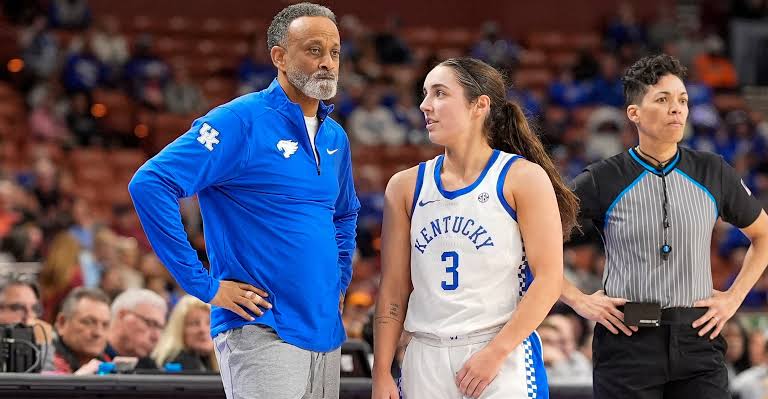
GREENVILLE, S.C. — There was no spin. No deflection. No carefully managed narrative designed to protect a program’s image in the aftermath of a difficult loss. When Kentucky head coach Kenny Brooks sat down at the postgame press conference following the Wildcats’ 87-64 quarterfinal defeat to South Carolina, she delivered something increasingly rare in elite college athletics — complete, unfiltered honesty.
What followed was one of the most revealing and genuinely moving coaching press conferences of the SEC Tournament.
Pride Over Results: A Coach Who Understands the Bigger Picture
Brooks opened without a question, setting the tone immediately with an opening statement that reframed the entire conversation before it began.
“When you spend a lot of time with each other, there’s a lot of different, I don’t know, just feelings, emotions, everything that goes along. And sometimes after a win, you can feel like you just didn’t give it your all. You are a little disappointed because you’re trying to get to an end result that you know you’re capable of,” Brooks said. “And then sometimes you don’t play as well, and you don’t win a basketball game, but you’re super proud of your kids. This is one of those moments. And I am so proud of their effort, not only today, but the last three days, and we’re going to continue that. We’re going to build off of that. That’s exactly what we wanted from this experience right here. I think we’re going to be a team that’s going to be able to play a lot of basketball here in the next couple of weeks. So very, very proud of my kids.”
The emotional intelligence embedded in that statement is significant. Brooks isn’t measuring this week exclusively by wins and losses — she is measuring it by growth, effort, and the kind of team-building progress that tournament runs in March are built on. A coach who can hold both realities simultaneously — acknowledging a loss while genuinely celebrating what was gained — is a coach whose players will run through walls for her. That kind of leadership doesn’t show up in the box score, but it shows up in tournament performance when everything is on the line.
The SEC Tournament Is Not Something She Loves — And She’s Not Pretending Otherwise
When a reporter suggested Brooks had previously expressed affection for the SEC Tournament format, she corrected the record with characteristic candor — and what followed was the most searingly honest assessment of the conference tournament’s structural demands delivered by any coach this week.
“You are being facetious, right? That wasn’t, I don’t think I’ve ever said that I love this SEC Tournament. It’s taxing. It’s very taxing. You go through a grueling 16-game schedule, and to nobody’s fault but our own, we put ourselves in a situation where we had to play five games to get to the prize. Today, I had championship-day fatigue. What I mean by that is usually for you to get to the championship game, you’ve had two grueling games, and then you play a championship game. This is our third game,” Brooks said.
“And for us to have to come out and you play, and that’s why I’m so proud of my kids, man; they did not stop fighting. And they were tired. They were exhausted. And part of my responsibility and my contract says that I have to win basketball games. But part of my responsibility is to take care of them and make sure that they don’t hurt themselves, and today they were fatigued. They were very tired.”
The phrase “championship-day fatigue” is a precise and powerful description of what Kentucky walked into on Friday. In a traditional tournament structure, teams arrive at a championship game having played two games over several days — enough time to recover, adjust, and compete at full capacity. Kentucky arrived at its quarterfinal having already played the equivalent of a championship cycle’s worth of games. Brooks isn’t making excuses. She is accurately describing a structural reality that placed her program at a fundamental competitive disadvantage before tip-off.
Her acknowledgment that her contractual responsibility to win basketball games coexists with a deeper responsibility to protect her players’ physical wellbeing is a rare moment of coaching transparency — and speaks to a values system that extends far beyond the scoreboard.
Honest Self-Assessment: “We’re Not There Yet”
Perhaps the most striking aspect of Brooks’ press conference was his willingness to place Kentucky’s current standing in the conference hierarchy with complete clarity — no hedging, no false equivalence, no manufactured optimism.
“We’re not there yet. We’re not there yet to challenge for an SEC championship. We’re going to continue to get better to where we can,” Brooks said. “But I’ll tell you what, I know Vic [Schaefer] is probably a little upset, and Kim [Mulkey] is probably a little upset. That’s just a home game for South Carolina. And it’s hard enough to do it, to play against a really good basketball team.”
“I am elated right now that we’re walking out of here healthy, so that we can go out and we can prepare, and I think we have a chance to make a really long run in the NCAA Tournament.”
The reference to Schaefer and Mulkey — two of the most accomplished coaches in women’s college basketball — is telling. Brooks is effectively saying that even programs led by those coaches struggle with the structural advantages South Carolina enjoys in this state, at this venue. It’s not a complaint. It’s an acknowledgment of reality delivered with the kind of self-awareness that distinguishes genuinely excellent coaches from those who blame circumstances rather than learning from them.
The pivot to NCAA Tournament optimism is not hollow. Kentucky leaves Greenville having played five competitive games in a brutal stretch — games that, as Brooks noted, revealed an element her team had been missing and helped them find it. A team that discovers its identity under physical and competitive duress heading into March is a dangerous team.
Finding Joy in the Storm
When asked what Kentucky learned from a week that included four games in six days and two matchups against the nation’s top program, Brooks’ answer cut straight to the human core of the experience.
“I love my kids. We had a really good week. I’m not talking about whether we won a game or lost a game. We did a lot of things this week that a coach will look at and he’ll see or she’ll see, and we grew,” Brooks said. “I was very proud of our kids. As I sit up here and talk to you guys, you know, I knew this team had so much potential, but we were missing an element. And I think that we found it. And they’re playing with joy. They love each other. They love playing with each other. They’re connected now, and we’re going to keep that, fine-tune it, and then see what happens in the NCAA Tournament.”
The word “joy” appearing in a postgame press conference following a 23-point loss is not what most people expect from elite competitive athletics. But Brooks is describing something real and important — a team that has moved past the transactional elements of competition and into genuine collective investment in one another. That kind of connection, once found, becomes a competitive multiplier that is extremely difficult to game-plan against. Kentucky found it this week, in the hardest possible circumstances. That matters enormously heading into March.
Clara Strack: A Warrior Who Deserved Better From the Schedule
No conversation about Kentucky’s week is complete without addressing Clara Strack — and Brooks made sure of that, delivering one of the most passionate tributes to a player heard anywhere in college basketball this season.
Asked to assess Strack’s performance in Friday’s loss, Brooks was direct about the physical reality her star was operating under — and unwavering in her admiration.
“She was tired. She was exhausted. Her opponent was sitting at home while she was playing 75 minutes. And, again, that’s on us. We put ourselves in that predicament where we had to be the No. 9 seed and we had to play for five games,” Brooks said. “But that kid goes out, and she plays to her fullest every second that she’s on the floor. I saw it very early that she had that look on her face that she was trying to push through something that she probably couldn’t push through.”
“She’s a warrior. She is. She makes us go. And I wouldn’t trade her for anybody in the country because she epitomizes everything that I want in a student-athlete and a student-athlete at the University of Kentucky.”
The 75 minutes Strack had already played before Friday’s tip-off — across two games in two days — represents a physical demand that would compromise any player’s effectiveness, regardless of talent level. The fact that she still competed, still fought for every possession, and still finished with 11 points and five rebounds in limited minutes is a testament to the competitive character Brooks has been describing all week.
Brooks returned to Strack again when asked about her value heading into the NCAA Tournament, refusing to let Friday’s performance be defined by the circumstances surrounding it.
“No, today, withstanding, because she did so much for our kids. She was not going to stop. It didn’t matter. It didn’t matter that she was playing against somebody that was fresher. It didn’t matter there was two people on her. She was still going to play hard,” Brooks said. “She mentioned it, whether she’s scoring a point or not scoring a point, she’s going to try to do whatever she can to help us win. So you can include this game just as valuable as the ones she played, the two before that, because that is the epitome of what we want to be, even if things aren’t going spectacular for her, you can still do other things. She’s the ultimate. Like I said before, and I’ll say it a million times, I wouldn’t trade her for anyone.”
The SEC: A Privilege, Not a Burden
Brooks closed her press conference with a broader reflection on what it means to compete in the Southeastern Conference — a perspective shaped by her own coaching journey that began at the mid-major level.
“It’s a privilege to be able to play in this conference. It’s a privilege to be able to compete in this conference. So every night, you know you’re going to get someone’s best shot, but every night you know you’ll play against great players. I started off my career at a mid-major, James Madison, and I remember we just had to play against one player on the opposing team, who we had to worry about. It might have been Elena Delle Donne, but you could put three people on her; you didn’t have to worry about the other players. You come to the SEC, and everybody’s good. It’s a notch below the WNBA. It’s a privilege to be able to compete in this league, and it’s a privilege to be able to go against such great players,” Brooks said.
The Elena Delle Donne reference is more than a name drop. It is a vivid illustration of the difference in competitive landscape between mid-major and SEC basketball — and a reminder that Brooks has earned the right to make that comparison through lived experience. Her appreciation for the conference isn’t performative. It is the perspective of a coach who has seen both worlds and understands precisely what Kentucky’s membership in this league represents.
The Bigger Picture
Kyra Brooks walked out of Bon Secours Wellness Arena on Friday having lost to the best team in women’s college basketball by 23 points, after playing five games in a week that would have broken lesser programs. She walked out proud, clear-eyed, and already focused on what comes next.
That is not a consolation prize framing. It is the mindset of a coach who understands that the NCAA Tournament — not the SEC Tournament — is where Kentucky’s season will ultimately be defined. The growth found this week, the joy discovered in the storm, the connection built under the most demanding possible circumstances — these are the things that travel into March and matter when single-elimination basketball begins.
Kentucky leaves Greenville as a more complete team than the one that arrived. In the most important competition of the season, that may be exactly enough.