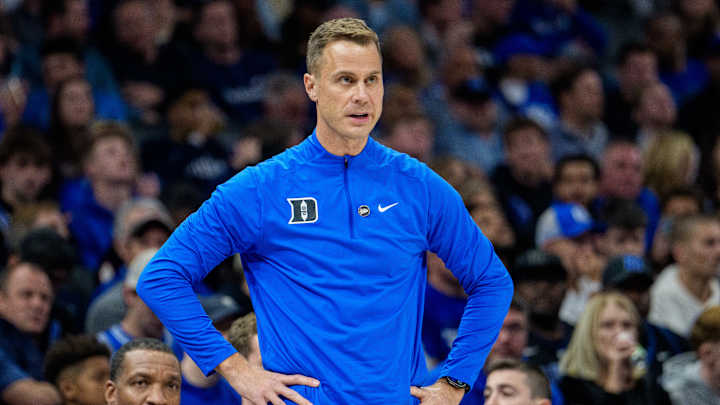
There are moments in college basketball that exist entirely outside the box score — moments that carry the full weight of a program’s history in a single exchange, a handshake, a look between two people who understand exactly what the jersey they are connected to means. When Jon Scheyer crossed the court after Duke’s 81-58 second-round victory over TCU and made his way to Grant Hill, that was one of those moments.
It was not scheduled. It was not a media obligation or a ceremonial appearance. It was a head coach, in the middle of a tournament run with everything at stake, seeking out one of the greatest players in Duke history — and a Hall of Famer who helped lay the very foundation Scheyer is now building upon.
The Man Who Came Before
To understand the significance of that postgame connection, you have to understand who Grant Hill is to the Duke program — and what he represents beyond the statistics and the trophies.
Hill won back-to-back national championships at Duke in 1991 and 1992, helping the Blue Devils become the first Division I program to win consecutive titles since UCLA’s dynasty in the 1960s and early 1970s. He became the first player in ACC history to collect more than 1,900 points, 700 rebounds, 400 assists, 200 steals, and 100 blocked shots — a combination so complete it defines what Duke basketball has always aspired to be: not just individual excellence, but all-around, team-first dominance.
He was a three-time All-American, a three-time All-ACC selection, and led Duke to a third NCAA Final Four appearance in four seasons as a senior, ultimately falling short of a third title in the 1994 championship game against Arkansas. That near-miss — a program that won two in a row and came agonizingly close to three — adds a layer of understanding to why Hill watches this current Duke team with such invested attention.
In 2018, he was inducted into the Naismith Basketball Hall of Fame. His jersey No. 33 hangs from the rafters at Cameron Indoor Stadium. He is, by any measure, one of the two or three most important players in Duke history.
Scheyer: The Successor Who Got It Right
When Jon Scheyer was hired to replace Mike Krzyzewski in 2022, the enormity of what he was inheriting was difficult to overstate. He was not simply taking over a job. He was taking stewardship of the most decorated program in college basketball history, in the immediate aftermath of its most legendary figure’s retirement.
Hill, who had come to know Scheyer over the years, reflected on that transition with the clarity of someone who had thought about it carefully.
“There’s a sense of pride as a former Duke Blue Devil that we got succession right,” Hill said earlier this season. “And that’s not always easy. There are countless examples in college, even in college football, where you have an iconic figure, someone who’s had an incredible legacy and won championships and been the standard for that university. And then that next person, usually in-house, doesn’t live up to the standard.”
“So we hire Jon Scheyer, who I’m not sure was on a lot of people’s radar as a candidate. It really speaks to the recognition of something there: a talent and a gift, an understanding that this kid has a chance to be special.”
That endorsement, from a Hall of Famer with championships in hand and the credibility to be blunt, is not ceremonial praise. It is the considered verdict of someone who spent his college years at the highest level of the game and has watched enough coaches to know the difference between those who belong and those who are merely present.
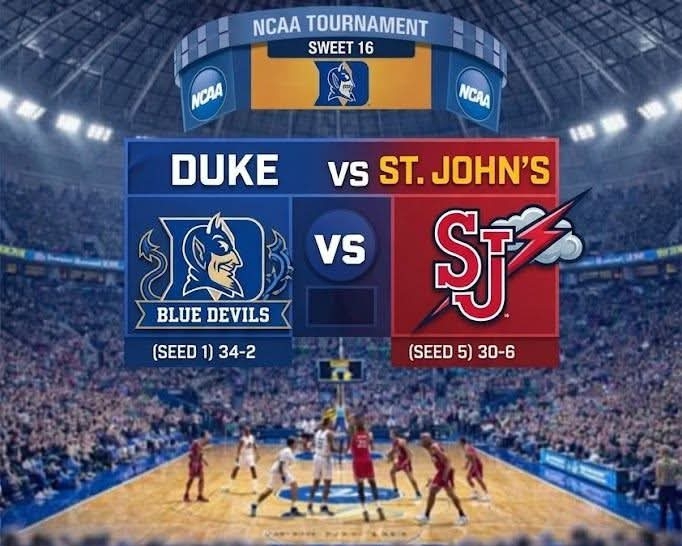
Four years into his tenure, Scheyer has led Duke to a 34-2 record and the Sweet 16 for the third consecutive season. He has steered the Blue Devils to a top-five seed in each of his first four years and this season earned the No. 1 overall seed in the tournament for the second straight year. The succession, as Hill said, was gotten right.
The Game That Earned the Moment
The win over TCU that preceded the Scheyer-Hill exchange was itself a study in the kind of character both men understand implicitly.
Duke led by just four at halftime, and Cameron Boozer — the freshman phenom who entered the game as a unanimous first-team AP All-American — had just two points on one shot attempt in the opening 20 minutes. For a team with championship expectations carrying the No. 1 overall seed, it was a quietly uncomfortable first half that had echoes of a near-disaster against Siena in the first round.
Then Duke did what this year’s team has repeatedly shown it can do — it found its defensive identity and let everything else follow.
“I thought the second half was (the team’s identity) — it was there after the first minute and a half, two minutes,” Scheyer said. “But you have the lead, and I thought when we got back to just guarding the way we can, valuing the ball on the offensive end, that’s where we got separation, and that’s been the identity all year.”
Duke shot 61.5% after halftime, with Boozer scoring 17 of his 19 points in the second half, twice converting on high-low feeds from Patrick Ngongba II — returning from injury in a walking boot just that morning — to fuel a 26-6 run that broke the game open.
“When we play defense, we get whatever we want on offense,” Boozer said postgame.
“TCU coming in, we knew how this would be a hard-fought game,” Scheyer said. “I just keep coming back to the character of these guys. For Pat to come back to this game, was not easy by any means. I thought the urgency we had tonight was there from the get-go.”
The final margin was 23 points. Duke outrebounded TCU 42-25, dominated the paint 38-28, and held a decisive edge in second-chance points.
What the Moment Means
When Scheyer walked over to Hill after the buzzer, he was crossing more than a hardwood floor. He was acknowledging the line of continuity that runs from back-to-back national titles in 1991 and 1992 — from Hill and Laettner and Hurley and the teams that defined what Duke basketball could be — through Krzyzewski’s five decades of excellence, and now into this new chapter that Scheyer is writing with Boozer and Evans and Ngongba and a group of freshmen who are just beginning to understand what they are building.
Hill’s assessment of Cameron Boozer earlier this season captured the reason Duke’s future feels so bright: “He just seems almost ready for the responsibility that comes with being a top pick and a top Player of the Year candidate, carrying a team and a program like Duke that has a great legacy. He takes it all in stride.”
Boozer has become only the Division I player in the last 30 seasons to record at least 700 points, 300 rebounds, and 100 assists while shooting better than 50% from the field in a single regular season — the kind of statistical landmark that belongs in the same conversation as the program’s greatest freshmen, from Laettner to Williamson to last year’s Cooper Flagg.
Grant Hill came to back-to-back championships and fell one game short of a third. He spent his career embodying everything the Duke program asks of its players. Now he watches from the stands as Scheyer builds something that, at its best, carries that same spirit forward.
The moment between them after the TCU win was brief. What it represented has been building for thirty years.